
Introduction
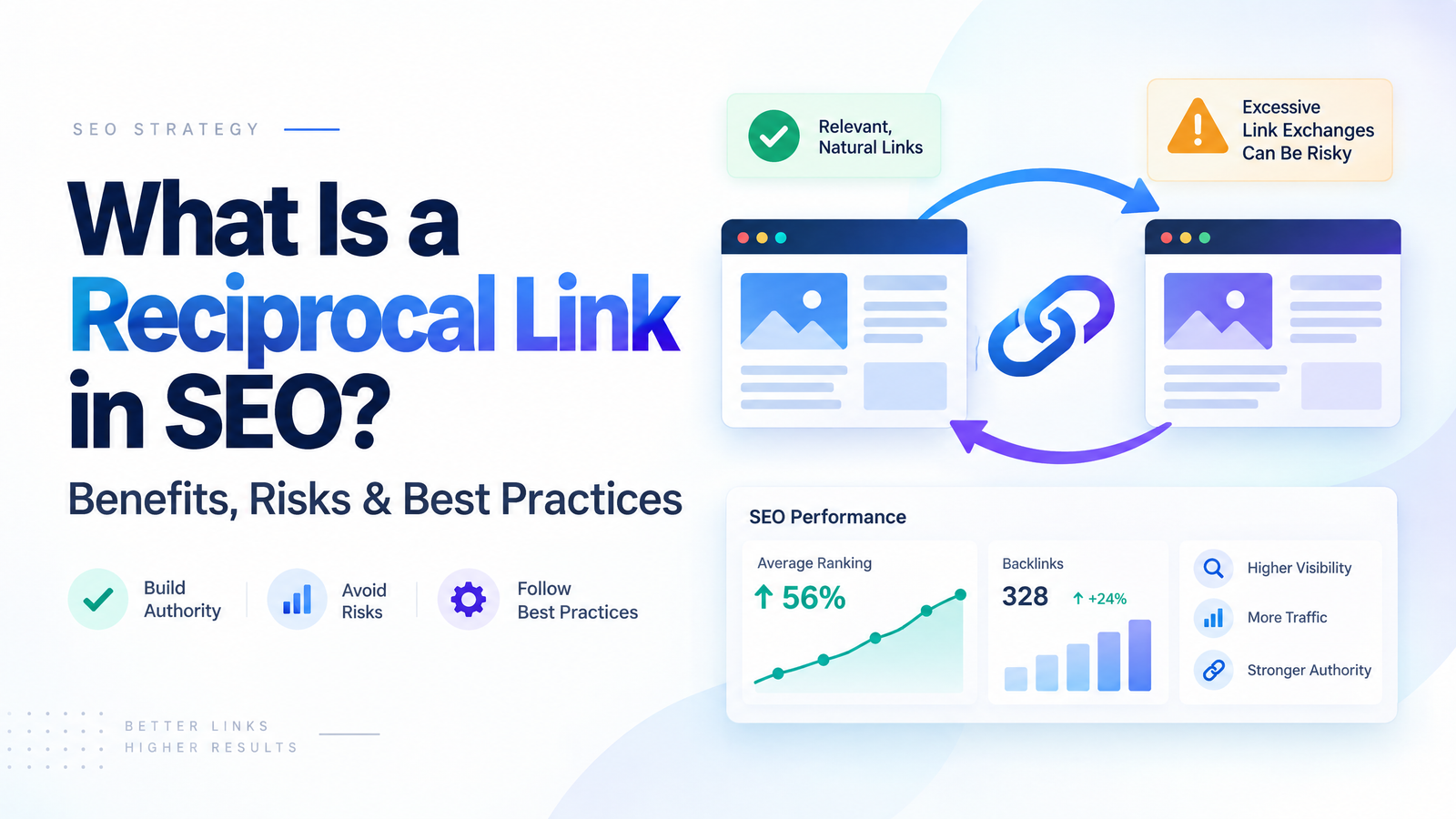
A reciprocal link in SEO occurs when two websites link to each other. For example, Website A links to Website B, and Website B also links back to Website A. This arrangement is commonly called a link exchange.
Reciprocal links can occur naturally when two businesses, bloggers, or publishers reference each other’s useful content. However, exchanging links primarily to manipulate search engine rankings can create SEO risks.
Understanding what is reciprocal link in SEO means can help website owners make better decisions about their backlink strategies. The goal should be to build meaningful connections between relevant pages rather than exchange links simply to influence rankings.
If you are new to search engine optimization, read our guide on what SEO is and how it works to understand the fundamentals of improving a website’s visibility in search results.
What Is a Reciprocal Link in SEO?
A reciprocal link is a linking relationship in which two websites link to each other. Each website provides a link to the other, creating a two-way connection.
For example:
- Website A publishes an article about digital marketing.
- Website A links to a useful resource on Website B.
- Website B later publishes a relevant article and links back to Website A.
Both websites now have reciprocal links.
This type of linking is not automatically against Google’s guidelines. The important factors include why the links exist, how they are placed, and whether they provide genuine value to visitors.
When websites reference each other’s useful resources naturally, the links can help readers discover additional information. However, large-scale link exchanges arranged primarily to manipulate search rankings can violate Google’s spam policies.
How Do Reciprocal Links Work?
Reciprocal linking usually follows a straightforward process.
1. Two Websites Find Relevant Content
Website owners identify another website that publishes useful information related to their audience. For example, a digital marketing blog might reference a web development guide that explains website performance.
2. One Website Adds a Link
The first website links to a relevant resource on the second website. The link might support a statement, explain a technical concept, or help readers explore a topic in greater detail.
3. The Second Website Links Back
The second website may later reference the first website when its content provides useful information for readers.
4. Both Websites Provide Additional Resources
Visitors can move between related resources and discover more information. However, the existence of reciprocal links does not guarantee higher rankings, additional traffic, or improved website authority.
The value of each link depends on its context, relevance, quality, and purpose.
Example of a Reciprocal Link
Imagine two websites operating in related industries.
- Website A: A digital marketing blog that publishes SEO guides.
- Website B: A website development company that publishes technical tutorials.
Website A writes an article about website optimization and links to a technical guide on Website B.
Later, Website B publishes an article about improving online visibility and references a relevant SEO resource on Website A.
This creates a reciprocal link relationship.
The arrangement can be reasonable when both links help readers. However, if the website owners insert links into unrelated articles only because they agreed to exchange backlinks, the links may provide little value and could appear manipulative.
Are Reciprocal Links Good for SEO?
Reciprocal links can have legitimate uses, but they should not be treated as a shortcut to better rankings.
Potential Benefits of Reciprocal Links
1. Help Readers Discover Useful Resources
When two websites cover related subjects, linking to each other’s resources can help visitors find additional information. This is especially useful when a linked page answers a related question or supports a discussion.
2. Build Industry Relationships
Content creators, businesses, publishers, and agencies may naturally reference one another. Genuine relationships can lead to useful collaborations, expert contributions, and better resources for readers.
3. Generate Referral Traffic
A link from a relevant website can introduce your content to a new audience. Some visitors may click through to your website and explore your articles, services, or products.
4. Support Content Discovery
Links can help readers navigate between complementary resources. For instance, someone learning about reciprocal links may also want to understand what SEO means in marketing and how search visibility supports business growth.
These benefits are possible, not guaranteed. A reciprocal link does not automatically improve rankings or increase website traffic.
What Are the Risks of Reciprocal Linking?
Reciprocal links become risky when website owners prioritize search rankings over genuine usefulness.
1. Excessive Link Exchanges
Google identifies excessive link exchanges and pages created primarily for links as examples of link spam.
For example, if a group of website owners agrees to exchange large numbers of backlinks primarily to manipulate rankings, that arrangement may violate Google’s spam policies.
2. Links From Irrelevant Websites
A backlink from an unrelated website may provide little value to readers. For example, two websites covering completely different subjects might exchange links only to increase their backlink counts.
Relevance is not the only factor that matters, but links should make sense in the context where they appear.
3. Low-Quality Link Networks
Some websites participate in networks designed mainly to exchange or sell backlinks. These networks may contain thin content, unrelated pages, or websites created primarily to manipulate search results.
Building a backlink profile around these arrangements can expose a website to unnecessary SEO risk.
4. Over-Optimized Anchor Text
Using the same exact-match keyword in numerous exchanged links can create an unnatural pattern.
Anchor text should describe the destination page clearly and fit the surrounding sentence. For example, “SEO fundamentals guide” is more appropriate when it accurately describes the linked resource than forcing a keyword into an unrelated paragraph.
5. Poor Long-Term Results
Links that do not attract relevant visitors or improve the reader experience may offer little practical value. Time spent arranging unnecessary exchanges could be better invested in publishing useful content and earning editorial references.
Reciprocal Links vs. Natural Backlinks
Reciprocal links and natural backlinks are not mutually exclusive. A reciprocal link can occur naturally, and a natural backlink can exist without a link in return.
| Factor | Reciprocal Link | Natural Backlink |
|---|---|---|
| Definition | Two websites link to each other | One website links to another |
| Linking direction | Usually two-way | May be one-way |
| Common reason | Mutual reference or link exchange | Editorial choice or useful reference |
| SEO risk | Depends on intent, scale, and context | Generally lower when genuinely earned |
| Guaranteed ranking benefit | No | No |
The most important distinction is not simply whether a link is reciprocal. It is whether the link exists to help users or primarily to manipulate search rankings.
How to Use Reciprocal Links Safely
If you are considering a reciprocal link, focus on relevance and editorial judgment instead of the number of links exchanged.
1. Choose Relevant Websites
Look for websites that cover related subjects and share an audience with your business. A relevant resource is more likely to help visitors than a website chosen only because it offers a backlink.
2. Link Only When It Makes Sense
Do not promise a backlink in return for every link you receive. Add links when the destination genuinely improves your content or helps readers understand the subject.
3. Avoid Bulk Link Exchanges
Do not create large-scale campaigns designed primarily to manipulate search rankings. Focus on genuine editorial references rather than artificial linking networks.
4. Use Natural Anchor Text
Write anchor text that accurately explains the destination page. Keep it relevant to the sentence and avoid forcing exact-match keywords where they do not fit.
5. Review Your Backlink Profile
Monitor links pointing to your website and investigate suspicious patterns. An SEO report can help organize information about referring domains, backlinks, organic traffic, and search performance.
Do not assume that every reciprocal link is harmful. Review the context and purpose before deciding whether any action is needed.
6. Follow Search Engine Guidelines
Google’s official spam policies for Google Search explain which linking practices may violate its guidelines. Review the policies before building a link acquisition strategy.
Reciprocal Links vs. Link Schemes
A reciprocal link is a two-way linking relationship. A link scheme is a broader practice involving links created primarily to manipulate search rankings.
For example, two businesses may independently reference each other’s genuinely useful resources. That does not automatically make their links a link scheme.
In contrast, a group of website owners might agree to exchange large numbers of keyword-rich links solely to influence rankings. Such a practice can fall under Google’s link spam policies.
The distinction matters because not every reciprocal link is spam, but reciprocal linking used to manipulate rankings can violate search engine guidelines.
The same principle applies to other SEO practices: the method and purpose matter. Sustainable optimization should improve the information and experience available to users rather than misrepresent a page to search engines.
How to Build Backlinks Without Relying on Link Exchanges
Instead of making reciprocal links the foundation of your strategy, focus on earning relevant references.
- Publish original resources: Create helpful guides, research, statistics, and tutorials that other websites may want to reference.
- Contribute expert insights: Share useful knowledge with relevant publications and editors.
- Build genuine partnerships: Collaborate with businesses and publishers when the relationship benefits both audiences.
- Create useful industry content: Answer specific questions your target audience is researching.
- Evaluate opportunities carefully: Consider topical relevance, editorial standards, audience quality, and the purpose of each link.
You should also understand the search results you are competing in. Our guide on what SERP means in SEO explains how search engine results pages display information in response to users’ queries.
For more practical SEO guides and digital marketing resources, visit Digital Soules.
Frequently Asked Questions
Are reciprocal links bad for SEO?
No. Reciprocal links are not automatically bad. Relevant, naturally occurring links can help users discover useful resources. Excessive exchanges intended primarily to manipulate rankings can violate Google’s spam policies.
Do reciprocal links improve Google rankings?
They do not guarantee ranking improvements. Search engines evaluate many factors, and the value of a link depends on its relevance, context, quality, and purpose.
What is a three-way link exchange?
A three-way link exchange involves three websites rather than two. For example, Website A links to Website B, Website B links to Website C, and Website C links to Website A.
Using three websites does not automatically make an exchange safe. Arrangements intended to manipulate rankings can still be problematic.
Should I remove all reciprocal links from my website?
No. Do not remove links simply because they are reciprocal. Review whether they are relevant, useful, and editorially justified. Investigate links that are part of manipulative schemes instead of treating every two-way link as harmful.
How many reciprocal links are safe?
There is no universal safe number. The purpose, relevance, quality, and overall pattern matter more than a fixed quantity. Avoid creating links solely to manipulate rankings.
Conclusion
Reciprocal links in SEO occur when two websites link to each other. They can support content discovery, referral traffic, and genuine industry relationships when the links are relevant and useful to readers.
However, reciprocal linking should not become a strategy for manufacturing backlinks at scale. Avoid excessive exchanges, unrelated links, and arrangements designed primarily to manipulate search rankings. Instead, prioritize useful content, relevant editorial references, and long-term website growth.
For more practical SEO guides and digital marketing resources, explore Digital Soules and discover ideas to support your website’s long-term organic growth.