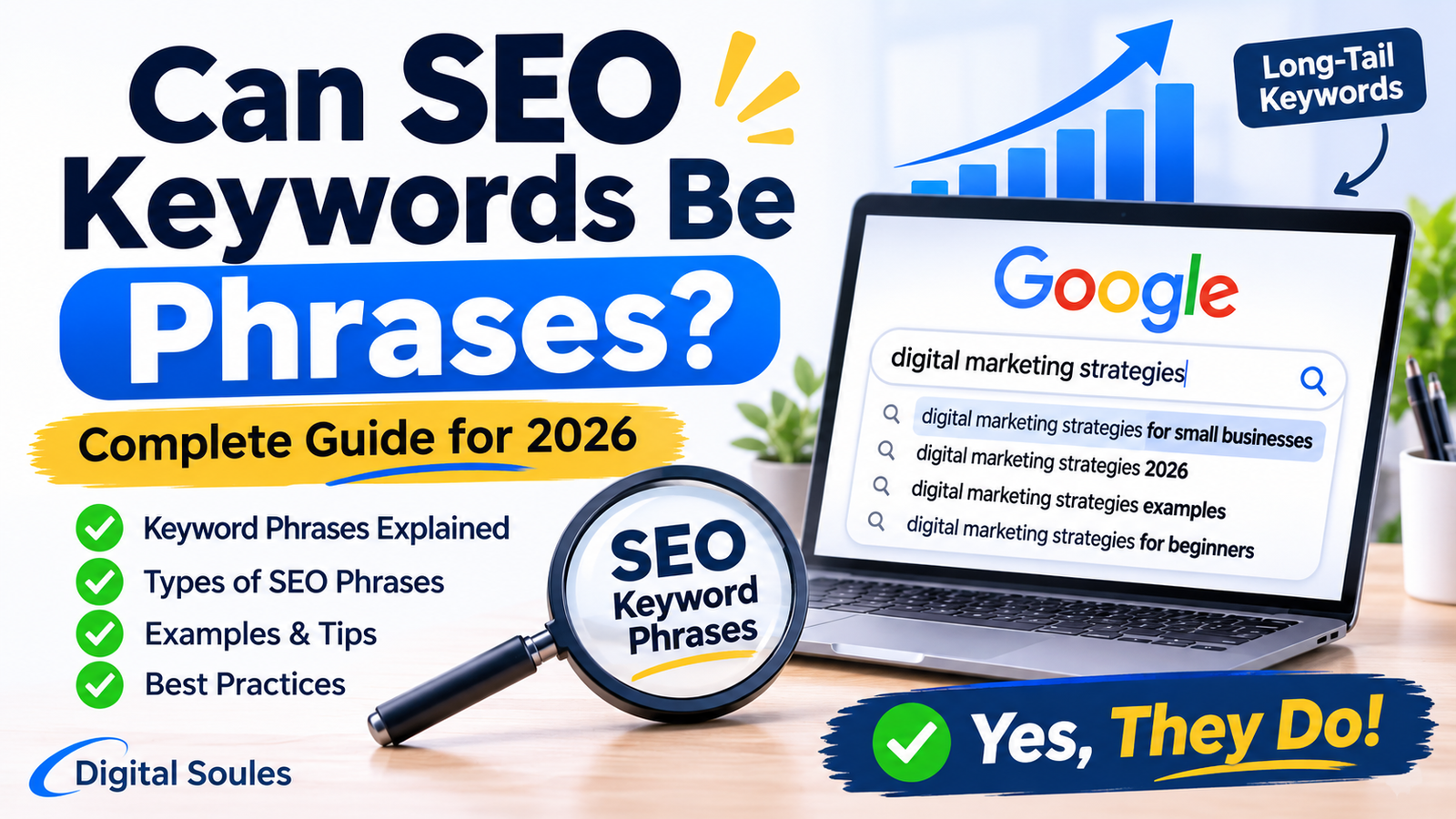
Yes, SEO keywords can be individual words, short combinations of words, or complete phrases. Search engines do not require website owners to target only single words. In fact, keyword phrases are an important part of modern SEO because they often reflect what people actually type into search engines.
For example, consider these search terms:
- Marketing
- Digital marketing
- Digital marketing strategies
- Digital marketing strategies for small businesses
Each one can be used as an SEO keyword. However, longer phrases usually provide more information about the searcher’s interests and intentions.
When someone searches for “marketing,” their exact requirement is unclear. They might want a definition, a course, a job, or marketing services.
But when someone searches for “digital marketing strategies for small businesses,” the purpose is much easier to understand.
This is why keyword phrases are useful when planning website content.
What Are Keyword Phrases in SEO?
Keyword phrases are groups of two or more words that people enter into search engines when looking for information, products, or services.
They are also commonly called keyphrases or search phrases.
For example:
| Keyword type | Example |
| Single-word keyword | Backlinks |
| Short keyword phrase | SEO backlinks |
| Long keyword phrase | How to get backlinks for a new website |
| Service-based phrase | Affordable SEO services for small businesses |
| Question-based phrase | How do backlinks help SEO? |
All these examples can be relevant SEO targets.
The main difference is how much information each search term communicates.
A single word can have several meanings, while a longer phrase often makes the searcher’s requirement clearer.
Why Are Keyword Phrases Important for SEO?
Keyword phrases help website owners understand what their audience wants. They also make it easier to create content around specific topics instead of targeting broad terms without a clear purpose.
Here are some important reasons to use them.
1. They Help You Understand Search Intent
Search intent refers to the reason behind a person’s search.
For example:
- “SEO” — the user may want general information.
- “What is SEO?” — the user wants an explanation.
- “Best SEO tools” — the user wants to compare tools.
- “Hire an SEO agency” — the user may be ready to purchase a service.
These phrases show different intentions.
When you understand search intent, you can create pages that answer the right questions and provide relevant information.
2. They Help You Target Specific Audiences
Broad keywords can attract visitors with different interests. Keyword phrases help you focus on a more specific audience.
For example, a website offering SEO services may target:
- SEO services
- Local SEO services
- SEO services for restaurants
- SEO services for real estate agents
- Affordable SEO services for startups
Each phrase represents a different audience or requirement.
Instead of trying to attract everyone through one broad keyword, you can create relevant pages for different customer needs.
3. They Can Help You Find Long-Tail Keywords
Long-tail keywords are specific search queries that usually contain three or more words. They often have lower search volume than broad keywords, but they can attract visitors with more specific needs.
Examples include:
- How to improve local SEO for a small business
- Best keyword research tools for beginners
- How to write SEO-friendly product descriptions
- Affordable website SEO services for startups
Not every long-tail keyword has low competition, and not every long-tail search has high conversion potential. However, these phrases can reveal useful content opportunities.
4. They Make Content Planning Easier
Keyword phrases can give you ideas for blog posts, landing pages, service pages, and FAQs.
For example, if your main topic is keyword research, you may discover related phrases such as:
- How to do keyword research
- Free keyword research tools
- How to find low-competition keywords
- Keyword research for beginners
These searches can help you understand which questions deserve their own content and which ones can be answered within one comprehensive article.
Types of SEO Keyword Phrases
Not all keyword phrases serve the same purpose. Understanding their different types can help you select the right keywords for your website.
1. Short-Tail Keyword Phrases
Short-tail keywords are broad search terms that usually contain one or two words.
Examples:
- SEO tools
- Digital marketing
- Website design
- Content marketing
These keywords may have high search demand, but they can be difficult to target because their search intent is often broad.
2. Long-Tail Keyword Phrases
Long-tail keywords are more detailed search phrases that generally contain three or more words.
Examples:
- Best SEO tools for small businesses
- How to improve website loading speed
- Free keyword research tools for beginners
- How to build backlinks for a new website
They help you target more specific searches and can be useful for informational and commercial content.
3. Question-Based Keyword Phrases
These are keywords written as questions. People commonly use them when looking for explanations or solutions.
Examples:
- What is off-page SEO?
- Can SEO keywords be phrases?
- How many keywords should I use on a page?
- Does website speed affect SEO?
Question-based phrases are useful for blog articles, tutorials, FAQ sections, and educational content.
4. Location-Based Keyword Phrases
Location-based keywords include a city, area, or region.
Examples:
- SEO agency in London
- Digital marketing services in New York
- Best restaurants in Lahore
- Website designers in Toronto
These phrases are particularly useful for local businesses that want to reach customers in specific locations.
5. Commercial Keyword Phrases
Commercial phrases indicate that someone is researching products or services before making a decision.
Examples:
- Best SEO agencies for startups
- Semrush vs Ahrefs
- Affordable SEO packages
- Best website hosting services
These keywords can work well for comparison articles, product reviews, and service pages.
Examples of SEO Keywords vs. Keyword Phrases
The following examples show how a broad keyword can become a more specific phrase.
| Broad keyword | Keyword phrase |
| Backlinks | How to build backlinks for a new website |
| SEO | How to improve SEO for a small business |
| WordPress | Best SEO plugins for WordPress |
| How to increase Instagram story views | |
| Marketing | Digital marketing strategies for startups |
| Website design | SEO-friendly website design services |
| Keywords | How to find the right keywords for SEO |
The longer phrases provide more context and can help you plan content around a specific search requirement.
However, longer does not automatically mean better. The best keyword is the one that matches your page’s purpose and your audience’s search intent.
How to Find SEO Keyword Phrases
You do not need expensive software to start finding keyword phrases. Several free and paid methods can help you discover what people search for.
1. Use Google Autocomplete
Start typing a topic into Google’s search bar. Google may suggest related searches based on popular queries and other signals.
For example, type:
“How to improve SEO…”
You may see suggestions such as:
- How to improve SEO on a website
- How to improve SEO rankings
- How to improve SEO for beginners
These suggestions can give you ideas for relevant phrases.
Remember that autocomplete suggestions are ideas, not verified search-volume data.
2. Check Google’s People Also Ask Section
Search for your main topic on Google and look at the People Also Ask section.
For example, searching for “SEO keywords” may reveal questions about keyword placement, keyword research, and keyword usage.
These questions can help you identify topics that deserve answers in your content.
3. Use Google Search Console
If your website already receives organic traffic, Google Search Console can help you find the actual search queries that generate impressions and clicks.
Check the Performance report and review:
- Queries
- Impressions
- Clicks
- Average position
- Click-through rate
Look for relevant phrases that already bring visitors to your website. You may discover opportunities to improve existing pages or create new content.
4. Use Keyword Research Tools
Keyword research platforms can provide additional information about search phrases, including estimated search volume, competition, keyword difficulty, and related terms.
Some commonly used tools include:
- Google Keyword Planner
- Ahrefs
- Semrush
- Ubersuggest
- Moz Keyword Explorer
Remember that different tools use different data sources and estimation methods. Their metrics should guide your decisions, not replace your judgment.
How to Use Keyword Phrases in Website Content
Finding keyword phrases is only the first step. You also need to use them naturally in your content.
Here are some important places to consider.
1. Add Your Main Phrase to the SEO Title
Your SEO title should clearly explain what the page is about.
For example:
Can SEO Keywords Be Phrases? A Beginner’s Guide
This title includes the main phrase and tells readers what they can expect.
2. Use It in the Main Heading
Your H1 heading should accurately describe the page’s topic.
For example:
“Can SEO Keywords Be Phrases?”
You do not need to repeat the exact same phrase in every heading.
3. Include It Naturally in the Introduction
Mention the main topic early in the article when it fits naturally.
Avoid forcing keywords into sentences where they do not belong. Your introduction should help readers understand what the article will cover.
4. Use Related Phrases in Subheadings
Related phrases can help organize your content.
For example, an article about keyword phrases could include headings such as:
- What Are Keyword Phrases in SEO?
- Why Are Keyword Phrases Important?
- Types of SEO Keyword Phrases
- How to Find Keyword Phrases
These headings make the article easier to navigate and help explain its different sections.
5. Add Relevant Phrases to Image Alt Text
If an image genuinely explains a topic, write descriptive alt text that tells users what the image shows.
For example:
“Examples of short-tail and long-tail SEO keyword phrases.”
Do not fill image alt text with unrelated keywords.
6. Use Relevant Internal Links
Internal links connect related pages on your website and help readers discover more information.
For example, if you are explaining how to select keyword phrases, you can link to your guide on how many keywords you should use for SEO.
Use descriptive anchor text that makes the destination clear.
Should You Use Exact Keyword Phrases or Variations?
You can use both.
An exact keyword phrase can help make your topic clear, but you do not need to repeat it word for word throughout the article.
For example, if your main phrase is “best keyword research tools for beginners,” you can naturally use related expressions such as:
- Keyword research tools for new users
- Beginner-friendly SEO tools
- Tools to find relevant search terms
- How to research keywords for a website
These variations make the writing more natural and allow you to explain the topic from different angles.
The goal is not to include every possible variation. Focus on making the page useful and relevant to the searcher’s needs.
Common Mistakes to Avoid When Using Keyword Phrases
Keyword phrases can improve your content planning, but using them incorrectly can make your pages less useful.
Avoid these mistakes:
1. Repeating the same phrase too many times: This can make your writing sound unnatural and may create keyword-stuffing problems.
2. Targeting phrases that do not match your content: A keyword should accurately describe the information or service on the page.
3. Choosing keywords only because they have high search volume: A popular phrase is not automatically the right choice for your website.
4. Creating separate pages for every small variation: Similar phrases may have the same search intent. Sometimes one comprehensive page is more useful than several competing pages.
5. Ignoring readers: Content should be written for people first. Keywords should support the message, not control every sentence.
Frequently Asked Questions
Can a single phrase be an SEO keyword?
Yes. A phrase containing two or more words can be an SEO keyword. For example, “SEO services for small businesses” is a keyword phrase.
Are long-tail keywords better than short-tail keywords?
Neither type is always better. Short-tail keywords can reach broader audiences, while long-tail keywords can target more specific searches. Choose based on your goals, competition, and search intent.
How many words should an SEO keyword phrase contain?
There is no fixed word limit. A keyword can contain one word, two words, or a longer sentence. The important thing is whether it represents a meaningful search query.
Can I target multiple keyword phrases on one page?
Yes. One page can naturally target a primary phrase and several closely related phrases. Make sure they share the same search intent and fit the page’s topic.
Do keyword phrases help Google understand my content?
Relevant phrases provide context about a page’s subject. However, Google uses many signals and language-understanding systems to interpret content. Simply adding a phrase does not guarantee better rankings.
Should I use keyword phrases in every heading?
No. Use headings to organize information and explain each section. Include relevant phrases where they fit naturally, but do not force them into every heading.
Are question-based keywords good for blog posts?
Yes. Question-based phrases can help you understand what readers want to learn. They are especially useful for tutorials, informational articles, and FAQ sections.
Final Thoughts
SEO keywords are not limited to individual words. They can be complete phrases that explain exactly what someone wants to find online. Using relevant keyword phrases helps you understand search intent, plan useful content, and connect your website with the right audience.
The important thing is to choose phrases that match your topic and use them naturally. Do not focus only on keyword length, search volume, or repetition. Focus on answering the searcher’s question better than competing pages.
If you want to learn more about SEO, keyword research, and website optimization, explore the practical guides available at Digital Soules.