
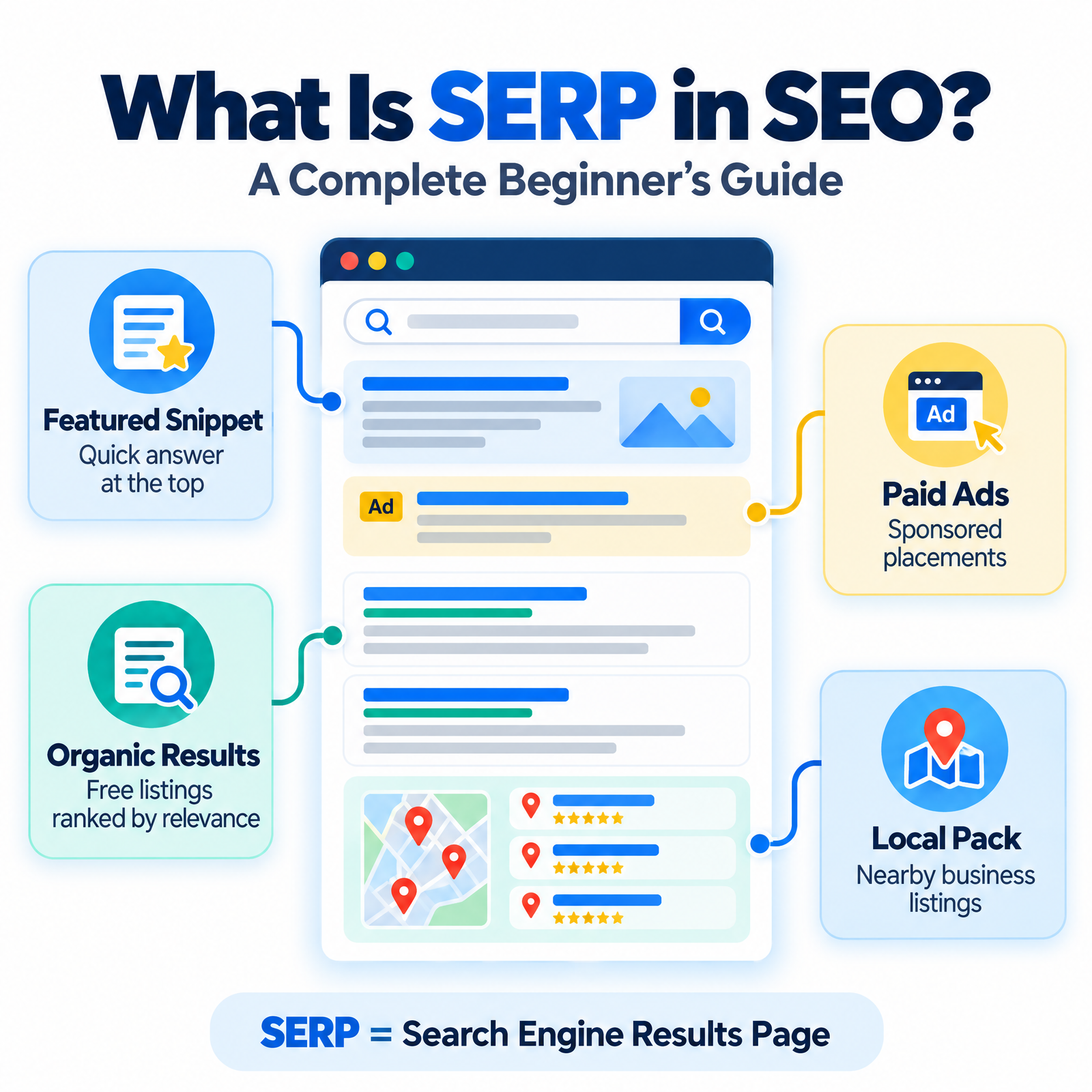
Whenever you search for something on Google, you see a page containing website links, advertisements, images, videos, and other information related to your query. This page is called a Search Engine Results Page, commonly known as a SERP.
In SEO, understanding SERPs helps you see how search engines display information, where your website may appear, and how potential customers discover your content. It also helps you analyze competitors, understand search intent, and identify opportunities to improve organic visibility.
For example, when someone searches for “SEO services,” Google may display paid advertisements, organic website listings, and other search features. Each element offers a different opportunity for businesses to reach relevant audiences.
To understand the bigger picture, start with what SEO is and how it works. This explains how search engines discover, index, and rank web pages.
In this guide, you will learn what SERP means in SEO, the main types of search results, why SERPs matter, and how to improve your website’s visibility.
What Does SERP Mean in SEO?
SERP stands for Search Engine Results Page. It is the page a search engine displays in response to a user’s search query.
When someone searches on Google or Bing, the search engine presents results it considers relevant to the query. These results may include:
- Organic search listings
- Paid search advertisements
- Featured snippets
- People Also Ask questions
- Local business listings and maps
- Image and video results
- Shopping listings
- Knowledge panels
- AI-generated summaries, where available
The layout depends on the search query, the search engine, the device, the user’s location, and other contextual factors.
Understanding what SEO means in marketing also helps explain why SERPs matter to businesses: they provide an opportunity to connect with people who are actively searching for information, products, or services.
How Does a SERP Work?
A SERP is generated after a user enters a search query. Search engines use automated systems to find relevant information and organize results according to their ranking systems.
1. The User Enters a Search Query
A search query is the word or phrase someone enters into a search engine.
Examples include:
- What is SEO?
- How to improve website rankings
- SEO services for small businesses
- What is keyword difficulty?
Each query reflects a different need. Someone searching for a definition may want an educational article, while someone searching for an SEO service may be comparing providers.
2. The Search Engine Finds Relevant Results
Search engines use their indexes and ranking systems to identify pages that may satisfy the query.
They evaluate various signals, including relevance, content usefulness, context, and other ranking factors. Different searches can produce different result formats.
3. The Search Engine Displays the Results
The search engine presents results in an order and format intended to help users find relevant information.
This is where SEO becomes important. Websites that provide useful content, maintain good technical accessibility, and match search intent may earn visibility in organic results.
However, a website’s presence on a SERP does not guarantee clicks. The position of a listing and the other features displayed on the page can influence user behavior.
What Are the Main Types of SERP Results?
SERPs can contain several different result formats. Understanding them helps you decide how to optimize your website and content.
1. Organic Search Results
Organic results are unpaid listings that appear because a search engine considers them relevant to a query.
A typical organic listing may include a title link, a website address or breadcrumb, and a short description.
For example, an article explaining SEO fundamentals may appear organically when someone searches for “what is SEO.”
Organic visibility is a central goal of SEO. Businesses improve their chances by creating useful content, optimizing pages, maintaining a technically accessible website, and earning relevant recognition.
2. Paid Search Results
Paid search results are advertisements displayed through advertising platforms such as Google Ads.
They often appear above organic results or in other designated advertising placements. Their placement depends on factors such as bids, ad quality, relevance, and the advertising auction.
Paid advertising and organic SEO can complement each other, but paying for an advertisement does not automatically improve organic rankings.
3. Featured Snippets
Featured snippets are highlighted results that provide an extract from a webpage to help answer a user’s query.
They may appear as paragraphs, lists, or tables.
For example, a search for “what is an SEO slug” may display a short explanation from a relevant webpage.
To improve your content’s chances of being selected:
- Answer questions clearly and directly.
- Use descriptive headings.
- Organize information into logical paragraphs and lists.
- Keep explanations accurate and relevant.
- Avoid unnecessary text that delays the answer.
There is no guaranteed way to earn a featured snippet. Search engines decide when to show one and which page to use.
4. People Also Ask
The People Also Ask section displays related questions that users can expand to see answers.
For an SEO-related search, these questions might include:
- How does SEO work?
- What is an SEO title?
- How long does SEO take?
- What is keyword difficulty?
These questions can help content creators understand what readers want to learn next. They can also reveal opportunities to connect related articles within a website.
5. Local Pack and Map Results
Local search results help users discover businesses in a particular geographic area.
For example, searching for “SEO consultant near me” may display local business listings alongside a map.
Local businesses can improve their visibility by maintaining accurate business information, optimizing their Google Business Profile, and earning genuine customer reviews.
6. Image and Video Results
Some queries trigger image thumbnails, video listings, or dedicated image and video sections.
These features are especially relevant when users need visual instructions, demonstrations, inspiration, or product examples.
Websites can improve their chances of appearing in relevant visual results by publishing useful media, providing descriptive alternative text where appropriate, and supporting images and videos with relevant page content.
7. Knowledge Panels and AI Search Features
Knowledge panels summarize information about recognized people, organizations, places, and other entities.
Google may also display AI-generated summaries for certain searches. These summaries can provide answers alongside links to supporting sources.
Their appearance varies by query and search experience. Websites should focus on accurate information, helpful content, and sound SEO practices rather than relying on a guaranteed method for appearing in these features.
Why Are SERPs Important for SEO?
SERPs help SEO professionals understand search behavior, evaluate competition, and identify ways to improve visibility.
Understand Search Intent
Search intent is the reason behind a search query.
For example, someone searching for “what is a reciprocal link in SEO” is likely looking for an explanation, while someone searching for SEO services may be evaluating providers.
Reviewing the results helps you understand whether searchers expect a guide, a product page, a service page, or another format.
Analyze Competitors
SERPs show which pages are already visible for a particular keyword.
You can review their topics, content structure, and search result presentation to identify areas where your own page could provide more useful information.
Identify Content Opportunities
SERP analysis can reveal opportunities to answer related questions, improve page titles, structure content more clearly, or target a more appropriate search intent.
For example, a page that explains rich snippets in SEO can use clear examples and structured information to help readers understand how enhanced search results work.
Understand Search Visibility
A website can appear on a SERP without receiving many clicks. Advertisements, featured snippets, and other prominent features may influence how users interact with organic listings.
This makes it important to evaluate both rankings and actual search performance.
How Can You Improve Your Website’s SERP Visibility?
Improving SERP visibility requires a consistent SEO strategy rather than focusing on one ranking factor.
Step 1: Choose Relevant Keywords
Research the queries your target audience uses. Select keywords that match your website’s purpose, your audience’s needs, and the content you can provide.
Step 2: Create Helpful Content
Answer the main question clearly and provide enough detail to satisfy the reader. Use headings, examples, lists, and tables when they make the information easier to understand.
Step 3: Optimize Page Titles and Descriptions
Write descriptive titles that accurately communicate each page’s subject. Meta descriptions should summarize the content and help users understand what they can expect.
If your website runs on WordPress, understanding what an SEO title is in WordPress can help you create and manage descriptive titles for individual pages and posts.
Search engines may rewrite title links or snippets, so the text you provide is not guaranteed to appear exactly as written.
Step 4: Use Clear URLs
Descriptive URLs help users understand what a page covers. For example, a URL containing the phrase what-is-serp-in-seo clearly communicates the topic.
Learn what an SEO slug is to understand how the final part of a URL can be structured for clarity.
Step 5: Strengthen Internal Links
Connect related pages using descriptive anchor text. Internal links help visitors discover more information and help search engines understand relationships between pages.
For example, this article connects SERP concepts with SEO fundamentals, WordPress titles, and URL structure. These links allow readers to move naturally between related topics.
Step 6: Monitor Your Results
Use Google Search Console to review impressions, clicks, click-through rate, and average position for your pages and queries.
An SEO report can help organize these metrics, highlight changes, and communicate performance to clients or stakeholders.
What Is SERP Analysis?
SERP analysis is the process of examining search results for a target keyword to understand search intent, competition, and opportunities for visibility.
A basic SERP analysis involves:
- Searching for the target keyword.
- Identifying the types of results displayed.
- Reviewing the pages ranking organically.
- Noting relevant search features, such as featured snippets or local listings.
- Comparing the content and formats used by competing pages.
- Planning content that satisfies the search intent and provides additional value.
For example, if the results for “what is an SEO slug” mainly feature beginner-friendly explanations, a clear educational article may be more appropriate than a sales-focused service page.
SERP analysis does not guarantee rankings, but it can help you make better content and optimization decisions.
Conclusion
A SERP, or Search Engine Results Page, is the page displayed after someone enters a query into a search engine. It can contain organic listings, paid advertisements, featured snippets, local results, images, videos, and other search features.
Understanding SERPs helps you identify search intent, evaluate competitors, improve content, and measure your website’s visibility.
To improve your SERP performance, focus on relevant keywords, helpful content, descriptive titles, clear URLs, and regular performance monitoring. Connect your related SEO articles through meaningful internal links to create a better experience for readers and a stronger content structure for your website.