
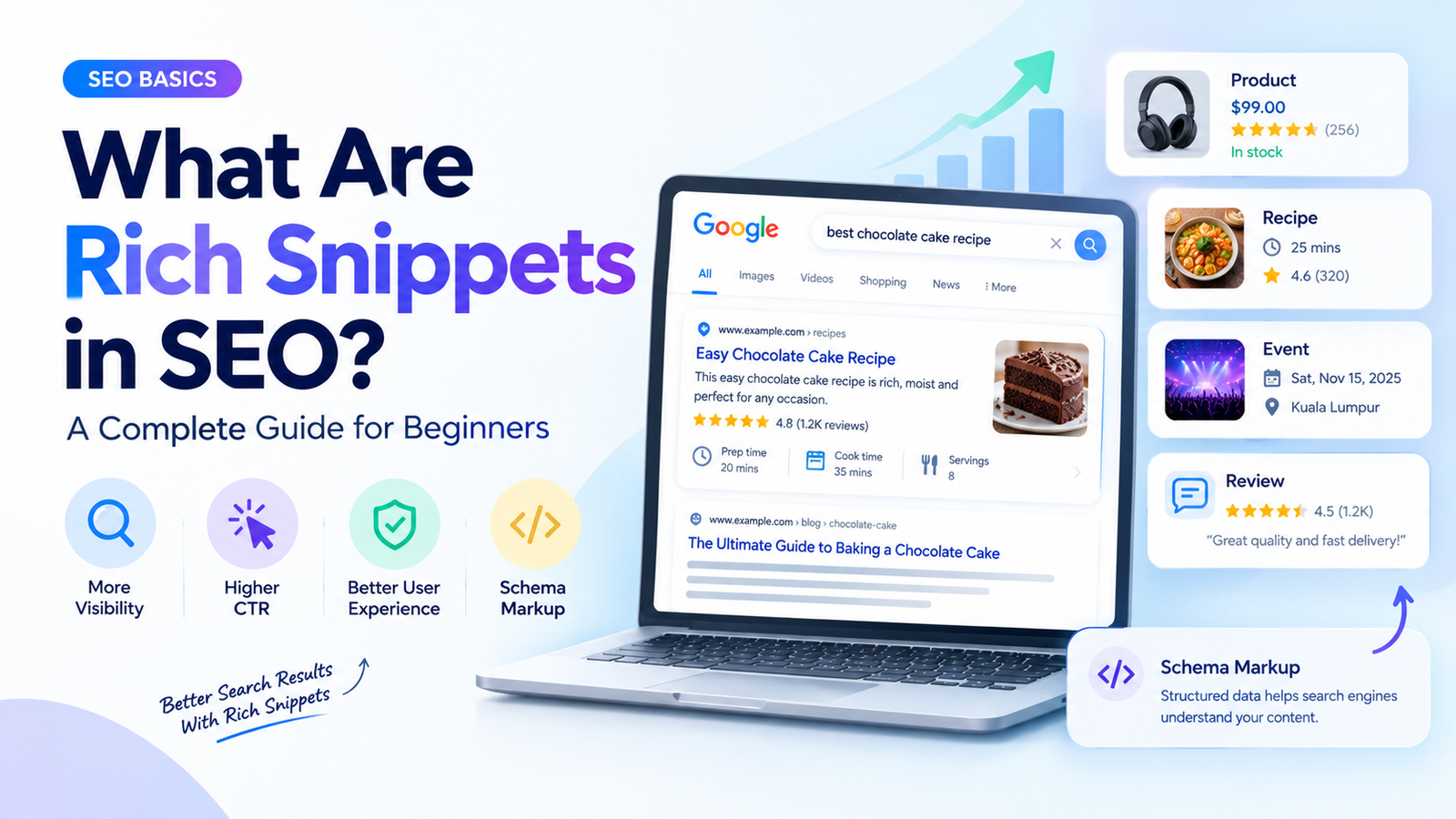
Rich snippets in SEO are enhanced search results that display additional information beyond the standard page title, URL, and meta description. They can help users understand what a webpage offers before clicking on it.
For example, when you search for a recipe on Google, you may see additional details such as cooking time, ratings, ingredients, and an image. Similarly, product results may display prices, availability, and review information.
These enhanced appearances make search results more informative and can help websites attract attention in search engine results pages (SERPs).
Rich snippets are generally enabled through structured data, a standardized format that helps search engines understand the information available on a webpage. However, adding structured data does not guarantee that Google will display a rich result.
In this guide, we will explain what rich snippets are, how they work, their common types, how to implement schema markup, and how to test your website for eligibility.
What Does Rich Snippet Mean in SEO?
A rich snippet is an enhanced presentation of a webpage in search results that includes additional information beyond the traditional search listing.
A standard Google search result generally contains:
- Page title
- Website URL or breadcrumb
- Meta description
An enhanced search result may display additional elements, including:
- Product prices and availability
- Review ratings
- Recipe information
- Images and video details
- Event dates
- Breadcrumb navigation
Google uses structured data to understand the content of a page and determine whether it may be eligible for certain enhanced search appearances.
It is useful to understand the difference between rich snippets, rich results, and structured data:
| Term | Meaning |
| Rich snippets | Commonly used term for search results with additional information |
| Rich results | Google’s broader term for enhanced search result experiences |
| Structured data | Code that helps search engines understand webpage content |
| Schema markup | A vocabulary used to describe entities and information through structured data |
Google officially uses the term rich results for enhanced search experiences. Rich snippets is still widely used in SEO discussions.
How Do Rich Snippets Work?
Rich snippets work through structured data added to a webpage. This markup provides search engines with additional context about the information published on the page.
For example, imagine you publish a recipe for chocolate cake.
Without structured data, Google may understand the page as a general article about chocolate cake.
With correctly implemented Recipe structured data, Google can identify specific details such as:
- Recipe name
- Ingredients
- Preparation time
- Cooking time
- Image
- Ratings, when genuine and eligible
Google can then use this information to determine whether the page qualifies for an enhanced recipe search appearance.
The process generally follows these steps:
Step 1: Create Useful Website Content
Start by publishing content that provides accurate and helpful information to visitors.
Your content could be a product page, recipe, article, event page, or another type of webpage.
Step 2: Add Relevant Schema Markup
Use structured data to describe the main information on the page.
For example, a product page may use Product structured data, while a recipe page may use Recipe structured data.
Step 3: Allow Search Engines to Crawl the Page
Google must be able to access the webpage and understand its content.
Make sure the page is not blocked by robots.txt, a noindex directive, or other access restrictions.
Step 4: Test Your Structured Data
Use Google’s Rich Results Test to identify supported structured data, errors, and warnings.
Step 5: Wait for Google to Process the Page
After implementation, Google may need to crawl and process the updated page.
Even if your structured data is valid, Google decides whether an enhanced search appearance is appropriate.
Google does not guarantee that every eligible page will receive a rich result.
Common Types of Rich Snippets in SEO
There are different types of enhanced search appearances depending on the content of a webpage and the structured data supported by Google.
Here are some common examples.
1. Review Snippets
Review snippets display rating information associated with eligible content, such as products, software applications, books, and certain other supported types.
For example, a product search result may display a star rating and the number of reviews.
These details can help users compare products before visiting a website.
However, ratings must be genuine and follow Google’s structured data guidelines. Adding fake ratings or marking up reviews that are not visible to users can make a page ineligible for rich results.
2. Product Rich Results
Product rich results can display additional shopping information in Google Search.
Depending on eligibility and the search experience, this information may include:
- Product price
- Availability
- Product ratings
- Review information
- Shipping details
- Return information
For example, an online store selling wireless headphones may use Product structured data to describe the product, its price, and availability.
This can help search engines understand the product information published on the page.
3. Recipe Rich Results
Recipe rich results are designed for websites that publish cooking instructions and food recipes.
They may display details such as:
- Recipe image
- Preparation time
- Cooking time
- Ingredients
- Ratings
- Nutritional information
For example, someone searching for “homemade pizza recipe” may see enhanced recipe results with images and preparation details.
Recipe structured data helps Google understand the recipe information.
4. Breadcrumb Rich Results
Breadcrumbs show the position of a webpage within a website’s hierarchy.
For example:
Home → SEO Guides → Technical SEO → Rich Snippets
Breadcrumb information can help users understand where a page belongs within a website.
Websites can use BreadcrumbList structured data to describe their navigation hierarchy.
5. Video Rich Results
Video rich results can display video information in Google Search.
Depending on the page and eligibility, they may include:
- Video thumbnail
- Video title
- Description
- Upload date
- Duration
This type of structured data can be useful for websites that publish tutorials, product demonstrations, educational videos, and other video content.
6. Event Rich Results
Event rich results can display information about eligible events.
Examples include:
- Concerts
- Conferences
- Workshops
- Festivals
- Live performances
Event structured data can describe the event name, date, location, and other relevant information.
This can help users discover events directly through Google Search.
7. Article Rich Results
Article structured data helps Google understand the information associated with news articles, blog posts, and other editorial content.
It can describe details such as:
- Article headline
- Author
- Publication date
- Modified date
- Featured image
For a blog website, Article structured data can help search engines interpret the content and its associated information.
It does not guarantee a special search appearance or higher rankings.
What Is Schema Markup in SEO?
Schema markup is a form of structured data that uses vocabulary from Schema.org to describe information on a webpage.
It helps search engines understand what different elements of a page represent.
For example, a webpage may contain a product name, price, rating, and availability. Schema markup can identify these elements as product-related information instead of leaving search engines to interpret them only from ordinary text.
Schema.org provides different types of markup for describing content, including:
- Article
- Product
- Recipe
- Organization
- LocalBusiness
- Event
- BreadcrumbList
- VideoObject
Google supports specific structured data types for enhanced search appearances. Not every Schema.org type creates a Google rich result.
Common Structured Data Formats
Google supports three main formats for implementing structured data.
1. JSON-LD
JSON-LD is a structured data format that is commonly recommended by Google.
It allows website owners to add structured data in a script block without placing markup throughout the visible HTML elements.
2. Microdata
Microdata uses HTML attributes to identify information directly within webpage elements.
It connects structured data with the content displayed on the page.
3. RDFa
RDFa is another format for adding structured data to HTML documents. It uses attributes to describe information and relationships between different elements.
For many website owners, JSON-LD is a practical option because it is easier to manage separately from the visible page content.
Example of JSON-LD Schema Markup
Here is a simple example of Article structured data that you can use to understand how JSON-LD works.
The following is an illustrative example. Replace the sample values with accurate information about your own article.
<script type=”application/ld+json”>
{
“@context”: “https://schema.org”,
“@type”: “Article”,
“headline”: “What Are Rich Snippets in SEO?”,
“description”: “A beginner-friendly guide to rich snippets and structured data.”,
“author”: {
“@type”: “Organization”,
“name”: “Digital Soules”
},
“publisher”: {
“@type”: “Organization”,
“name”: “Digital Soules”
},
“datePublished”: “2026-10-30”,
“dateModified”: “2026-10-30”
}
</script>
This markup describes the article’s headline, description, author, publisher, and publication dates.
Remember that structured data must accurately represent the visible content of the webpage. Do not add information that is misleading, inaccurate, or unrelated to the page.
Benefits of Rich Snippets in SEO
Rich snippets can improve how your website appears in search results and help users understand your content.
Here are some potential benefits.
1. Improve Search Result Visibility
Enhanced search appearances can make a listing more informative and visually noticeable.
For example, a product result showing its price and availability may attract more attention than a basic listing.
However, visibility depends on the search query, device, competition, and Google’s decision about which features to display.
2. Provide More Information to Users
Rich results can help people understand what a page offers before clicking.
A recipe result may show cooking time, while a product result may display pricing information.
This additional context helps users decide whether a webpage matches their needs.
3. Potentially Improve Click-Through Rate
A more informative search listing may encourage users to visit a website.
For example, someone searching for a product may prefer a result that clearly displays its price and availability.
However, improved click-through rate is not guaranteed. Results depend on the query, audience, competition, and how Google displays the listing.
4. Support Better Content Understanding
Structured data provides explicit information about the entities and content on a webpage.
This can help Google interpret whether a page describes an article, product, recipe, event, or another supported type of content.
5. Improve Product and Content Discovery
For eligible websites, structured data can make relevant information available to enhanced search experiences.
This can be especially useful for ecommerce stores, recipe publishers, event websites, and video platforms.
How to Add Rich Snippets to Your Website
Adding structured data does not have to be complicated. Website owners can implement it manually or use tools and plugins depending on their website platform.
Here is a basic process.
Step 1: Identify Your Page Type
First, decide what type of content you want to describe.
For example:
- Blog post: Article
- Product page: Product
- Recipe page: Recipe
- Event page: Event
- Website navigation: BreadcrumbList
Choose the most appropriate structured data type for the actual page content.
Step 2: Generate Schema Markup
You can create JSON-LD markup manually or use a structured data generator.
Make sure the information is accurate and follows Google’s requirements for the specific rich result type.
Step 3: Add Schema to Your Website
If you use WordPress, SEO plugins such as Yoast SEO and Rank Math can help generate structured data for supported content types.
You can also add custom JSON-LD through your theme or another suitable implementation method.
Avoid adding duplicate or conflicting schema markup.
Step 4: Test Your Markup
Visit Google’s Rich Results Test:
https://search.google.com/test/rich-results
Enter your webpage URL or paste a code sample to check whether Google can detect supported structured data.
Review any errors or warnings and make the necessary corrections.
Step 5: Monitor Your Website in Google Search Console
After publishing the markup, monitor relevant reports in Google Search Console.
Depending on the structured data types detected on your website, Search Console may provide enhancement reports showing valid items, warnings, and errors.
You can also use URL Inspection to understand how Google sees an individual page.
Best Tools to Test and Validate Rich Snippets
Several tools can help you create, test, and monitor structured data.
| Tool | Main Purpose |
| Google Rich Results Test | Checks eligibility for supported rich results |
| Google Search Console | Monitors detected structured data and enhancement issues |
| Schema Markup Validator | Validates Schema.org structured data |
| Rank Math | Helps WordPress users implement schema |
| Yoast SEO | Provides structured data features for WordPress websites |
| Merkle Schema Markup Generator | Helps generate structured data examples |
Google Rich Results Test: https://search.google.com/test/rich-results
Schema Markup Validator: https://validator.schema.org/
Google Search Console: https://search.google.com/search-console/
Rank Math: https://rankmath.com/
Yoast SEO: https://yoast.com/
These tools serve different purposes. For example, Google’s Rich Results Test checks eligibility for supported Google rich results, while Schema Markup Validator checks structured data against Schema.org vocabulary.
Common Rich Snippet Mistakes to Avoid
Adding structured data incorrectly can prevent your website from becoming eligible for enhanced search appearances.
Avoid these common mistakes.
1. Using Incorrect Schema Types
Always select structured data that matches the main purpose of your webpage.
For example, do not use Product schema for a general informational blog post simply because you want a more attractive search listing.
2. Adding Fake Reviews and Ratings
Never create artificial ratings or review information to make your search result appear more attractive.
Structured data should represent genuine information that is visible to visitors.
3. Marking Up Hidden Content
The information included in structured data should accurately represent content available to users on the webpage.
Adding hidden or unrelated information can violate Google’s guidelines.
4. Ignoring Required Properties
Some structured data types require specific properties to qualify for rich results.
Missing required information can make the markup invalid or ineligible.
5. Not Testing Schema Markup
Publishing structured data without testing it can leave errors unnoticed.
Always validate your implementation before and after publishing.
6. Expecting Guaranteed Rich Results
Even valid structured data does not guarantee an enhanced appearance in Google Search.
Google makes the final decision based on its systems, the search query, and the overall search experience.
Do Rich Snippets Improve Google Rankings?
Rich snippets are not a direct Google ranking factor.
Adding structured data does not automatically improve your website’s organic rankings or guarantee a higher position in search results.
However, structured data can help Google understand webpage content and make pages eligible for supported enhanced search appearances.
These appearances may improve how users interact with your search listings, but the impact varies.
You should treat structured data as part of a broader SEO strategy that includes helpful content, relevant internal links, technical SEO, and a strong website structure.
If you are building your SEO foundation, you can also read our guides on what SEO means in marketing and what SERP means in SEO.
Final Thoughts
Rich snippets are an important part of modern SEO because they help make search results more informative and useful. By implementing the correct structured data, website owners can help Google understand their content and make eligible pages available for enhanced search appearances.
However, structured data should never be treated as a shortcut to higher rankings. Focus on publishing useful content, choosing the correct schema type, following Google’s guidelines, and testing your implementation regularly.
Whether you manage a blog, ecommerce store, business website, or content platform, understanding rich snippets can help you improve your website’s search presentation and create a better experience for users.
At Digital Soules, we focus on practical SEO strategies that help businesses improve their online visibility through quality content, technical optimization, and sustainable search engine optimization practices.
Frequently Asked Questions (FAQs)
1. What are rich snippets in SEO?
Rich snippets are enhanced search results that display additional information beyond a standard search listing. Examples include product prices, review ratings, recipe details, and event information.
2. How do I get rich snippets on Google?
Add relevant structured data to your webpage, follow Google’s guidelines, and test the implementation using Google’s Rich Results Test. Google decides whether an eligible page receives an enhanced search appearance.
3. Are rich snippets and schema markup the same?
No. Schema markup is a vocabulary used to describe webpage information through structured data. Rich snippets are enhanced search result appearances that may use this information.
4. Do rich snippets improve SEO rankings?
Structured data is not a direct ranking factor. It can help search engines understand content and make eligible pages available for enhanced search appearances, but it does not guarantee higher rankings.
5. Which schema format is best for SEO?
Google recommends JSON-LD in most cases because it is generally easier to implement and maintain. Google also supports Microdata and RDFa.
6. How can I check if my website has rich snippets?
Use Google’s Rich Results Test to check a URL or code sample for supported structured data. Google Search Console can also help monitor detected structured data and enhancement issues.
7. Can every website use rich snippets?
Many types of websites can implement structured data, but eligibility depends on the content, the supported rich result type, and Google’s guidelines. Not every schema type creates a rich result in Google Search.