
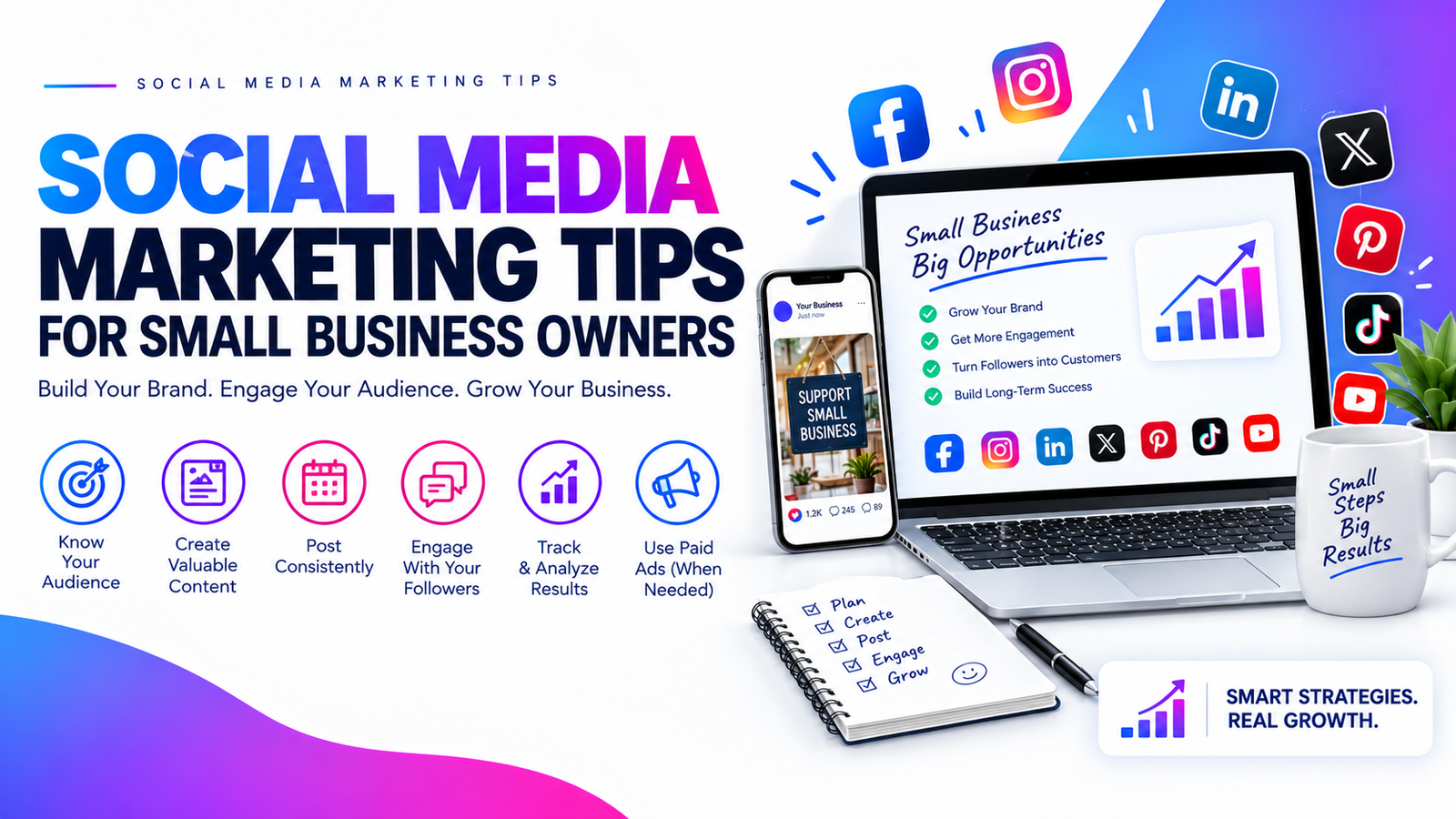
The best social media marketing tips for small business owners are simple. Pick one or two platforms where your buyers already spend time. Post about customer problems, not about your company. Reply to every comment and message. Ask happy customers for reviews. Measure saves, replies and leads, not follower counts.
This guide is for an owner with no budget and little free time. Every tip says what to do, why skipping it costs you, and the smallest version you can start this week. Written on 13 October 2026.
Where social media marketing tips for small business usually go wrong
Most advice assumes you have a designer, a writer and a media budget. You do not. So you try to be everywhere, post a few times, see no sales, and stop.
That stop and start pattern is the real problem. A quiet page with three old posts makes people wonder if you are still trading. Doing less every week beats a big launch that dies in a month. Pick a plan you can keep on your worst week, not your best one.
Quick answer: A small business needs one platform, one clear message and a weekly habit. Everything else can wait.
Pick one or two platforms where your buyers already are
You do not need Facebook, Instagram, LinkedIn, TikTok, X, Pinterest and YouTube. You need the one place your buyers already open every day.
Being on five platforms costs you in a hidden way. Each one needs its own format, captions and replies. Spread thin, you post weak content everywhere and good content nowhere.
The fix: ask your last ten customers where they found you. Then search each platform for your service plus your city. If you see local businesses with comments and questions, that platform works for your market. If you see silence, skip it.
| Platform | Best fit for | What to post |
|---|---|---|
| Local services, trades, clinics, shops and events | Before and after photos, opening hours, local offers, customer stories | |
| Anything visual: food, salons, apparel, interiors, fitness | Short videos, product close ups, process clips, customer photos | |
| Business to business services, consultants, software | Problem and fix posts, short case notes, lessons from client work |
Choose one main platform and one backup. Give the main one most of your effort.
Post about customer problems, not about your company
Open most small business pages and you see the same three things. Office photos, festival greetings, and posts that start with “we are proud to announce”.
Nobody follows a business to read about the business. People follow to solve something. Company news posts cost you reach because they earn no saves, shares or comments.
The fix: write down the ten questions customers ask before they buy. Price questions, fear questions, comparison questions. Each one becomes a post. Answer it plainly, the way you would on the phone.
A dentist does not post “we love our patients”. A dentist posts “why does a filling cost more than a cleaning”. One of those gets saved and sent to a spouse.
Quick answer: If a post does not answer a question, remove a fear or show proof, it is not worth your time.
Build a weekly content plan you can actually keep
A content calendar sounds like a big spreadsheet. For a busy owner it should fit on one page.
Use three slots a week and give each a fixed job. The job never changes, only the topic does. That removes the daily “what do I post today” decision, which kills most plans.
- Slot one, teach: answer one customer question in plain words.
- Slot two, show: a photo or clip of real work, stock, or your process.
- Slot three, prove: a review, a customer photo, a result, or a short story.
Write your next twelve topics in a notes app, four for each slot. That is a month planned in twenty minutes. Cross each one off as you use it, and add new ones as customers ask new questions.
If a week goes bad, drop to one post. Keep the habit alive rather than starting again from zero.
Turn one piece of content into several
Making new content from scratch every time is why owners burn out. You do not need more ideas. You need more uses for the ones you have.
Take one good answer to a customer question. That single piece becomes five:
- A short video of you saying it to the camera, filmed on your phone.
- A text post with the same answer written out.
- A photo post with the key line as a caption over the image.
- A story or status with one question from it, as a poll.
- A saved reply you reuse when someone asks it in your messages.
Space them out over two or three weeks. Most of your audience misses any single post, so repeating a good point is not lazy. It is how people remember you.
If you write a blog post, pull three lines from it for social. It is the same habit behind how to market a small local business online without hiring a team.
How often should a small business post?
Two to three times a week is enough to stay visible when you have no help. Daily posting is not required and most owners cannot keep it up.
A steady rhythm beats volume. Three posts a week for six months does more than twenty posts in one week followed by silence.
Pick fixed days, for example Tuesday, Thursday and Saturday. Put them in your phone calendar as a recurring reminder. Treat the slot like a customer appointment.
Timing matters less than people think, but it is free to get right. If Instagram is your main platform, check the best time to post on Instagram, then test your own account data, because your audience may differ.
Quick answer: Post two to three times a week on one platform, on the same days, and keep it up for at least three months before you judge it.
Reply to every comment and message, and reply fast
Replies are the cheapest growth you have. They cost nothing and do three jobs at once.
First, platforms show your post to more people when it gets conversation, and a reply from you often starts one. Second, a fast reply in your inbox is often the difference between a sale and a lost lead. Third, a public reply is read by everyone who scrolls past, so one answer serves dozens of silent readers.
Ignoring comments costs you in a way you never see. The person asking “how much” does not send a follow up. They go to the next business.
The fix: check comments and messages twice a day, for ten minutes each time. Answer directly, then invite the next step. Keep five saved replies for common questions, such as price range, service area and opening hours. Edit them slightly so they do not read like a robot.
Handle a bad comment in public, calmly, then move the detail to messages. Watchers judge how you handle it more than the complaint itself.
Ask happy customers for reviews and photos
Your own posts say you are good. A customer saying it is worth far more, and it costs you one sentence.
Most owners never ask, because it feels awkward. That silence is expensive. Buyers look for proof before they contact you, and if they find none they assume you are risky.
The fix: ask at the moment the customer is happiest, right after the job is done or the order arrives. Keep it short. “Would you mind leaving a quick review? One line is plenty, and it really helps a small business like ours.”
Then do two things with what you get. Share the review as a post, with permission. And ask for user generated content, which simply means a photo or clip the customer took themselves. A shaky real photo of your product in someone’s kitchen beats a studio shot, because it looks true.
Reviews also live outside social media. Claim your listings on the main business review sites where customers leave feedback, so the proof shows up when someone searches your name, not only when they scroll.
Make your content in one sitting, not every day
Daily content work breaks your day. Batching protects it.
Set aside ninety minutes once a week or once a fortnight. Shoot four or five clips in the same shirt, take ten photos, write the captions. Load them into the platform scheduler, free on Facebook, Instagram and LinkedIn, then close the app.
Batching also makes the posts better. When you make five together you think about the whole set, so they stop repeating each other.
When a small paid boost makes sense
You do not need ads to start. You may want a small boost once something is already working.
Boosting a weak post wastes money. Paid reach does not fix a post nobody wanted. It only buys more eyes on what you already made.
A small boost is reasonable in three cases. First, a post that already got unusual saves, shares or comments on its own, since the content is proven and you are only extending it. Second, something with a real deadline, like a seasonal offer or an event. Third, a narrow local radius around your shop, where the audience is small and cheap to reach.
If you try it, set a small daily amount you would not miss and run it for a week. Point the ad at one action, such as a message or a call. Judge it on enquiries, not likes, and stop if none appear. Read the platform guidance first. LinkedIn’s official best practices for Pages covers how organic posting, targeting and boosting fit together.
Quick answer: Boost only posts that already earned attention on their own, with a small daily amount, and judge the result by enquiries.
What to measure and what to ignore
Every platform shows you dozens of numbers. Almost all are noise for a small business.
Follower count is the worst one to chase. A page with two thousand dead followers performs worse than one with two hundred real locals.
| Worth measuring | Why it matters |
|---|---|
| Saves and shares | Shows the post was useful enough to keep or pass on |
| Comments and replies | Real conversation, which also helps the post reach more people |
| Messages and calls | The closest thing to a lead you can count inside the app |
| Profile visits and link clicks | Shows people moved from the post toward buying |
| Engagement rate | Engagement divided by reach, so it stays honest |
Safe to ignore: follower count on its own, impressions with no action behind them, and likes from accounts outside your service area. They feel good and tell you nothing about revenue.
How to tell if it is working
Social media rarely gives a straight line from post to sale. Judge it on direction over months, not on any single post.
Keep a one page log. Once a month write down four numbers: messages received, calls or enquiries, link clicks, and new reviews. Add one line on what you posted most that month.
After three months you can see a pattern. If messages are rising and more customers mention seeing you online, it is working. If everything is flat and you kept the habit, change the content, not the platform. Most flat accounts are posting about themselves.
Also ask every new customer one question: “where did you hear about us?” Write the answer down. That habit tells you more than any dashboard, and it is free.
Never expect a fixed result by a fixed date. Organic reach moves with platform changes and seasons, and no honest marketer can promise a number.
How social media marketing tips for small business connect to search
Your real goal is leads, and most leads still arrive through search. Social media and search support each other in three ways.
First, your profile is a search result. Fill it in completely: what you do, who you serve, your area, your hours, a working link and a contact button. A half empty profile loses people who were ready to contact you.
Second, keep your name, address and phone number (NAP) identical everywhere. Same spelling on your Facebook page, Instagram bio, LinkedIn page, Google Business Profile and website footer. Mismatched details confuse customers and search engines, and fixing it costs nothing but an hour.
Third, social activity creates brand searches. Someone sees your clip, does not click, then types your business name into Google two days later. If your site and listings are in order, that search turns into an enquiry. If not, the interest you worked for leaks away.
So treat social media as what makes people curious, and your website and listings as what closes. If the website side is the weak link, an affordable SEO service for small business can handle the technical work while you keep talking to customers.
Quick answer: Complete your profile, keep your name, address and phone number (NAP) the same everywhere, and make sure your website is ready for the brand searches your posts create.
Frequently asked questions
how often should a small business post on social media
Two to three posts a week is enough for most small businesses with no marketing help. A steady rhythm matters more than volume. Pick fixed days and keep them for at least three months. One good post a week is better than seven posts in one week followed by a month of silence.
which social media platform is best for a small business
The best platform is the one your buyers already use daily. Facebook suits local services and shops. Instagram suits visual businesses like food, salons and apparel. LinkedIn suits business to business services. Ask your last ten customers where they found you, then commit to one main platform.
how do i get followers without ads
Answer customer questions in public, reply to every comment, and share real customer photos and reviews. Useful posts get saved and shared, which puts you in front of new people for free. Growth this way is slow and steady. Expect months, not days, and never buy followers.
do i need to be on every social media platform
No. Being on every platform spreads your limited time too thin. Each one needs different formats and separate replies. One strong, active profile beats five quiet ones. Choose one main platform and at most one backup, then add another only when the first runs without stress.
how much should a small business spend on social media ads
Start with an amount you would not miss if it returned nothing. Spend it on a post that already earned saves, shares or comments on its own. Run it for about a week, aimed at one action like a message or a call. Judge it on enquiries, not likes.
does social media help seo
Social media links do not act like normal backlinks for ranking. The help is indirect. Posts create brand searches, and a complete profile with consistent name, address and phone number (NAP) supports your local presence. Think of social media as demand, and your website and listings as the place that demand converts.
how long before social media brings leads
Plan for three to six months of steady posting before the pattern is clear. Early signs are more saves, comments and messages, even before sales move. Track messages, enquiries, link clicks and new reviews monthly. No one can promise a set number of leads by a set date.