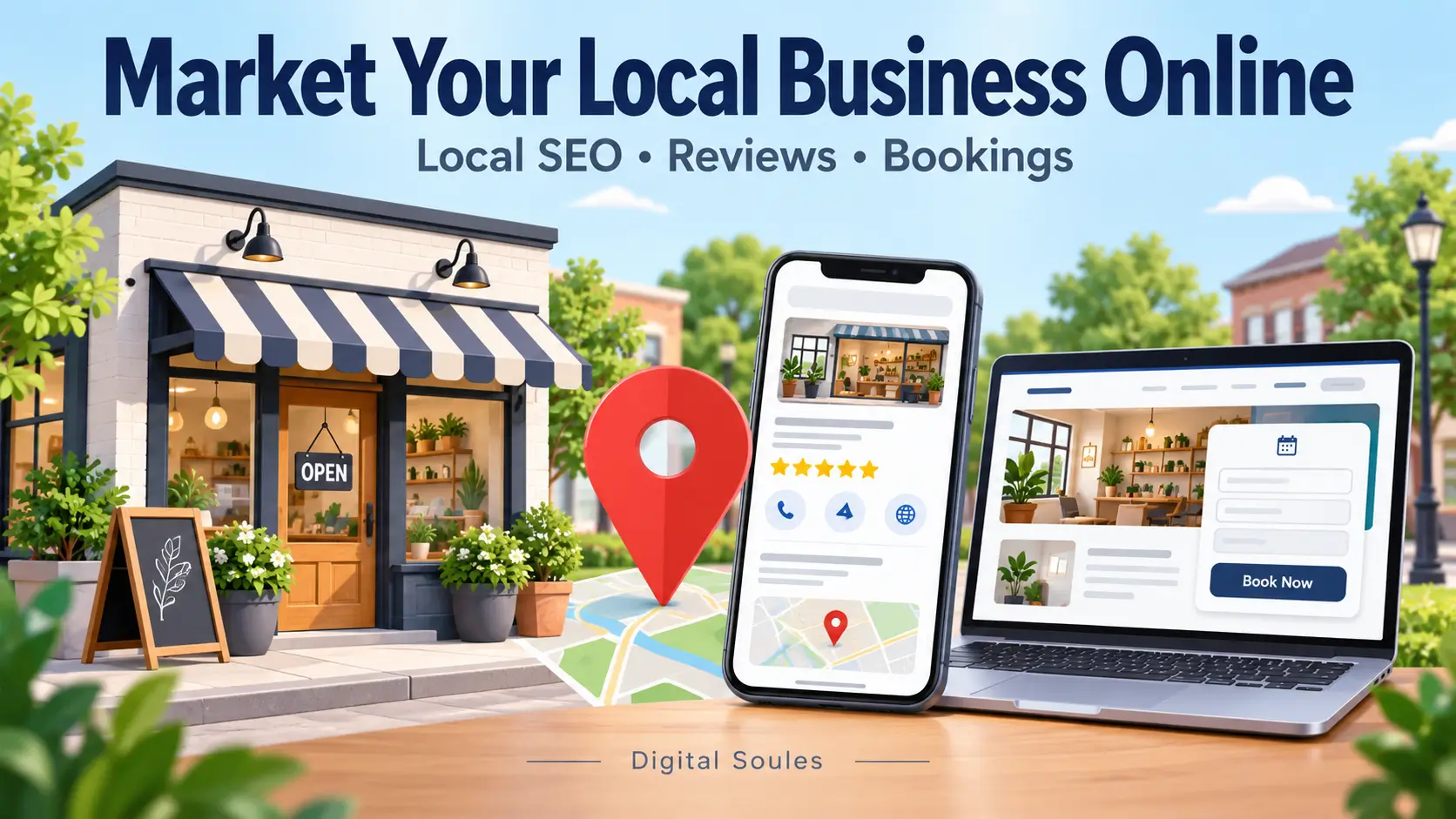
Start with a Google Business Profile, a clear website, genuine customer reviews, and one marketing channel your customers use. Track enquiries and sales, then invest more in activities that bring profitable customers.
Local SEO helps nearby people find your business through unpaid search results. Advertising, social media, and email can support discovery and repeat purchases.
You do not need to launch everything at once. The following process helps you build the basics, choose suitable channels, and avoid wasting your budget.
1. Choose Your Customers, Service Area, and Main Offer
Before opening marketing accounts, decide whom you want to reach. A cleaning business serving homeowners needs a different message from one serving offices.
Write a short plan using these questions:
- Customer: Who needs your product or service?
- Area: Which places can you realistically serve?
- Offer: Which product or service has demand and a useful profit margin?
- Difference: Why would someone choose you?
- Action: Should visitors call, book, request a quote, or visit?
- Capacity: How much extra work can you handle?
For example, a mobile cleaner might promote regular home cleaning within towns they already visit. Their main website action could be requesting a quote.
Make your difference specific and truthful. Clear pricing, convenient hours, specialist experience, or a documented service process can help customers decide.
Review nearby competitors’ profiles and websites. Note their services, reviews, booking options, and unanswered customer questions.
Use this research to improve your offer. Avoid copying competitors’ claims or competing on price without checking your costs.
2. Understand How Local SEO Works
Local SEO means improving your visibility when people search for businesses serving a particular area. It covers your Google profile, website, reviews, business information, and relevant local mentions.
A customer might search for “bike repair near me” or “house cleaning in [town].” Your information should clearly explain the relevant service and where it is available.
Google’s local ranking guidance identifies three main factors:
- Relevance: How closely your business matches the search.
- Distance: How far your business is from the searcher.
- Prominence: How well known your business is, including evidence from reviews and links.
Accurate details help Google understand your business. Genuine reviews and relevant website links can also support visibility.
Distance limits what optimisation can achieve. Listing many service areas does not guarantee high rankings across those places.
Local SEO can support ongoing discovery without paying for every organic click. However, it requires maintenance, and rankings vary with location and competition.
You cannot pay Google for a better organic local ranking. Paid advertisements operate separately.
3. Set Up Your Google Business Profile Correctly
Google Business Profile is free to create and manage. Eligible businesses generally meet customers in person, either at their premises or at customers’ locations.
An online-only business without in-person customer contact generally does not qualify.
Claim, Complete, and Verify Your Profile
Follow this sequence:
- Search Google Maps for your business name and town.
- Open an unverified listing and select Claim this business, then Manage now, when offered.
- Request ownership if someone else already manages the profile.
- If no listing exists, open Google’s Business Profile setup and choose Add your business.
- Enter your real business name and the most suitable primary category.
- Add an accurate address or service area, phone number, and website if available.
- Complete verification using the methods Google offers your business.
- Add relevant services, applicable hours, and clear, genuine photos.
- Check the public profile and keep changes current.
Do not add extra keywords to your business name unless they belong to its real name. Choose categories that describe your business, rather than every keyword you want to target.
Verification methods vary. Follow the options shown instead of assuming every business can verify by postcard or telephone.
Use photos that help customers recognise your premises, products, or work. Share relevant updates and offers where those features are available.
Photos and updates help customers understand your business. Treat them as useful information, without expecting guaranteed ranking improvements.
Use the Right Setup for Your Business Type
Storefront: Show an eligible location where customers can visit. Keep the address and customer-facing hours accurate.
Service-area business: If customers never visit your premises, hide the address from public display. List the places you actually serve.
Hybrid business: A business that receives customers and travels to them may display its eligible address and service areas.
Avoid rented mailing addresses used only to create a local presence. Travelling to several towns does not justify a separate profile for each town.
A profile audit can identify incorrect details or missing information. Our local SEO services explain support for profiles, listings, reviews, and tracking.
4. Build a Website That Turns Searches Into Enquiries
Your website gives customers room to compare services and decide whether to contact you. A profile and website serve different purposes, so keep their information aligned.
A simple website should include:
- Your main products or services.
- The area you serve and any travel limits.
- Clear contact details and appropriate opening hours.
- A working contact form, booking option, or clickable phone number.
- Genuine examples of your work, with permission where needed.
- Useful answers about pricing, availability, and the buying process.
Make the next action easy to find on a phone. Test forms yourself and confirm enquiries reach someone who can respond.
If you need help creating these pages, explore our business website development options.
Find Local Keywords From Real Customer Questions
Start with the words customers use during calls, messages, and quote requests. Combine your actual services with locations you genuinely serve.
Useful keyword patterns include:
- “[service] in [town]”
- “[product] shop in [area]”
- “[service] cost in [town]”
- “[service] appointment”
- “[service] for [customer type]”
Check search results to understand each phrase. Some searches need a service page, while others need an explanation or pricing guide.
If your website already receives search traffic, review its Google Search Console queries. These show phrases associated with your site’s search impressions and clicks.
Use location wording naturally in page titles, headings, and relevant text. Repeating “near me” throughout a page cannot make you nearby to every searcher.
Create Useful Service and Location Pages
Give each important service enough detail for a customer to evaluate it. Explain scope, availability, process, pricing approach, and the next step.
A cleaning page could describe included tasks, exclusions, available schedules, and how quotes are calculated. Add genuine local examples where available.
Create separate location pages when you have useful information specific to those places. Include relevant services, access details, local work, or area-specific answers.
Avoid publishing dozens of identical pages with only town names changed. A clear service-area page may be more useful for a small business.
Our SEO content strategy service explains how to connect page topics with customer searches.
Check the Website Basics
Check mobile usability, loading problems, broken links, and search indexing settings. A public site should allow search engines to access the pages you want discovered.
For a public WordPress site, open Settings → Reading. Ensure Discourage search engines from indexing this site is unchecked, then save.
Check that important pages are accessible and appear in your sitemap. A sitemap lists pages you want search engines to find.
Structured data is code that describes business details to search engines. A developer can assess suitable markup using accurate, visible information.
It does not guarantee special search displays or higher Maps rankings. Avoid publishing a private home address just to pursue a search feature.
5. Build Trust Through Reviews and Local Listings
Reviews help people assess real customer experiences. Create a consistent process for inviting honest feedback after completed purchases or services.
Ask for Genuine Reviews Without Incentives
Use your profile’s review link or QR code. Invite customers neutrally and let them choose whether to respond.
A simple request could say:
“Thank you for choosing us. If you would like to share your experience, please leave an honest Google review.”
Send requests consistently, without filtering customers by expected rating. Never offer discounts, gifts, or payments in exchange for reviews.
Avoid asking customers to include specific keywords or staff names. Do not pressure people to post while they are at your premises.
Reply politely to positive and negative feedback. Discuss sensitive details privately and report reviews only when they violate platform rules.
An unhappy review does not automatically qualify for removal. Use recurring complaints to identify service problems you can fix.
Keep Business Listings Accurate and Earn Relevant Mentions
Check important local directories, trade associations, and platforms your customers actually use. Correct outdated names, phone numbers, hours, and public location details.
For home-based service businesses, protect address privacy across public listings. Consistency does not require publishing a residential address everywhere.
Choose relevant listings over large packages of unknown directories. A chamber listing or useful industry directory may be more appropriate.
Build real relationships with complementary local businesses. Joint events, helpful contributions, or genuine supplier listings can introduce customers and earn relevant website mentions.
Avoid buying links simply to manipulate rankings. A partnership should make business sense even without an SEO benefit.
6. Compare Online Marketing Channels: Pros and Cons
Start with one discovery channel and one way to retain customers. Expand when you can maintain them and measure results.
| Channel | Suitable use | Pros | Cons |
|---|---|---|---|
| Google profile and local SEO | People searching for nearby products or services | No charge for organic clicks; supports relevant discovery | Needs maintenance; visibility depends on geography and competition |
| Paid search ads | Testing demand for a defined service | Budget and targeting controls; can generate traffic while campaigns run | Click costs; tracking and ongoing management required |
| Organic social media | Showing products, work, events, or personality | Direct interaction; useful visual proof | Requires regular effort; reach and customer intent vary |
| Bringing interested customers back | Direct follow-up; useful for repeat purchases | Needs permission and a relevant list; poor messages can annoy subscribers | |
| Local partnerships | Reaching related local audiences | Builds relationships and referrals | Requires coordination; results can be harder to attribute |
These are practical trade-offs, not a universal ranking of channel performance. Customer behaviour and your business economics should guide the choice.
Use Social Media With a Clear Purpose
Choose a platform your customers already use. A bakery might show products, while a repair business might explain common problems.
Rotate three types of posts:
- Useful answers to customer questions.
- Genuine products, completed work, or customer experiences shared with permission.
- Clear availability, booking information, or relevant offers.
Include a practical next action when appropriate. Respond to enquiries, and follow local group rules before posting promotions.
Use Email to Encourage Repeat Business
Invite customers to subscribe voluntarily through your website or normal customer interactions. Explain what they will receive and provide an easy unsubscribe option.
Send relevant reminders, useful advice, or occasional offers. A service business could share maintenance reminders; a shop could announce suitable new stock.
Respect customer preferences and avoid purchased mailing lists. Measure responses and purchases instead of treating list size as success.
7. Test Local Advertising With a Controlled Budget
Advertising is useful when you have a clear offer, working contact process, and money available for testing. It cannot fix poor service or unanswered enquiries.
Use this beginner process:
- Select one service or product with suitable demand and margin.
- Create a page that matches the advertised offer.
- Choose the areas you can actually serve.
- Review location settings so they match where your intended customers are.
- Choose relevant search terms or audiences and exclude unsuitable ones.
- Set a budget you can afford, including platform spending rules.
- Track meaningful enquiries, bookings, or purchases.
- Review lead quality and adjust or pause weak activity.
For nearby-only services, review Google’s “Presence” location option. Businesses attracting visitors from elsewhere may need broader targeting.
Location targeting is not perfectly accurate. Check where actual enquiries originate and whether you can serve them.
In search advertising, negative keywords exclude unsuitable searches. For example, a cleaning company might exclude recruitment terms if it is advertising cleaning services.
Google Ads’ average daily budget is not always a hard daily spending cap. Review daily and monthly limits before launching.
Local Services Ads may also be available for eligible categories and locations. Check availability and requirements before choosing them.
8. Set a Budget Based on Customer Value
There is no single suitable marketing budget for every local business. Your margin, capacity, repeat sales, and cash flow all matter.
Separate these costs when planning:
- Cash spending: Advertising, website hosting, software, or outside support.
- Setup work: Website pages, profile corrections, photography, and tracking.
- Ongoing work: Replies, reviews, updates, content, and campaign checks.
- Owner time: Hours that could otherwise support customers or operations.
Free channels still require effort. Track total marketing costs when comparing DIY work with paid support.
Example: Compare Marketing Cost With Customer Contribution
The following figures are hypothetical US-dollar amounts, not industry averages:
- Marketing spending: $300
- Qualified enquiries: 15
- New paying customers: 5
- Revenue per new customer: $150
- Direct service costs per customer: $60
Cost per qualified enquiry is $300 ÷ 15 = $20. Cost per new customer is $300 ÷ 5 = $60.
Each customer contributes $90 after direct service costs. Five customers contribute $450, leaving $150 after the marketing spending.
That amount still needs to cover overhead and any other excluded costs. It is not automatically net profit.
Compare this calculation with actual results. Include agency fees and other campaign costs, and avoid counting uncertain future purchases as guaranteed income.
9. Follow a Practical 30-Day Setup Plan
Treat this as a setup schedule, not a promise to rank or gain customers within 30 days. Verification and website work may take longer.
| Week | Main tasks | What you should have |
|---|---|---|
| Week 1 | Define audience, area, offer, and goal; claim your profile | A clear plan and accurate business details |
| Week 2 | Improve service information; check mobile contact and booking | A working path from discovery to enquiry |
| Week 3 | Start neutral review requests; correct key listings; publish useful content | A repeatable trust and communication process |
| Week 4 | Review enquiry quality; test one channel if ready; plan improvements | A tracking record and next priorities |
After setup, reserve a regular weekly session for replies, updates, and measurement. Assign someone to monitor incoming enquiries between those sessions.
10. Measure Calls, Bookings, and Sales
Choose one main result, such as qualified quote requests, appointments, or completed purchases. Record where enquiries came from and whether they became customers.
A simple spreadsheet can track:
- Date and discovery source.
- Requested product or service.
- Whether the enquiry fits your area and offer.
- Booking or sale outcome.
- Attributed revenue, direct costs, and marketing spending.
Ask new customers how they found you. Combine their answers with website tracking, since neither source is perfect.
Google Business Profile performance can show interactions such as website clicks and call-button clicks. A call-button click does not prove a completed call or booking.
Likewise, a directions request does not prove a store visit. Profile performance can include advertising activity, so check attribution before labelling everything an SEO result.
Search Console helps show which searches produce website impressions and clicks. Connect those visits with enquiry or purchase tracking to judge business outcomes.
Low enquiries may indicate weak visibility or an unclear offer. Many enquiries with few sales may indicate poor targeting, slow responses, or a pricing mismatch.
Check these problems before simply increasing advertising spending.
11. Decide What to Do Yourself and When to Hire
DIY work can suit a small budget when you have time and basic website access. Profile updates, review invitations, and simple content are reasonable starting tasks.
Outside help may suit technical website problems, complex tracking, competitive markets, or campaigns you cannot manage. Our SEO consultancy page explains support with audits and priorities.
Before hiring, ask for:
- A defined scope and explanation of priorities.
- Separate advertising spending, management fees, and other costs.
- Reporting on useful enquiries and customer outcomes.
- Clear access to accounts, website files, and business data.
- Realistic expectations without guaranteed rankings.
Keep ownership of your business accounts and grant suitable access to providers. Understand contract terms and how access works when the arrangement ends.
Frequently Asked Questions About Local Online Marketing
How Can I Promote My Local Business Online for Free?
Start with an eligible Google Business Profile, genuine review invitations, useful social posts, and relevant free listings. Answer customer questions and build local partnerships.
These activities require time even when there is no platform fee. Choose a manageable routine instead of opening many inactive accounts.
Can I Market a Local Business Without a Website?
Yes, an eligible Google profile, social presence, and suitable directory listings can help people discover you. Keep your phone and other contact options clear.
A website adds control over service details, booking, and measurement. Build a simple one when it supports a clear customer need.
How Long Does Local SEO Take to Work?
There is no fixed timeline. Results depend on your starting position, competition, geography, website, and the work completed.
Correct urgent errors first and measure changes over time. Treat promises of guaranteed rankings by a specific date cautiously.
Should I Choose Local SEO or Google Ads?
Local SEO develops unpaid visibility; ads buy exposure while campaigns run. Ads can test a defined offer, but ongoing clicks cost money.
Build accurate information and a working contact process first. Then choose or combine channels based on customer quality and economics.
How Many Google Reviews Do I Need?
There is no review count that guarantees a ranking. Invite genuine feedback consistently and focus on providing experiences customers can describe honestly.
Can I Rank in Every Town I Serve?
Serving an area does not guarantee visibility throughout it. Distance, relevance, and prominence still affect local results.
Create useful content for genuine service areas and monitor actual enquiries. Avoid fake locations or duplicate profiles for towns you merely visit.
Start With the Next Useful Action
Check your business information and test how easily a customer can contact you today. Then choose one channel and measure the enquiries it produces.
Build a routine around accurate information, useful content, honest feedback, and reliable follow-up. Those habits give your marketing a practical foundation.