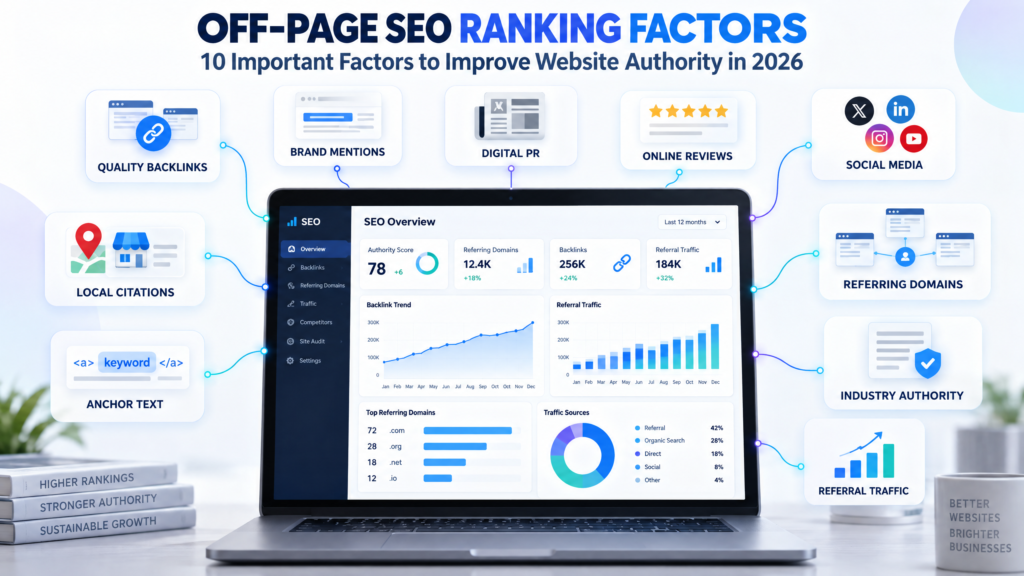
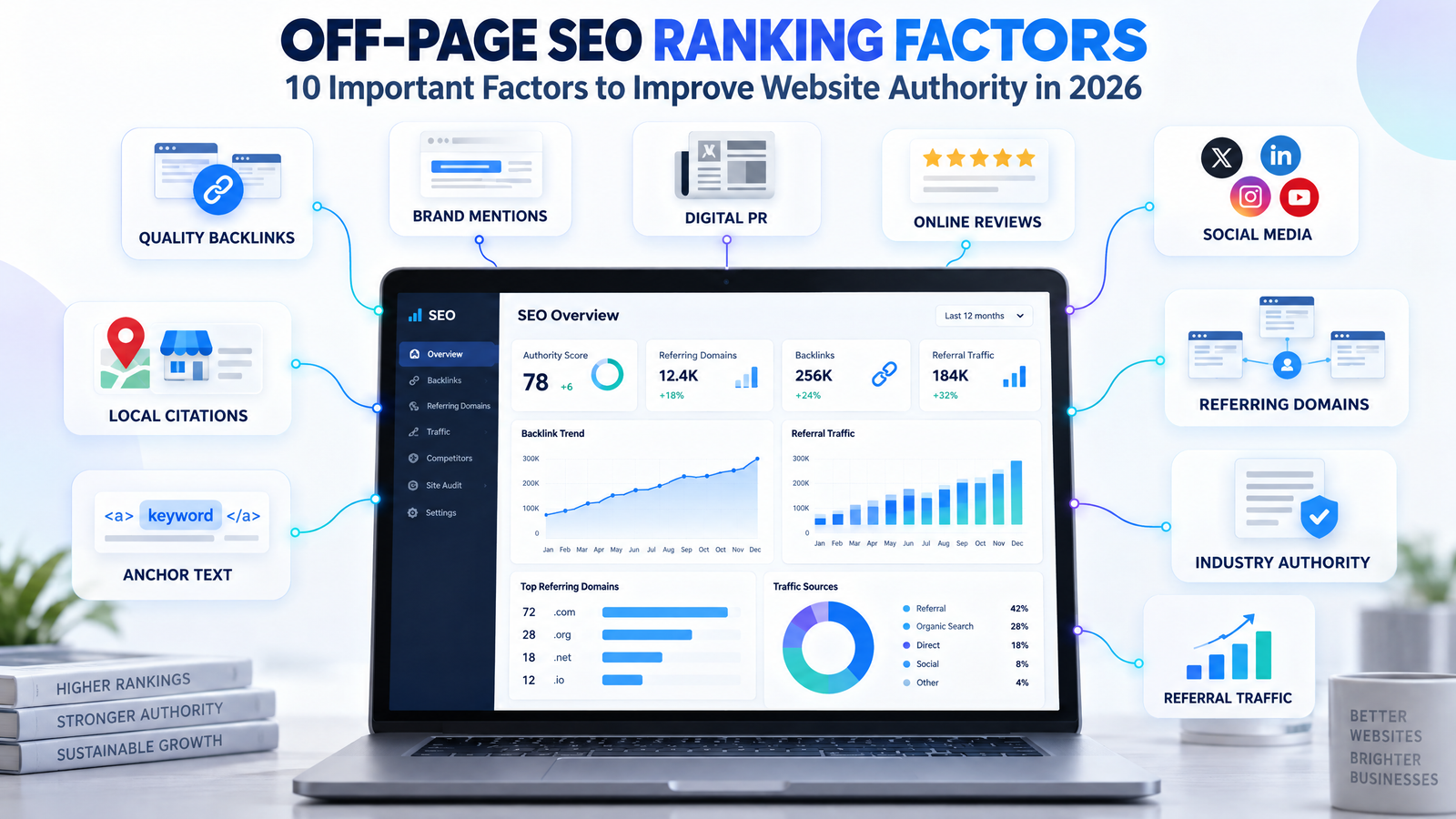
Off-page SEO ranking factors are signals and activities outside your website that can influence how search engines understand your website’s reputation, relevance, and authority.
Unlike on-page SEO, which focuses on improving your website’s content, headings, keywords, and internal links, off-page SEO focuses on building your website’s reputation across the internet.
For example, imagine you publish a detailed article about digital marketing. Another respected marketing website finds your article useful and links to it as a reference. That link can help search engines discover your page and understand its relevance and value.
Backlinks are one of the best-known off-page SEO signals, but they are not the only activity worth considering.
Other off-page activities include:
- Earning links from relevant websites.
- Building brand awareness.
- Getting genuine customer reviews.
- Publishing expert contributions on reputable platforms.
- Earning mentions from trusted publications.
- Building relationships within your industry.
- Maintaining a positive online reputation.
Google uses multiple systems and signals to rank search results. Its documentation specifically explains that links and PageRank remain part of its ranking systems. However, Google does not publish a complete list of ranking factors or their exact weights.
If you are new to SEO, start with our guide on what SEO is and how it works to understand how different SEO activities work together.
Why Is Off-Page SEO Important?
Publishing useful content is important, but your website also exists within a larger online ecosystem.
Other websites, customers, publishers, and industry communities can help people discover your content and business.
Off-page SEO can support your website in several ways.
1. Builds Website Authority
When relevant and trustworthy websites link to your content, they provide a useful reference for their readers.
These links can help search engines understand how your pages relate to other resources on the web.
However, website authority scores from third-party SEO tools are estimates. They are not official Google metrics.
2. Helps Search Engines Discover Content
Links from other websites can help search engines find pages they may not have discovered otherwise.
For example, if an industry publication links to a newly published guide on your website, search engine crawlers may follow that link to discover the page.
3. Generates Referral Traffic
Not every valuable backlink needs to improve rankings directly.
A link from a relevant website can send interested visitors to your business.
For example, a software company mentioned in a technology publication may receive visitors who are already interested in its product.
4. Improves Brand Visibility
Mentions across industry websites, news publications, communities, and social platforms can introduce your brand to new audiences.
Even when a mention does not include a clickable link, it may help people recognize and remember your business.
5. Supports Business Credibility
Positive reviews, expert contributions, and genuine recommendations can help potential customers feel more confident about choosing your business.
These activities are especially useful for companies that depend on trust and reputation.
10 Important Off-Page SEO Ranking Factors and Signals
Let’s look at the most important off-page factors and activities to understand when building a sustainable SEO strategy.
1. Quality Backlinks
Backlinks are links from external websites that point to your website.
They are among the most established off-page SEO signals because Google’s ranking systems use link analysis, including PageRank, to understand relationships between pages.
However, getting hundreds of random backlinks does not guarantee better rankings.
The quality and context of a backlink matter.
For example, imagine you operate an SEO agency.
A link from a respected digital marketing publication discussing SEO strategies is more relevant to your business than a random link from an unrelated website.
When evaluating backlinks, consider:
- Relevance: Does the linking website cover topics related to your industry?
- Editorial value: Was the link included naturally because your content provides useful information?
- Page quality: Is the page useful and relevant to its audience?
- Context: Does the surrounding content explain why your website is being referenced?
- Traffic potential: Could the link bring interested visitors to your website?
Focus on earning links that make sense for real readers rather than collecting links simply to increase a metric.
2. Referring Domain Quality and Diversity
A referring domain is a website that links to your website.
For example, if five different websites link to your blog, you have five referring domains.
Referring domains are useful for understanding your backlink profile, but there is no official Google requirement to obtain a particular number of referring domains.
A natural backlink profile can include links from different relevant sources, such as:
- Industry blogs.
- News publications.
- Business websites.
- Educational resources.
- Professional communities.
- Relevant industry directories.
The goal is not to collect links from as many domains as possible. It is to earn meaningful references from websites that have a genuine reason to mention your content.
3. Relevance of Linking Websites
Relevance is an important consideration when evaluating backlinks.
Suppose you operate a website that publishes SEO and digital marketing guides.
A backlink from a marketing agency, SEO publication, or technology blog discussing search optimization makes sense in that context.
However, a backlink from an unrelated website may have little value to your audience.
Relevant backlinks can help establish a clearer relationship between your website and its subject area.
Before pursuing a backlink opportunity, ask:
- Does this website cover a related topic?
- Is its audience interested in my content?
- Does the proposed link provide additional information?
- Would the link make sense even if search engines did not exist?
If the answer is yes, the opportunity may be worth considering.
4. Natural Anchor Text
Anchor text is the clickable text used in a hyperlink.
For example:
“Learn more about our SEO services.”
Here, “SEO services” is the anchor text.
Anchor text provides context about the destination page. Google also recommends using descriptive link text so people and search engines can understand linked pages.
However, using the same keyword-rich anchor text repeatedly across hundreds of backlinks can look manipulative.
A natural backlink profile may contain different anchor text types:
| Anchor text type | Example |
| Branded | Digital Soules |
| Exact match | Off-page SEO |
| Partial match | Off-page SEO strategies |
| Generic | Read more |
| Naked URL | https://digitalsoules.com/ |
Do not try to force every external website to use your exact target keyword.
The publisher should choose anchor text that makes sense for its readers.
5. Brand Mentions and Online Reputation
A brand mention occurs when another website, publication, or online platform refers to your business.
For example, a marketing blog might mention Digital Soules while discussing SEO resources.
The mention may include a backlink, or it may simply refer to the brand by name.
Brand mentions can increase awareness, introduce your business to potential customers, and create opportunities for future links.
However, an unlinked brand mention should not automatically be treated as a confirmed direct Google ranking factor.
You can build brand visibility through:
- Industry interviews.
- Expert contributions.
- Digital PR campaigns.
- Business partnerships.
- Helpful community participation.
- Original research and reports.
- Relevant online discussions.
The best approach is to give people a genuine reason to talk about your business.
6. Digital PR and Editorial Links
Digital PR is the process of promoting your business, expertise, research, or content to online publications and relevant audiences.
It can help you earn editorial mentions and backlinks from websites that publish information about your industry.
For example, an SEO agency could publish an original report about changes in local search visibility. Industry writers might reference the findings in their own articles.
Other digital PR opportunities include:
- Sharing original research.
- Publishing industry statistics.
- Providing expert comments to journalists.
- Creating useful reports.
- Announcing meaningful company developments.
- Offering expert insights on trending industry topics.
Digital PR is valuable because it can build brand awareness and generate genuine editorial references.
The important point is to earn coverage through useful information rather than paying for links intended to manipulate rankings.
7. Online Reviews and Customer Reputation
Online reviews are especially important for businesses that serve local customers.
People often check customer feedback before choosing a restaurant, agency, hotel, contractor, or professional service.
Positive and genuine reviews can help improve customer confidence and influence purchasing decisions.
For local search, Google specifically identifies relevance, distance, and prominence as important factors in local results. Reviews and positive ratings can contribute to prominence.
Businesses can improve their review process by:
- Asking genuine customers for feedback.
- Responding professionally to reviews.
- Addressing customer complaints.
- Keeping business information accurate.
- Avoiding fake or purchased reviews.
Remember that reviews are not a universal ranking shortcut. Their role depends on the type of search and business.
8. Local Citations and Business Listings
A local citation is an online mention of a business’s information, commonly including:
- Business name.
- Address.
- Phone number.
- Website.
- Business category.
For example, a local marketing agency may appear in business directories, industry listings, and local business platforms.
Accurate business information makes it easier for customers to identify and contact your company.
For local businesses, maintaining consistent information across important platforms is a useful part of local SEO.
Focus on relevant and trustworthy directories rather than submitting your business to hundreds of low-quality listing websites.
9. Social Media Visibility and Content Sharing
Social media platforms allow businesses to distribute content, communicate with audiences, and increase brand awareness.
For example, an SEO agency can share a new blog post on LinkedIn, discuss industry updates on X, or publish short educational videos on Instagram.
Social media engagement can help your content reach more people.
It may also lead to:
- Referral traffic.
- Brand searches.
- New business relationships.
- Content sharing.
- Editorial backlink opportunities.
However, likes, shares, followers, and comments should not be treated as confirmed direct Google ranking factors.
Social media is better understood as a content distribution and brand-building channel that can support your broader SEO strategy.
10. Topical Reputation and Industry Recognition
A website becomes more recognizable within an industry when its business, authors, and content are consistently associated with relevant subjects.
For example, an SEO agency that regularly publishes useful guides, contributes expert opinions, and participates in relevant industry discussions can build a stronger reputation within the marketing community.
You can work toward this by:
- Publishing original industry research.
- Contributing expert articles.
- Participating in relevant professional communities.
- Sharing practical case studies.
- Building relationships with industry publishers.
- Maintaining consistent expertise across your content.
There is no simple public metric that measures this entire reputation or guarantees a ranking improvement.
Still, industry recognition can support credibility, audience growth, and opportunities to earn genuine editorial links.
Confirmed Ranking Signals vs. Other Off-Page Activities
Not every off-page activity has the same relationship with Google rankings.
The following table separates established Google documentation from activities that are mainly useful for visibility, reputation, and referral traffic.
| Factor or activity | How to understand it |
| Links and PageRank | Confirmed part of Google’s ranking systems |
| Relevant editorial backlinks | Can contribute useful link signals |
| Anchor text | Helps explain the destination of a link |
| Brand mentions without links | Useful for awareness; not a confirmed direct ranking factor |
| Social media likes and shares | Useful for distribution; not a confirmed direct ranking factor |
| Online reviews | Relevant to local prominence and customer trust |
| Local business citations | Help maintain business information and local visibility |
| Digital PR | Can earn editorial links and brand exposure |
| Third-party authority scores | SEO tool estimates, not official Google metrics |
Google’s ranking systems documentation explains the role of link analysis and PageRank.
Its spam policies also explain why manipulative link-building practices can create problems.
Off-Page SEO Techniques That Can Harm Your Website
Not every backlink-building technique is safe.
Some practices may violate Google’s spam policies and create ranking risks.
Here are common mistakes to avoid.
1. Buying Links to Manipulate Rankings
Paying another website specifically to provide ranking credit through a backlink can violate Google’s link spam policies.
Paid advertising and sponsorship links are allowed when appropriately qualified with rel=”sponsored” or rel=”nofollow”.
2. Excessive Reciprocal Link Exchanges
A reciprocal link exchange happens when two websites link to each other.
A natural exchange between relevant resources is not automatically a problem. However, excessive link exchanges created primarily to manipulate rankings can violate Google’s policies.
3. Automated Backlink Building
Some tools promise thousands of backlinks within a short period.
These links may come from spam websites, automated comments, irrelevant pages, or low-quality directories.
Google identifies automated programs and services used to create links for ranking manipulation as link spam.
4. Low-Quality Directory Submissions
Submitting your website to every directory you can find is not a sustainable strategy.
Many low-quality directories exist mainly to distribute links rather than provide useful business information.
Choose directories that are relevant to your industry, location, or audience.
5. Keyword-Stuffed Guest Posts
Guest posting can be useful when it provides valuable information to another website’s audience.
However, publishing large amounts of low-quality guest content primarily to build optimized backlinks can violate Google’s spam policies.
Focus on relevant publications, original information, and genuine editorial value.
How to Improve Your Off-Page SEO
Building a strong off-page SEO profile takes time. Instead of chasing quick backlink numbers, create a process that focuses on reputation and useful relationships.
Follow these steps.
Step 1: Analyze Your Existing Backlink Profile
Start by checking which websites already link to your domain.
You can use tools such as:
- Ahrefs.
- Semrush.
- Moz Link Explorer.
- Google Search Console.
Review your referring domains, linked pages, anchor text, and the relevance of linking websites.
Step 2: Study Your Competitors
Identify websites that link to competitors in your industry.
Look for opportunities where your content, research, or services could provide additional value.
Do not copy every competitor backlink. Evaluate whether each opportunity is relevant and worthwhile.
Step 3: Create Link-Worthy Content
Useful content gives other websites a reason to reference your work.
Consider publishing:
- Original research.
- Detailed tutorials.
- Industry statistics.
- Free tools and resources.
- Case studies.
- Expert guides.
- Helpful comparison articles.
For example, an SEO agency could publish a detailed guide to local SEO audits that other marketing websites may reference.
Step 4: Build Industry Relationships
Connect with publishers, business owners, marketing professionals, and relevant communities.
Participate in discussions where you can contribute useful information.
Strong professional relationships can create opportunities for collaborations, interviews, and editorial mentions.
Step 5: Monitor Your Progress
Track your off-page SEO activity regularly.
Useful metrics include:
- Referring domains.
- New and lost backlinks.
- Backlink relevance.
- Referral traffic.
- Brand mentions.
- Local review activity.
- Organic search performance.
Remember that an increase in backlinks does not automatically mean rankings will improve. Measure the overall results rather than relying on a single metric.
Best Off-Page SEO Tools
You can use several tools to analyze backlinks, monitor brand visibility, and evaluate your off-page SEO performance.
| Tool | Main purpose |
| Ahrefs | Backlink analysis and competitor research |
| Semrush | Backlink audits and link-building research |
| Moz Link Explorer | Link analysis and domain metrics |
| Google Search Console | Links report and organic search performance |
| Google Alerts | Monitoring selected brand or topic mentions |
| BrightLocal | Local SEO and reputation management |
Each tool provides different information. Third-party metrics such as Domain Rating, Authority Score, and Domain Authority are useful for comparison, but they are not Google ranking scores.
Frequently Asked Questions
What are the most important off-page SEO ranking factors?
Backlinks and link analysis are among the best-established off-page ranking signals. Other valuable activities include building brand awareness, earning editorial mentions, maintaining a good online reputation, and improving local business visibility.
Are backlinks still important for SEO in 2026?
Yes. Google’s documentation confirms that link analysis systems, including PageRank, remain part of its ranking systems. However, the relevance and context of links matter more than simply collecting large numbers of backlinks.
Are social media signals a direct Google ranking factor?
Social media likes, shares, and followers are not confirmed direct Google ranking factors. However, social platforms can help distribute content, increase brand visibility, and attract referral traffic and potential editorial links.
Do brand mentions help SEO?
Brand mentions can increase awareness and help people discover your business. However, an unlinked brand mention should not be treated as a confirmed direct Google ranking signal.
How many backlinks do I need to rank on Google?
There is no fixed number of backlinks required to rank on Google. The number depends on the search query, competition, content quality, relevance, and many other factors.
Is guest posting still useful for off-page SEO?
Guest posting can be useful when you publish original, relevant content for a genuine audience. Avoid mass-produced guest posts and paid links intended to manipulate search rankings.
What is the difference between on-page and off-page SEO?
On-page SEO focuses on elements within your website, such as content, headings, internal links, and page structure. Off-page SEO focuses on external signals and activities, such as backlinks, digital PR, brand reputation, and online mentions.
Can off-page SEO improve website authority?
Earning relevant editorial backlinks and building a positive industry reputation can strengthen your website’s position within its online ecosystem. However, third-party authority scores are estimates and should not be confused with official Google ranking metrics.
Final Thoughts
Off-page SEO is about building your website’s reputation beyond your own pages. Quality backlinks, relevant editorial mentions, digital PR, customer reviews, and genuine industry relationships can all contribute to a stronger online presence.
However, not every off-page activity is a direct Google ranking factor. Social media engagement, unlinked brand mentions, and third-party authority scores should be understood in their proper context.
Instead of focusing on how many backlinks you can build, concentrate on earning meaningful references, publishing useful content, and creating a trustworthy brand.
If you want to learn more about SEO strategies, backlink building, and digital marketing, explore Digital Soules for practical guides and resources.