
ChatGPT’s strongest available models lead this comparison in broad reasoning performance. Grok stands out for research on X, integrated video creation, and competitive API pricing.
The better choice depends on your tasks, budget, and the models your account can access. Both platforms now support much more than answering questions, including coding, document creation, connected applications, and ongoing agent tasks.
This Grok vs ChatGPT comparison explains what changed since 2025, which models matter, and where each platform performs well.
Updated October 2, 2026. This comparison uses official OpenAI and xAI documentation and published independent evaluations. Recommendations reflect that evidence, rather than firsthand testing.
Grok vs ChatGPT at a glance
| Your priority | Best place to start | Main reason |
|---|---|---|
| Difficult reasoning and analysis | GPT-6 Astra or GPT-6.1 Sol | Higher scores in the broad intelligence evaluation discussed below |
| Research about public conversations on X | Grok | Direct access to public X posts alongside web search |
| Documents, presentations, and spreadsheets | Compare ChatGPT Work and Grok | Both support substantial work involving files |
| Professional coding | Compare Codex and Grok Build | Development tools matter alongside the model |
| Integrated image and video creation | Grok deserves an early trial | Its product includes Imagine image and video workflows |
| A lower-priced mainstream paid subscription | ChatGPT Plus | $20/month versus $30/month for SuperGrok |
| Persistent background agents | Compare ChatGPT Dots and Grok Bot | Both can continue tasks between conversations |
Before comparing features, separate the assistant, model, and subscription.
ChatGPT is OpenAI’s product. GPT-6 Astra is a model available within supported parts of its ecosystem.
Similarly, Grok is an assistant, Grok 4.7 is a model, and SuperGrok is a subscription. Paying for a particular subscription does not automatically provide every model or feature discussed online.
What changed between 2025 and 2026?
The biggest shift is toward completing work across multiple steps.
Both ecosystems increasingly combine research, tools, files, and connected applications. Their agents can also continue certain tasks beyond an individual conversation.
OpenAI introduced new reasoning and work-focused models
In 2025, OpenAI released the o3 and o4-mini reasoning models. The GPT-5 API family followed in August, with GPT-5.1 arriving in November.
OpenAI’s API changelog records further releases during 2026:
| Model release | API release date |
|---|---|
| GPT-5.6 | July 2026 |
| GPT-6 Astra | September 3, 2026 |
| GPT-6 Sol and GPT-6 Luna | September 22, 2026 |
| GPT-6.1 Sol | September 29, 2026 |
These are API release dates. Availability inside ChatGPT follows its own rollout.
The product also distinguishes Chat, Work, and Codex. Chat supports conversation, Work focuses on deliverables, and Codex provides development tools.
For users, this creates more choices between demanding reasoning, balanced performance, and cheaper repeatable tasks.
Grok expanded into building, media, and persistent agents
Grok 3 beta arrived in February 2025. Grok 4 followed in July, with Grok 4.1 arriving in November.
By September 2026, Grok 4.7 was the latest released flagship. During this period, the ecosystem also expanded into application building, connectors, media creation, and persistent agents.
Grok Bot launched in August 2026. Grok 4.6 emphasized longer tasks, followed by Grok 4.7’s focus on coding and knowledge work.
An older comparison of GPT-4o and Grok 3 therefore misses many current capabilities.
Which ChatGPT and Grok models should you compare?
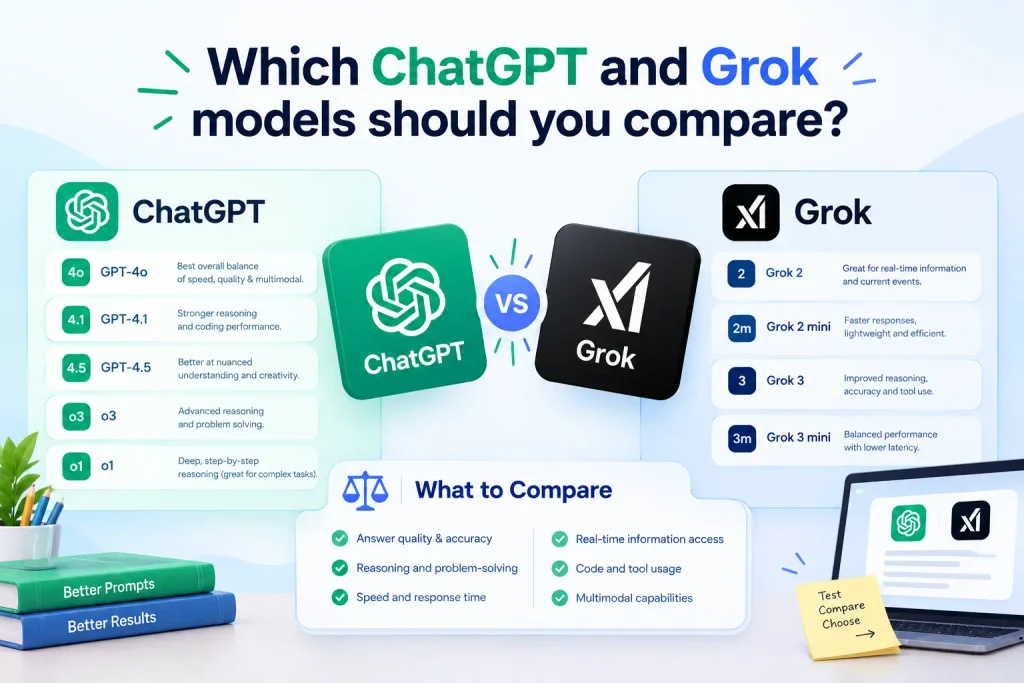
The following models are relevant to this comparison. They are not all available in every ordinary chat window.
| Model | Main role | Important access detail |
|---|---|---|
| GPT-6 Astra | Demanding reasoning and complex work | Access depends on the product, plan, and workspace settings |
| GPT-6.1 Sol | Complex coding and work at a lower API price than Astra | Documented in Work, Codex, and the API; not ordinary Chat |
| GPT-6 Luna | Efficient summaries, extraction, and smaller coding tasks | Documented in Work, Codex, and the API; not ordinary Chat |
| GPT-6 Sol | Earlier balanced GPT-6 option | Still documented, with GPT-6.1 Sol rolling out separately |
| Grok 4.7 | Latest released Grok flagship for coding and knowledge work | Confirmed in Grok Build, Cursor, the API, and partner environments |
| Grok 4.6 | Previous Grok flagship | Still advertised on the consumer pricing page |
| Grok 4.3 | Earlier API option | Relevant for pricing and its larger context window than Grok 4.7 |
OpenAI’s documentation distinguishes Work and Codex model access from ordinary Chat. GPT-5.6 Sol, Terra, and Luna also remain available during the rollout.
Grok requires similar care. Its Grok 4.7 announcement confirms Build and API access, while consumer pricing still advertises Grok 4.6.
When comparing results, record the model actually selected. The application’s brand name alone does not tell you which model produced an answer.
Which is smarter: Grok or ChatGPT?
Among the models examined here, OpenAI leads the current Artificial Analysis Intelligence Index.
That conclusion applies to the evaluated models and reasoning settings.
| Model and reasoning setting | Intelligence Index v4.3.2 score |
|---|---|
| GPT-6 Astra, Max | 53 |
| GPT-6.1 Sol, Max | 52 |
| Grok 4.7, xHigh | 46 |
Artificial Analysis reported these scores in the evaluations checked on October 2, 2026.
However, individual tests show a more balanced picture. Grok 4.7 leads Astra on two professional-work evaluations:
| Evaluation | Grok 4.7 | GPT-6 Astra |
|---|---|---|
| AA-Briefcase v1.1 | 1,657 | 1,569 |
| GDPval-AA v2.1 | 1,695 | 1,542 |
These two evaluations use relative Elo ratings. Their numbers are not success percentages.
The broader Intelligence Index combines multiple evaluations. It is not an IQ score or the percentage of everyday questions answered correctly.
It also primarily evaluates English-language text tasks. Image generation, voice quality, and multilingual performance require separate comparisons.
Astra has the stronger broad benchmark case. Grok remains competitive for specific professional tasks. Neither result proves that one platform will produce the best answer to every prompt.
Which AI Model Is faster?
In the evaluated configurations, Grok 4.7 xHigh generated approximately 75 tokens per second. Astra Max generated approximately 52.
These figures measure API output speed. They do not measure the complete time needed to finish a useful job.
Reasoning, searches, tool calls, and revisions can change the result. For your own work, measure the time until you receive an accurate, usable output.
Which is better for writing and content creation?
Both assistants can brainstorm, outline, explain, and revise. The better choice is the one that follows your brief accurately and needs less correction.
ChatGPT Work supports documents, spreadsheets, presentations, and PDFs. Grok also supports uploads and connected tools for working with existing material.
Give both assistants the same audience, sources, tone, and formatting requirements. Then check whether they preserve facts and improve the draft after feedback.
For business publishing, a clear SEO content strategy helps connect AI-assisted writing with search intent and useful information. Choosing a capable model does not replace original evidence, editing, or an understanding of your audience.
For example, an article can sound polished while answering the wrong question. Your evaluation should reward relevance and accuracy more than confident language.
Which is better for research and current information?
Grok is a natural starting point when your research focuses on public conversations on X. Its documentation confirms access to public X posts and live web search.
ChatGPT also searches the web and provides citations. Its Work experience supports deeper research across sources, subject to availability.
The difference is especially relevant for tasks such as:
- Following public reactions to an announcement.
- Finding discussions within a particular industry.
- Comparing claims made by different accounts.
- Identifying questions people are asking about a product.
However, fresh information is not automatically reliable information.
For either assistant, open important sources and check their dates. Ask it to distinguish confirmed facts, reported claims, and its own interpretation.
Whichm LLM is stronger for coding?
For development work, compare Codex and Grok Build using specific models.
The surrounding tools matter. File access, project context, testing, and the ability to respond to errors can change the outcome.
Published results do not support declaring one universal coding winner. In xAI’s Grok 4.7 results, it beats GPT-5.6 Sol on CursorBench 4.0 but trails it on DeepSWE v1.1.
Those results use particular configurations and reasoning settings. They do not provide a complete comparison against GPT-6.1 Sol or Astra.
A useful test should involve a small task from your own project. Check whether the assistant:
- Understands the underlying problem.
- Changes the correct files.
- Preserves existing behavior.
- Runs meaningful checks.
- Explains remaining uncertainty.
For a generated website, evaluate functionality and web performance before treating the project as finished. Quickly generated code can still produce slow pages or a poor user experience.
Images, video, and voice: which AI offers more?
Both ecosystems support media creation, but their specialist models and access routes differ.
OpenAI’s API catalog includes GPT-Image-2.5 Sunburst and Flare, alongside GPT-Live and other audio models. Its built-in ChatGPT image documentation separately names GPT-Image-2.
Grok’s API lineup includes Imagine Image 2.0, Imagine Video 1.5, and Voice ThinkFast 2. Its consumer product also supports image and video creation.
These API names do not establish which model powers every consumer interaction. Check the feature available within your account.
Older video comparisons also need updating. OpenAI’s deprecation notice lists Sora 2 models and the Videos API as removed on September 24, 2026.
That notice concerns API availability. It should not be treated as evidence about every consumer feature.
When comparing creative outputs, use the same brief and evaluate the details that matter:
| Format | What to check |
|---|---|
| Images | Readable text, composition, consistency, and editing control |
| Video | Motion consistency, visual quality, and instruction following |
| Voice | Clarity, responsiveness, interruptions, and language support |
Grok deserves consideration when image and video creation belong in the same workflow. The better creative result still depends on your brief and available tools.
ChatGPT Dots vs Grok Bot
Persistent agents change what users can delegate to an assistant.
ChatGPT Dots can continue tasks between conversations using a cloud computer, tools, and relevant context. They are powered by GPT-6 Astra, with access depending on availability and plan.
Grok Bot also provides persistent cloud computers, connected applications, and routines.
This makes both relevant to ongoing work, such as recurring research or tasks involving several applications.
Before choosing an agent, check whether you can:
- Inspect its progress and finished work.
- Control which applications it accesses.
- Require approval for important actions.
- Understand its usage allowance.
- Recover when a task fails.
Continuous availability does not mean unlimited usage or flawless execution. The useful comparison is how reliably the agent completes your actual work.
Which has more resources?
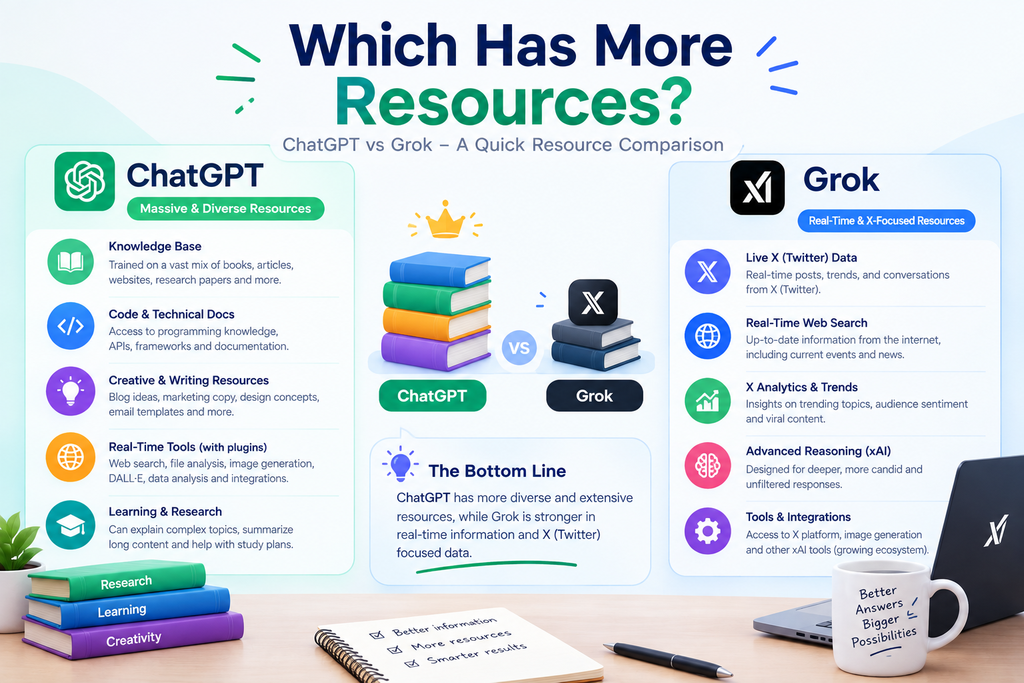
“More resources” can mean a larger context window, more tools, fresher information, or greater computing capacity.
These are separate questions.
Which has the larger context window?
A context window is the amount of information a model can work with in a request. Tokens are small units of text or other encoded content.
Context is different from permanent memory and the amount of information used during training.
| Model | Documented API context window |
|---|---|
| GPT-6 Astra | 1,050,000 tokens |
| GPT-6.1 Sol | 1,050,000 tokens |
| GPT-6 Luna | 1,050,000 tokens |
| Grok 4.7 | 500,000 tokens |
| Grok 4.6 | 500,000 tokens |
| Grok 4.3 | 1,000,000 tokens |
These figures come from OpenAI and xAI’s published API specifications.
The listed GPT-6 models support more API context than Grok 4.7. However, these limits do not establish the allowance of every consumer subscription.
A larger window also does not guarantee that the model will correctly use every detail in a long document.
Which has more useful tools?
Both platforms offer capabilities beyond chat.
OpenAI documents research, file creation, coding, plugins, and agents. Grok documents web and X search, uploads, connectors, Build, and Bot.
Focus on the connections your work requires. Access to the right document store or development environment matters more than a headline integration count.
Which has more training data or computing power?
The sources reviewed do not provide enough comparable information to declare a winner.
Funding totals, data-center capacity, model context, and intelligence measure different things. None should be treated as a direct substitute for the others.
For a purchasing decision, prioritize documented capabilities and relevant results.
Grok vs ChatGPT pricing in 2026
Subscription prices
OpenAI and xAI listed the following US-dollar prices when checked on October 2, 2026.
Local prices, taxes, billing terms, and app-store charges may differ.
| Plan | Listed price |
|---|---|
| ChatGPT Free | $0 |
| ChatGPT Go | $8/month |
| ChatGPT Plus | $20/month |
| ChatGPT Pro | $100, $200, or $500/month options |
| ChatGPT Business | $20/user/month billed annually; $25 billed monthly; minimum two users |
| Grok Free | $0 |
| SuperGrok | $30/month |
| SuperGrok Plus | $100/month |
| Grok Business | $30/user/month |
SuperGrok Heavy is listed, but its current public price could not be verified in the reviewed material.
X Premium+ is a separate subscription. Its web pricing starts at $40/month or $395/year.
Check its current Grok benefits before assuming it matches a standalone SuperGrok subscription.
Usage allowances matter alongside monthly prices. OpenAI’s Work and Codex share usage, while Grok describes a shared weekly pool across several products.
API prices
An API lets developers connect a model to their own software. These charges are separate from ordinary app subscriptions.
The following standard rates apply per million tokens, using uncached input.
| Model | Input | Output |
|---|---|---|
| GPT-6 Astra | $10 | $50 |
| GPT-6.1 Sol | $2 | $10 |
| GPT-6 Luna | $0.10 | $0.50 |
| Grok 4.7 | $2 | $6 |
| Grok 4.6 | $2 | $6 |
| Grok 4.3 | $1.25 | $2.50 |
OpenAI’s listed GPT-6 rates apply through 272,000 input tokens. Above that threshold, the whole request uses higher rates.
All three listed Grok models have higher rates when prompts reach 200,000 tokens. Tools, caching, and processing options can also change the bill.
Grok 4.7 costs less per token than Astra at these base rates. Its input price matches GPT-6.1 Sol, while its output price is lower.
Luna is cheaper than either, but targets a different balance of capability and efficiency.
For businesses, measure the cost of completing an acceptable task. Repeated attempts and manual corrections can outweigh a low token price.
ChatGPT pros and cons
Advantages
- Strong broad intelligence results from Astra and GPT-6.1 Sol.
- Work, Codex, research, and file tools support varied tasks.
- Multiple model costs, including the efficient Luna option.
- ChatGPT Plus costs less than SuperGrok at listed monthly prices.
- The listed GPT-6 models offer large API context windows.
Limitations
- Access differs across Chat, Work, Codex, plans, and rollout stages.
- Astra’s API token prices are high compared with Grok 4.7.
- Higher reasoning effort can increase waiting time and usage.
- Strong benchmark performance does not eliminate factual mistakes.
Grok pros and cons
Advantages
- Direct public-X search supports platform-specific research.
- Competitive coding capabilities and relatively low flagship API prices.
- Leads Astra on the two professional-work evaluations discussed above.
- Image, video, voice, connectors, and agents broaden its uses.
- Standalone web and mobile access makes it useful beyond X.
Limitations
- Grok 4.7 trails Astra and GPT-6.1 Sol on the cited broad intelligence evaluation.
- The newest released model may differ from the model advertised for consumer chat.
- Shared usage and extra charges require attention during heavy workloads.
- Fresh information can still contain unreliable claims.
Privacy and business controls
Consumer accounts, business workspaces, and API services can have different data rules.
OpenAI states that Business, Enterprise, and Edu Work data is not used for training by default. Grok Business also states that business content is not used for model training.
Training use, retention, access controls, and application permissions are separate questions. A no-training policy does not automatically mean that no information is stored.
For confidential work, review the specific plan and your organization’s requirements. For agents, also check which accounts they can access and which actions require approval.
Upcoming models and confirmed changes
The official sources reviewed do not establish a confirmed release date for GPT-7 or Grok 5.
Claims about their launch dates or capabilities should therefore be treated as speculation.
Several concrete changes have been announced:
| Announced change | What it means |
|---|---|
| GPT-5.5 retirement on October 14, 2026 | Scheduled removal from ChatGPT, Work, and Codex; the notice excludes the OpenAI API |
| GPT-6.1 Sol Ultrafast | Described as coming later, without a confirmed date in the reviewed guidance |
| Imagine Image Quality API retirement on November 2, 2026 | Scheduled redirection to Imagine Image 2.0 at low quality |
These changes appear in OpenAI’s model guidance and xAI’s migration documentation.
Current releases suggest continued competition around reliable agents, connected applications, and lower task costs. That is an interpretation of product direction, not a confirmed specification for an unreleased model.
How to choose between Grok and ChatGPT
A small comparison using your own work is more useful than choosing purely from a leaderboard.
Step 1: Choose three realistic tasks
Use tasks you expect to repeat. These might include a sourced explanation, a document revision, and a coding or spreadsheet task.
Step 2: Give both the same instructions
Provide identical files, goals, constraints, and success criteria.
Different instructions can make one assistant appear stronger without providing a fair comparison.
Step 3: Record the model and tools
Note the selected model, reasoning setting, enabled tools, and subscription.
This helps explain the result and makes the comparison easier to repeat.
Step 4: Check the finished output
Evaluate accuracy, instruction following, citations, usefulness, and correction effort.
A confident answer should not receive a high score unless its content is correct.
Step 5: Compare total time and cost
Include time spent reviewing and repairing the result.
Start with ChatGPT if your priority is strong OpenAI reasoning models and Work or Codex workflows. Start with Grok if public-X research, integrated video, or its API pricing fits your main task.
Keep both only when they provide distinct value.
Frequently asked questions
Is Grok smarter than ChatGPT in 2026?
There is no universal winner across every task. Astra and GPT-6.1 Sol lead the broad intelligence evaluation reviewed here.
Grok leads Astra on certain professional-work tests. These results apply to specific model configurations.
Is Grok cheaper than ChatGPT?
ChatGPT Plus costs less than SuperGrok at the listed monthly prices.
For API usage, Grok 4.7 has lower base token rates than Astra. GPT-6 Luna is cheaper than Grok 4.7.
Does Grok have better access to current information?
Grok has a particular advantage for searching public conversations on X. Both services can search the web.
Research quality still depends on source reliability and how accurately the assistant represents its findings.
Is Grok 4.7 available in every Grok chat?
The reviewed sources confirm access through Build, Cursor, the API, and partner environments.
Consumer pricing still advertises Grok 4.6. Check your actual model selector and subscription.
Which is better for students and beginners?
Try both on a subject you understand. Ask for worked steps, examples, and checkable sources.
Choose the assistant that helps you understand and verify the answer with less confusion.
Which should a business choose?
Compare required integrations, data controls, output quality, and cost per completed task.
Use a small, representative project before adopting either platform more widely.