
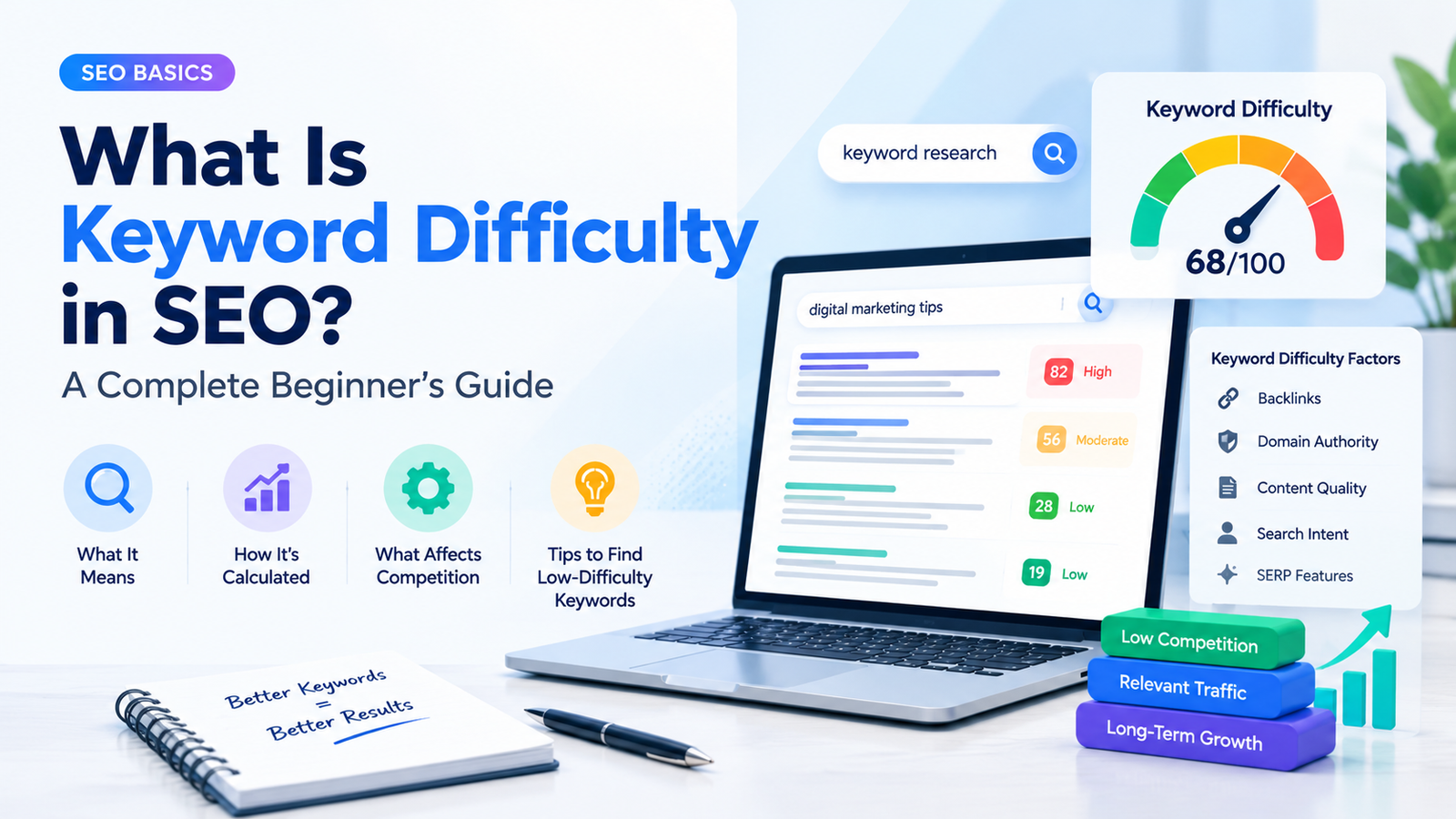
Keyword difficulty in SEO is a metric that estimates how challenging it may be for a website to rank in Google’s organic search results for a particular keyword.
When you search for a keyword, you may find that some search results come from highly authoritative websites with strong backlink profiles, while others come from smaller websites with relatively few backlinks. This difference can help explain why certain keywords are more difficult to rank for than others.
For example, ranking for a broad keyword such as “digital marketing” can be challenging because many established websites compete for it. However, a more specific keyword such as “digital marketing tips for local restaurants” may have less competition.
Understanding keyword difficulty helps SEO professionals choose realistic keywords, plan content, and prioritize opportunities that match a website’s authority and resources.
In this guide, we will explain how keyword difficulty works, what influences it, how SEO tools calculate it, and how you can use it when building a keyword strategy.
What Does Keyword Difficulty Mean?
Keyword difficulty, sometimes called SEO difficulty or keyword competition, estimates the level of competition for a keyword in organic search results.
Most SEO platforms display keyword difficulty as a score, commonly ranging from 0 to 100. A lower score generally indicates less estimated competition, while a higher score suggests that ranking may require stronger content, backlinks, and website authority.
However, keyword difficulty is not a direct Google ranking factor. Google does not publish an official keyword difficulty score. It is a third-party estimation created by SEO tools using their own data and calculations.
This distinction is important because a keyword with a high difficulty score is not automatically impossible to rank for. Similarly, a keyword with a low score does not guarantee that your page will reach the first page of Google.
If you are new to search engine optimization, you can first understand what SEO is and how it works before using keyword difficulty to plan your content strategy.
How Is Keyword Difficulty Calculated?
Different SEO tools use different methods to estimate keyword difficulty. Their calculations may consider several signals associated with the pages already ranking for a keyword.
Some of the most common factors include:
1. Backlink Profiles
Backlinks are links from other websites that point to a particular page. Search engines can use links as signals when discovering and evaluating pages.
If the top-ranking pages have many relevant, high-quality backlinks, competing against them may require a stronger link profile.
However, backlink quantity alone does not determine ranking difficulty. Relevance, quality, context, and the overall strength of competing pages also matter.
2. Website Authority
Some SEO platforms use proprietary authority metrics to estimate the strength of websites and their backlink profiles.
Websites with established reputations and strong link profiles may have an advantage in competitive search results.
Keep in mind that metrics such as Domain Rating, Domain Authority, and Authority Score are third-party measurements. They are not official Google ranking scores.
3. Page-Level Competition
A keyword may be difficult because the individual pages ranking for it are already well optimized and supported by relevant backlinks.
For example, if the top results include detailed guides from established websites, a short page with limited information may struggle to compete.
This is why it is important to examine the actual ranking pages instead of relying only on a keyword difficulty number.
4. Search Intent and Content Quality
Search intent refers to the reason behind a user’s search.
Someone searching for “what is keyword difficulty” probably wants an explanation, while someone searching for “best keyword research tool” may be comparing software.
If your content does not match the intent behind a keyword, it may struggle to perform even when the keyword difficulty score is low.
5. SERP Features and Search Results
Search engine results pages can contain featured snippets, videos, local listings, shopping results, and other special features.
These elements can affect how much visibility traditional organic listings receive.
Understanding what SERP means in SEO can help you examine the search results and identify the type of content Google is displaying for a particular query.
Keyword Difficulty Score: What Do the Numbers Mean?
Many SEO tools use a 0–100 scale to display keyword difficulty. The exact scoring system varies by platform, so the following ranges should be treated as general guidelines rather than universal standards.
| Keyword Difficulty | General Competition | Suggested Approach |
| 0–20 | Very low | Good opportunities to investigate |
| 21–40 | Low to moderate | Suitable for many growing websites |
| 41–60 | Moderate to high | Requires stronger content and SEO |
| 61–80 | High | Usually needs a competitive strategy |
| 81–100 | Very high | Often challenging for newer websites |
A website with limited authority may benefit from targeting relevant keywords with lower estimated difficulty first. An established website with strong content and backlinks may be able to compete for more difficult terms.
Do not treat these ranges as fixed rules. A keyword with a difficulty score of 25 can still be difficult if the search results are dominated by highly relevant, established competitors.
Why Is Keyword Difficulty Important in SEO?
Keyword difficulty helps SEO professionals make more informed decisions before investing time in creating and optimizing content.
Here are some important reasons to consider it during keyword research.
1. Helps Find Realistic Ranking Opportunities
Not every keyword is suitable for every website.
A new website may struggle to compete for broad, highly competitive search terms. By identifying relevant keywords with lower estimated difficulty, you can find opportunities that better match your current resources.
For example, a new marketing agency might find it more practical to target “SEO tips for small accounting firms” before competing for a broad term such as “SEO services.”
2. Improves Keyword Prioritization
Keyword research can produce hundreds or thousands of potential keywords. Keyword difficulty gives you another way to organize these opportunities.
Instead of choosing keywords based only on search volume, you can consider:
- Search volume
- Keyword difficulty
- Search intent
- Business relevance
- Potential traffic value
- Existing website authority
This creates a more balanced approach to keyword selection.
3. Supports Better Content Planning
Keyword difficulty can help you decide which topics to publish first.
For example, a website may start with specific informational keywords, build topical coverage, and gradually target more competitive subjects.
This approach allows you to develop a useful collection of related content instead of publishing unrelated articles simply because they have high search volume.
4. Helps Set Realistic SEO Expectations
Keyword difficulty can help explain why ranking for certain terms may require more time and resources.
A competitive keyword might require detailed content, technical improvements, internal links, and relevant backlinks.
Using difficulty as one part of your evaluation helps create more realistic SEO plans for clients and businesses.
How to Check Keyword Difficulty
You can check keyword difficulty using several popular SEO platforms. Each tool has its own scoring system, so scores may differ for the same keyword.
1. Ahrefs
Ahrefs provides a Keyword Difficulty metric based largely on the backlink profiles of pages ranking in the top 10 search results.
You can enter a keyword into its Keywords Explorer tool to review its difficulty score, search volume, and other keyword data.
Website: https://ahrefs.com/keyword-difficulty
2. Semrush
Semrush provides a Keyword Difficulty percentage through its keyword research tools.
It estimates how challenging it may be to rank for a keyword using several competitive signals. You can also review search volume, intent, keyword variations, and related opportunities.
Website: https://www.semrush.com/
3. Moz Keyword Explorer
Moz provides a Keyword Difficulty score to help users evaluate competition for organic search rankings.
Its keyword research features can also help identify related keywords and compare potential opportunities.
Website: https://moz.com/explorer
4. Ubersuggest
Ubersuggest provides keyword ideas and SEO difficulty estimates alongside search volume and other keyword metrics.
It can be useful for exploring keyword opportunities, particularly when building an initial keyword list.
Website: https://neilpatel.com/ubersuggest/
5. Google Keyword Planner
Google Keyword Planner provides competition data primarily for paid advertising.
This is an important difference: its advertising competition metric is not the same as organic SEO keyword difficulty.
You can still use Keyword Planner to explore keyword ideas and search demand, but do not treat its paid competition score as a direct measurement of organic ranking difficulty.
Website: https://ads.google.com/home/tools/keyword-planner/
Keyword Difficulty vs. Keyword Search Volume
Keyword difficulty and search volume measure two different things.
Search volume estimates how often people search for a keyword within a given period, while keyword difficulty estimates how challenging it may be to rank organically for that keyword.
For example:
| Keyword | Search Volume | Difficulty | General Opportunity |
| SEO | High | High | Highly competitive |
| Local SEO tips for dentists | Lower | Moderate | More specific audience |
| How to improve Google rankings for a small business | Lower | Low to moderate | Specific informational intent |
These are illustrative examples, not live keyword-tool measurements.
A keyword with high search volume is not always the best choice. If the competition is too strong or the search intent does not match your website, ranking for it may not deliver meaningful results.
Likewise, a low-volume keyword can attract highly relevant visitors who are more likely to become customers.
How to Find Low-Difficulty Keywords
Finding low-difficulty keywords requires more than sorting a keyword list from lowest to highest score. You should also consider relevance, search intent, and the quality of existing search results.
Here is a practical process you can follow.
Step 1: Start With Your Main Topic
Choose a broad subject related to your website, service, or audience.
For example, if you run an SEO agency, your starting topics might include:
- Local SEO
- Technical SEO
- On-page SEO
- Keyword research
- Link building
- SEO reporting
These topics can help you generate more specific keyword ideas.
Step 2: Find Long-Tail Keyword Variations
Long-tail keywords are more specific search phrases that usually target a narrower topic or audience.
Examples include:
- How to find keywords for a new website
- Local SEO checklist for small businesses
- How to improve website page titles
- Keyword research tips for beginners
Long-tail keywords often have lower search volume, but they can offer more focused search intent and less competition.
Step 3: Check Keyword Difficulty
Enter your keyword ideas into an SEO platform such as Ahrefs, Semrush, or Moz.
Record the difficulty score along with search volume and other useful metrics.
Do not select keywords based on difficulty alone. A low-difficulty keyword is not valuable if it has no meaningful connection to your website or audience.
Step 4: Analyze the Top 10 Search Results
Search for your target keyword in Google and examine the pages currently ranking.
Look for:
- The type of websites ranking.
- Whether the results match your search intent.
- How detailed and useful the content is.
- Whether the pages have relevant backlinks.
- Whether the results are outdated or incomplete.
- Whether smaller or newer websites are ranking.
This manual review can reveal opportunities that a numerical difficulty score might not show.
Step 5: Choose Keywords Based on Business Relevance
After reviewing keyword data and search results, prioritize the terms that offer the best balance of relevance, ranking potential, and business value.
A keyword does not need thousands of searches to be useful. A specific phrase that attracts the right audience may be more valuable than a broad keyword that brings unrelated visitors.
Common Keyword Difficulty Mistakes to Avoid
Even experienced website owners can make mistakes when evaluating keyword difficulty. Avoid these common problems when planning your SEO strategy.
1. Treating Keyword Difficulty as a Google Ranking Factor
Keyword difficulty scores are created by third-party SEO platforms. Google does not assign websites an official keyword difficulty score.
Use these metrics as research indicators, not as direct explanations of Google’s ranking decisions.
2. Choosing Keywords Only by Low Difficulty
A keyword may have a very low difficulty score but little relevance to your business.
Always consider whether the keyword attracts the right audience and supports your website’s goals.
3. Ignoring Search Intent
Creating a blog post when searchers expect a product page, or publishing a service page when they want an informational guide, can lead to poor results.
Review the existing SERP before deciding what type of content to create.
4. Ignoring Backlinks and Content Quality
A low difficulty score does not mean you can publish a weak article and expect it to rank.
Your content should answer the user’s question clearly, provide useful information, and compete with the quality of existing results.
5. Relying on One SEO Tool
Different platforms use different data sources and calculation methods. Therefore, the same keyword can receive different difficulty scores.
If possible, compare multiple tools and perform a manual SERP review before making an important decision.
Final Thoughts
Keyword difficulty is an important part of keyword research because it helps SEO professionals estimate how competitive a search term may be before creating content around it. However, it should never be the only metric used to choose target keywords.
A successful keyword strategy considers search volume, search intent, content quality, backlink competition, and the website’s current authority. Rather than targeting only high-volume keywords, focus on relevant opportunities that your website has a realistic chance of competing for.
Start with specific keywords, study the pages already ranking in Google, and create genuinely useful content that satisfies search intent. As your website develops stronger content and earns relevant backlinks, you can gradually target more competitive keywords.
At Digital Soules, we believe effective SEO starts with informed research and a strategy built around long-term organic growth. Understanding keyword difficulty can help you make smarter content decisions and build a stronger foundation for search visibility.
FAQs
1. What is a good keyword difficulty score?
A score between 0 and 30 is often considered relatively low competition in many SEO tools. However, what counts as a good score depends on your website, niche, competitors, and the tool’s calculation method.
2. Is keyword difficulty a Google ranking factor?
No. Keyword difficulty is a third-party SEO metric. Google does not publish an official keyword difficulty score or use the scores provided by SEO tools as direct ranking factors.
3. Is low keyword difficulty always better?
Not necessarily. A low-difficulty keyword may have little search demand or business relevance. You should evaluate search intent, potential traffic value, and relevance before selecting it.
4. What is the difference between keyword difficulty and keyword competition?
Keyword difficulty usually refers to estimated organic search competition. Keyword competition can have a broader meaning and may also refer to paid advertising competition, depending on the tool.
5. Can a new website rank for high-difficulty keywords?
It is possible, but it may require significant effort. A new website can improve its chances by publishing useful content, targeting specific search queries, building relevant backlinks, and developing topical coverage over time.
6. Which tool is best for checking keyword difficulty?
Ahrefs, Semrush, and Moz are popular options. Each uses its own methodology, so compare their estimates with an actual review of Google’s search results rather than relying on one score.