
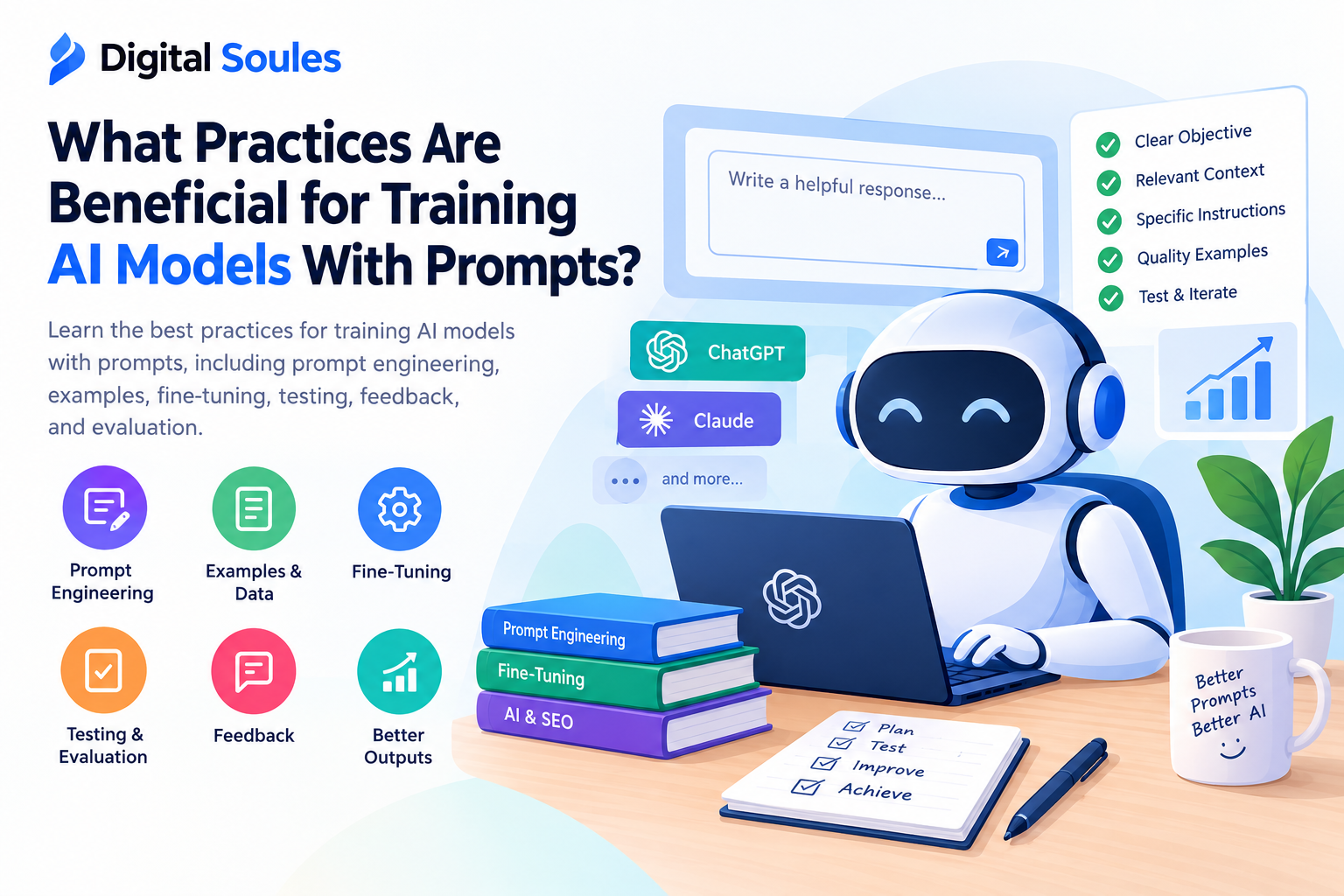
Artificial intelligence is changing how businesses create content, analyze data, automate tasks, and communicate with customers. However, the quality of an AI-generated response depends on more than the model itself. The instructions, examples, context, and feedback provided to an AI system can significantly influence its output.
This is why learning how to write effective prompts has become an important skill for marketers, content creators, developers, researchers, and business owners.
But there is an important distinction to understand: writing better prompts is not the same as training an AI model. Prompts guide a model’s behavior during a particular task, while training and fine-tuning involve adjusting model parameters using data and optimization methods. Both approaches can help improve AI performance, but they solve different problems.
Whether you want to improve ChatGPT responses, develop a consistent content workflow with Claude, evaluate an AI application, or prepare data for model fine-tuning, following the right practices can make your results more reliable.
In this guide, we will explore the most beneficial practices for working with prompts, preparing training examples, evaluating model outputs, avoiding common mistakes, and building effective AI workflows.
What Does Training AI Models With Prompts Mean?
The phrase “training AI models with prompts” is often used broadly to describe teaching an AI system how to respond to particular instructions. In practice, it can refer to several different activities.
Understanding these differences helps you choose the correct approach for your project.
1. Prompt Engineering
Prompt engineering involves designing clear instructions that help an existing AI model complete a task accurately.
For example, instead of asking an AI assistant to write a blog post about SEO, you could specify the target audience, search intent, required headings, tone, length, and source requirements.
The model uses these instructions as context when generating a response. The prompt itself does not permanently change the model’s learned parameters.
2. In-Context Learning
In-context learning means providing examples or demonstrations inside a prompt so the model can follow a particular pattern.
For example, a business might provide three examples of approved product descriptions and ask an AI model to write new descriptions using the same structure and tone.
The model uses the supplied examples to guide its response without necessarily undergoing additional training.
3. Fine-Tuning
Fine-tuning involves continuing the training process on a pretrained model using a task-specific dataset. Depending on the method, this process adjusts some or all of the model’s parameters.
A company might fine-tune a model to classify customer support messages, follow a specialized response format, or perform a recurring task using consistent examples.
Unlike ordinary prompting, fine-tuning requires a suitable training pipeline and evaluation process.
4. Reinforcement Learning and Feedback-Based Optimization
Some AI development workflows use feedback to improve model behavior through additional optimization. Feedback may come from human preferences, automated evaluations, or other signals, depending on the training method.
This is different from simply telling a chatbot that an answer was incorrect. A user correction during an ordinary conversation does not automatically retrain the underlying model.
For most everyday business tasks, prompt engineering is a practical starting point. Fine-tuning and other training methods become relevant when you need systematic improvements that cannot be achieved reliably through instructions and examples alone.
Why Are Good Prompting Practices Important?
A well-designed prompt gives an AI model a clearer understanding of the task, the expected result, and the boundaries it should follow.
Poorly designed prompts can produce generic answers, unsupported claims, inconsistent formatting, and irrelevant recommendations. These problems become particularly important when AI is used for business decisions, content production, customer service, or data analysis.
Here are several benefits of effective prompting.
1. More Relevant Responses
Clear prompts explain what the user actually needs rather than leaving the model to guess.
For example, “Write about digital marketing” is a broad request. A prompt that specifies a small-business audience, a local SEO objective, and practical implementation steps provides a more useful direction.
2. Better Consistency
Reusable prompts help teams produce outputs that follow similar guidelines across multiple tasks.
This is useful for product descriptions, email responses, content briefs, social media captions, and customer support workflows.
3. Reduced Unnecessary Revisions
When instructions specify the expected format, tone, length, and success criteria, the first response is more likely to match the intended result.
Human review is still necessary, but clear requirements can reduce avoidable editing.
4. Improved Task Performance
A prompt can help a model focus on relevant evidence, follow a logical process, and produce an answer that addresses the actual question.
However, a good prompt cannot guarantee factual accuracy or compensate for information the model does not have.
5. Easier Evaluation
When prompts contain explicit success criteria, teams can compare outputs more objectively.
Instead of asking whether a response “looks good,” reviewers can assess factual accuracy, relevance, completeness, formatting, and compliance with instructions.
10 Best Practices for Improving AI Model Outputs With Prompts
The following practices can help you design more effective prompts for existing AI models and prepare better examples for more advanced training workflows.
1. Define a Clear Objective Before Writing the Prompt
The first step is to identify exactly what you want the AI model to accomplish.
A vague objective creates room for interpretation. A specific objective makes it easier to provide the right context and evaluate the result.
For example, consider these two prompts:
Weak prompt:
“Write an article about AI tools.”
Improved prompt:
“Write a practical guide for beginner content creators comparing AI video editing tools. Explain their main features, limitations, suitable use cases, and pricing considerations. Use clear English and include a comparison table and frequently asked questions.”
The improved version defines the subject, audience, purpose, and expected structure.
Before writing a prompt, ask yourself:
- What task should the AI complete?
- Who will use the result?
- What information should the response include?
- What format should the final output follow?
- How will you determine whether the response is successful?
These questions help turn an unclear request into a measurable task.
2. Provide Relevant Context and Background Information
Context helps an AI model understand the environment in which it is working.
Depending on the task, useful context may include audience details, product specifications, business goals, previous examples, source documents, brand guidelines, or technical requirements.
For example, a marketing agency asking an AI assistant to create content for a software company should provide the product’s actual capabilities, target customers, differentiators, and preferred tone.
Without this information, the model may produce generic copy or make assumptions about the business.
However, adding more information is not always better. Irrelevant background can distract from the task or make important requirements harder to identify.
Best practice: Include information that materially affects the answer, organize it clearly, and distinguish verified facts from assumptions.
For document-heavy tasks, you can also ask the model to identify missing information before producing its final response.
3. Use Clear Instructions and Specific Constraints
A good prompt explains what the model should do and, when necessary, what it should avoid.
Constraints can include word limits, required sections, supported data sources, formatting rules, tone, language, and prohibited assumptions.
For example:
“Summarize the supplied report in 300–400 words. Include the three most important findings, supporting evidence, and practical recommendations. Do not invent statistics or introduce claims that are not supported by the report. Clearly identify any missing information.”
This instruction defines the task and establishes boundaries.
For more complex prompts, organize requirements into separate sections:
- Task: What needs to be completed?
- Context: What should the model know?
- Requirements: What must the output include?
- Restrictions: What must it avoid?
- Output format: How should the answer be presented?
- Evaluation criteria: What makes the answer acceptable?
This structure is particularly useful when building reusable prompts for teams.
4. Include High-Quality Examples
Examples are among the most useful ways to demonstrate the output you expect from an AI model.
This approach is commonly called few-shot prompting when a prompt contains a small number of examples.
For instance, if you want an AI assistant to classify support messages, you can provide sample messages and their correct categories before asking it to classify a new message.
Similarly, content teams can supply examples of approved product descriptions, email replies, or editorial summaries.
The quality of these examples matters. If the examples are inconsistent, outdated, inaccurate, or biased, the model may reproduce those weaknesses.
A strong example should demonstrate the desired behavior clearly and match the task you want the model to perform.
When selecting examples:
- Use representative cases rather than only easy examples.
- Include different situations the model may encounter.
- Show the correct format and level of detail.
- Avoid conflicting examples unless the distinction is explained.
- Include difficult or borderline cases when they matter.
For actual model fine-tuning, examples must also be converted into the format required by the selected training system.
5. Break Complex Tasks Into Smaller Steps
Some tasks require research, analysis, decision-making, and final content generation. Asking an AI model to complete everything in one vague instruction can make errors harder to detect.
A better approach is to divide the workflow into manageable stages.
For example, an SEO content workflow might follow this sequence:
- Identify the target audience and search intent.
- Review the available source material.
- Identify relevant topics and information gaps.
- Develop an article outline.
- Draft the article using verified information.
- Review factual accuracy, structure, and readability.
- Prepare the final content for publication.
Each stage has a clear purpose and produces an output that can be reviewed before proceeding.
For tasks that depend on external facts, provide reliable sources or use an appropriate research tool rather than assuming the model already has the necessary information.
Breaking a task into stages is not always necessary for simple requests. Use it when the task is complex enough that intermediate checks improve reliability.
6. Use Structured Output Formats
Sometimes the answer is useful but difficult to apply because its format is inconsistent.
Structured output instructions can solve this problem by specifying how information should be organized.
For example, a business analyzing customer feedback may need a table with these fields:
- Customer issue
- Sentiment
- Supporting evidence
- Priority
- Recommended action
A prompt can require the model to return these fields in a consistent table or a machine-readable format such as JSON.
For JSON or other structured outputs, validate the result against the required schema rather than assuming the model will always follow the format correctly.
Structured outputs are especially useful for:
- Data extraction
- Product categorization
- Lead qualification
- Customer feedback analysis
- Automated reporting
- Content inventories
- Workflow integrations
When the output will be processed by software, schema validation and error handling should be part of the workflow.
7. Test Prompts With Different Examples
A prompt that works well on one example may fail on another.
For instance, a customer support prompt might correctly classify straightforward complaints but struggle with messages containing multiple issues, sarcasm, missing information, or unusual terminology.
Testing prompts against varied inputs helps identify these weaknesses before the workflow is used at scale.
Create a small test set containing typical cases, edge cases, and examples where the correct answer is known. Record the outputs and evaluate them against predefined criteria.
You can compare different prompt versions to determine whether a change actually improves performance.
For a fair comparison:
- Use the same test examples.
- Keep evaluation criteria consistent.
- Record the model and relevant settings.
- Check for both improvements and regressions.
- Test again after major prompt or model changes.
For more rigorous evaluation, keep a separate set of examples that was not used to design or refine the prompt. This helps reveal whether the prompt works beyond the examples that inspired it.
8. Use Feedback to Improve the Prompt Systematically
Feedback is most useful when it identifies what went wrong and how the response should change.
Instead of saying, “This answer is bad,” a reviewer might explain that the response contains unsupported claims, misses two required fields, or fails to follow the requested tone.
These observations can be converted into more precise instructions, additional examples, or stronger validation rules.
For example:
“Every recommendation must be linked to an observed issue in the supplied data. If the evidence is insufficient, state that the issue cannot be confirmed rather than guessing.”
This rule addresses a specific failure mode.
However, keep a record of prompt versions and test results. A change that fixes one problem may introduce another.
Also distinguish between two types of feedback:
- Prompt improvement: Revising instructions, examples, or validation rules for an existing model.
- Model training feedback: Using suitable feedback data in a training or optimization pipeline that actually updates the model.
This distinction prevents teams from assuming that correcting an answer in a chat automatically improves the underlying model for future users.
9. Prevent Hallucinations and Unsupported Claims
AI models can generate plausible-sounding information that is inaccurate or unsupported. Better prompts can reduce some of these risks, but they cannot eliminate them completely.
For research, content writing, and business analysis, instruct the model to distinguish between verified information, reasonable interpretations, and unknown details.
For example:
“Use the supplied sources to answer the question. Support factual claims with relevant evidence. If the sources do not establish an answer, explain what is missing. Do not invent statistics, citations, URLs, or quotations.”
You should also verify important claims against the original source material.
For tasks involving current information, the model may need access to up-to-date sources. For calculations, software workflows, or data analysis, independent checks may be necessary.
For higher-risk applications, combine prompting with retrieval systems, source validation, automated tests, and human review as appropriate.
10. Evaluate Results Against Measurable Criteria
A prompt should not be considered successful simply because it produces a polished response.
Define what good performance means for your particular task.
For an article-writing workflow, useful criteria might include factual accuracy, search intent alignment, readability, completeness, originality, and adherence to the brief.
For a classification workflow, relevant measures might include precision, recall, and performance across different categories.
For structured data extraction, you could measure the percentage of correctly extracted fields and the frequency of invalid outputs.
Use criteria that match the real objective rather than relying on a single overall quality score.
A useful evaluation process includes:
- Defining success criteria before testing.
- Creating representative test examples.
- Comparing the model’s output with expected results.
- Recording errors and recurring failure patterns.
- Revising the prompt or workflow.
- Repeating the tests to check whether performance improved.
For model training, evaluation should also include an appropriate held-out dataset so that improvements are not judged solely on examples used during development.
How to Create an Effective AI Prompt: A Practical Framework
You can use the following framework to create prompts for many business, content, research, and productivity tasks.
The Six-Part Prompt Framework
1. Role or perspective
Explain the relevant expertise or perspective the model should apply.
Example: “Act as an experienced technical SEO consultant.”
A role can help establish the desired perspective, but it does not prove that the model possesses real-world credentials.
2. Task
Describe the exact job the model must complete.
Example: “Review the supplied page content for on-page SEO issues.”
3. Context
Provide the audience, objective, source material, and other relevant background.
Example: “The page targets small business owners who want to improve their local search visibility.”
4. Requirements
List the checks, questions, or components the response must cover.
Example: “Review the title tag, meta description, heading structure, internal links, search intent, and content gaps.”
5. Constraints
State the limitations and quality requirements.
Example: “Do not invent ranking data. Separate confirmed problems from recommendations that require additional evidence.”
6. Output format
Specify the structure of the final response.
Example: “Return a table with the issue, evidence, priority, and recommended fix.”
Example: A Reusable Prompt for an SEO Audit
The following prompt demonstrates how these principles can work together.
Act as an SEO consultant reviewing an existing website page.
Task: Conduct an on-page SEO audit using the page content and supporting data I provide.
Context: The target audience is small business owners. The primary keyword and intended search intent will be supplied separately.
Requirements: Review the title tag, meta description, H1–H3 structure, content relevance, internal linking opportunities, missing information, and readability.
Evidence rules: Distinguish confirmed issues from assumptions. Do not claim that a page has indexing, backlink, traffic, or ranking problems unless the relevant evidence is provided.
Output: Create a table containing the issue, supporting evidence, priority, recommended fix, and any additional data required.
Final check: Identify the three most important actions and explain why they should be prioritized.
This example illustrates how a clear prompt can produce a more actionable output than a general request to “audit my website.”
For additional guidance on using Claude in SEO workflows, read Digital Soules’ guide to GitHub SEO Skills for Claude.
How to Improve AI Prompts for SEO and Content Marketing
SEO and content marketing involve several tasks where clear prompts can improve efficiency. However, AI-generated content still requires original value, source verification, and editorial judgment.
1. Use Prompts for Search Intent Analysis
Provide a target query, relevant search results or research data, and information about the intended audience.
Ask the model to identify the likely user need, related questions, and the information a useful page should cover.
Do not assume the model has live access to search results or keyword metrics unless the relevant tool or data is available.
2. Develop Better Content Briefs
A content brief should explain the article’s objective, audience, key questions, scope, source requirements, and expected structure.
You can ask an AI assistant to organize research into a brief, but verify the information before publishing.
3. Identify Internal Linking Opportunities
Provide a list of existing URLs and short descriptions of their content. Ask the model to identify relevant links, suggested anchor text, and suitable placements within the new article.
The goal should be to help readers discover genuinely useful related content, not to insert links merely to increase the number of internal links.
For example, a new article about AI prompting could naturally reference a related guide comparing Claude and ChatGPT when explaining how different AI assistants can support distinct workflows.
4. Improve Content Quality Instead of Producing More Text
Prompt the model to identify missing explanations, unsupported statements, repetitive sections, and questions the article has not answered.
This is generally more useful than simply asking it to make an article longer.
5. Support AI Search Visibility Research
AI tools can help organize research about how brands appear in AI-generated answers. However, visibility claims should be based on actual observations and appropriately defined measurements.
For broader context, see Digital Soules’ article on AI SEO services.
A prompt can help summarize visibility reports, identify patterns, and propose follow-up research. It cannot replace the underlying evidence.
Prompt Engineering vs. Fine-Tuning: Which Approach Should You Choose?
Prompt engineering and fine-tuning are complementary techniques, but they serve different needs.
| Factor | Prompt engineering | Fine-tuning |
| Main purpose | Guide an existing model through instructions and examples | Adapt a model through additional training |
| Model parameters | Usually unchanged | Some or all parameters may be updated, depending on the method |
| Training dataset | Not necessarily required | A suitable training dataset is required |
| Initial setup | Often straightforward | Requires a compatible training workflow |
| Best starting point | New or changing tasks | Repeated tasks where measured adaptation is justified |
| Iteration | Revise prompts and examples | Prepare data, train, evaluate, and iterate |
| Main risks | Ambiguity, missing context, inconsistent outputs | Poor training data, overfitting, evaluation errors, and additional costs |
For many businesses, prompt engineering is the simplest starting point because it is easy to test and revise.
Fine-tuning may become worthwhile when a recurring task has clear requirements, sufficient high-quality examples, and measurable shortcomings that prompting alone does not resolve.
The correct decision should be based on evaluation results, not the assumption that a trained model is automatically better than a well-prompted one.
Common Mistakes to Avoid When Working With AI Prompts
Even a detailed prompt can fail when its instructions or supporting information are poorly designed.
Giving Vague Instructions
A prompt such as “Make this better” does not explain what needs improvement.
Instead, specify whether you want better readability, stronger evidence, shorter sentences, clearer structure, or more relevant recommendations.
Adding Too Many Unrelated Instructions
Combining multiple unrelated tasks in one prompt can make it harder to evaluate the result.
Keep the objective focused and separate tasks when they require different inputs or evaluation criteria.
Using Low-Quality Examples
Incorrect or inconsistent examples can teach the wrong pattern through demonstrations or training data.
Review examples before using them, and ensure they represent the behavior you actually want.
Treating Every AI Answer as Correct
Confident language does not establish that a claim is true.
Verify important facts, calculations, citations, and recommendations against reliable evidence.
Ignoring Privacy and Confidentiality
Do not include sensitive customer information, passwords, confidential business data, or personal information in prompts unless the tool and workflow are approved for that use.
For training datasets, apply appropriate data minimization, access controls, consent and legal requirements, and data-handling policies.
Changing Prompts Without Measuring the Results
A rewritten prompt may sound better but perform worse on real examples.
Keep test cases and compare results before adopting a change across a production workflow.
Expecting Prompts to Permanently Train a Model
A prompt usually influences the current task or conversation. It does not automatically update the model’s underlying parameters.
If persistent behavioral adaptation is required, investigate the model’s supported features, system instructions, retrieval options, memory mechanisms, or fine-tuning capabilities.
How to Measure Whether Your Prompt Is Working
Effective prompt improvement requires a repeatable evaluation process.
Start by identifying the errors that matter most for your task. Then create a test set that reflects realistic use.
For example, a customer support assistant may be evaluated on correct classification, policy compliance, tone, and escalation decisions. An SEO assistant may be assessed on evidence-based recommendations, relevance, completeness, and the accuracy of its technical claims.
You can use a simple scorecard:
| Evaluation criterion | What to check |
| Accuracy | Are factual statements supported by evidence? |
| Relevance | Does the response answer the actual question? |
| Completeness | Are all required elements included? |
| Consistency | Does the model follow the same rules across similar cases? |
| Format compliance | Does the output follow the requested structure? |
| Safety | Does the response respect applicable privacy and safety requirements? |
| Efficiency | Does the workflow reduce unnecessary editing or processing? |
Not every criterion needs equal weight. For a high-stakes classification task, correctness and safety may matter more than writing style.
Record the results for each prompt version. This makes it easier to determine whether a change improved the overall workflow or simply shifted the errors elsewhere.
Frequently Asked Questions
What are the best practices for training AI models with prompts?
The most useful practices include defining a clear objective, providing relevant context, using precise instructions, including high-quality examples, testing across different inputs, gathering structured feedback, and evaluating results against measurable criteria.
If you mean actual model training, you also need a suitable dataset, a compatible training process, and separate evaluation data.
Does prompt engineering train an AI model?
No, not in the usual technical sense. Prompt engineering changes the instructions and context supplied to an existing model. Fine-tuning and other training methods involve an optimization process that can change the model’s learned parameters.
How many examples should a prompt contain?
There is no universal number. Simple tasks may work well with zero examples, while more complex tasks may benefit from several carefully selected examples. Test different quantities and measure the results.
Can better prompts eliminate AI hallucinations?
No. Clear instructions, source material, retrieval systems, and validation can reduce certain errors, but they cannot guarantee that every response will be correct.
Is prompt engineering better than fine-tuning?
Neither approach is universally better. Prompt engineering is generally easier to test and update, while fine-tuning can help adapt a model to recurring tasks when the data and evaluation results justify the additional work.
Can prompts improve SEO content generated by AI?
Yes. Prompts can help define search intent, target readers, article structure, source requirements, and editorial standards. They do not guarantee rankings. Content should still be accurate, useful, original, and reviewed before publication.
Do ChatGPT and Claude respond to prompts in the same way?
No. Different models may interpret instructions differently and have different capabilities, limitations, and tool access. Test prompts with the specific model and workflow you intend to use.
For a detailed comparison, explore Claude vs. ChatGPT: Which Is Best in 2026?.
Final Thoughts
Effective prompting is an important skill for anyone who wants to use AI more reliably. Clear objectives, relevant context, specific constraints, representative examples, structured outputs, and systematic evaluation can all improve the usefulness of AI-generated responses.
However, successful AI development requires more than writing a clever instruction. The right approach depends on the problem: prompt engineering may be sufficient for everyday tasks, while specialized applications may require retrieval systems, automated validation, fine-tuning, or additional model training.
Start with a clearly defined task, test your prompt against realistic examples, and use evidence to determine whether it works. Improve the instructions when necessary, and invest in model training only when there is a clear reason to do so.
For more practical guides on SEO, AI tools, and digital marketing strategies, explore Digital Soules and discover ways to use AI more effectively in your digital workflow.