SEO stands for Search Engine Optimization. It is the process of improving a website, its content, technical structure, and online authority so that search engines can better understand its pages and people can find useful information when they search.
In simple words, SEO helps the right people discover the right website through search engines.
When someone searches for a service, product, question, business, or solution, search engines have to decide which pages are most useful for that search. SEO helps your website make its purpose, relevance, quality, and relationships easier to understand.
SEO is not just about adding keywords to a page.
A complete SEO strategy can involve:
- Keyword research
- Search intent analysis
- Content creation
- On-page optimization
- Technical SEO
- Internal linking
- Link building
- Local SEO
- Website architecture
- Structured data
- Image optimization
- User experience
- Search performance measurement
- AI search and answer-engine optimization
This guide explains how SEO works, the major areas of SEO, how to create an SEO strategy, and where to learn more about each part.
What Does SEO Mean?
SEO means Search Engine Optimization.
Search Engine Optimization is the practice of improving web pages and websites so they can be discovered, understood, crawled, indexed, and appropriately surfaced for relevant searches.
For example, imagine you own a company that provides roofing services.
A potential customer may search:
- roofing company near me
- roof repair services
- emergency roof repair
- how much does roof repair cost?
- commercial roofing company
If your website has useful pages that clearly answer these needs, your business has an opportunity to appear when those searches happen.
SEO connects search demand with useful website content.
It is important to understand that SEO does not mean simply trying to manipulate search rankings. Good SEO starts with understanding what people need and then creating a website that provides a clear, accessible, trustworthy answer.
How Does SEO Work?

Search engines generally need to perform several important tasks before a page can appear for a search.
A simplified SEO process looks like this:
Crawling → Processing → Indexing → Retrieval → Ranking → Search Result
1. Crawling
Search-engine systems discover URLs and access their content.
Links, sitemaps, previously known URLs, and other discovery mechanisms can help search engines find pages.
If important pages cannot be crawled effectively, they may have difficulty entering the search engine’s index.
2. Processing
Search engines analyze the page and its resources.
They can examine elements such as:
- Text
- Headings
- Links
- Images
- Structured data
- Page relationships
- Canonical signals
- Technical accessibility
- Other content and page signals
3. Indexing
A search engine may store information about a page in its index.
Indexing does not mean a page will automatically rank highly.
A page can be indexed and still receive little or no organic traffic.
4. Retrieval
When someone performs a search, the search engine identifies pages that may be relevant to the query.
5. Ranking
Search systems then determine how results should be presented for that particular search.
The exact systems used by search engines are complex and continuously changing.
This is why SEO should focus on creating useful, accessible, relevant pages rather than chasing a single ranking trick.
6. Search Results
The final result can include traditional organic listings as well as other search features.
Depending on the query, users may encounter:
- Organic results
- Local results
- Featured content
- Images
- Videos
- Shopping results
- News
- AI-generated search experiences
- Other specialized search features
Why Is SEO Important?
SEO matters because search is one way people discover information, businesses, products, services, and solutions.
A website may have excellent products or services, but if search engines and users cannot understand its pages, the website may miss relevant opportunities.
A well-planned SEO program can help a business:
Increase relevant organic visibility
SEO can help pages become more discoverable for searches related to the business.
Reach people with existing demand
Someone searching for a specific problem may already be looking for information, a product, or a service.
Build useful website content
SEO research can reveal the questions and problems people are trying to solve.
Improve website structure
Technical and internal-linking improvements can make a website easier to navigate and understand.
Support long-term acquisition
Unlike advertising, where traffic generally depends on continuing spend, organic search can continue generating visits after content has been published and optimized.
However, SEO is not free traffic.
It requires research, content, technical work, authority building, monitoring, and ongoing improvement.
The Main Types of SEO
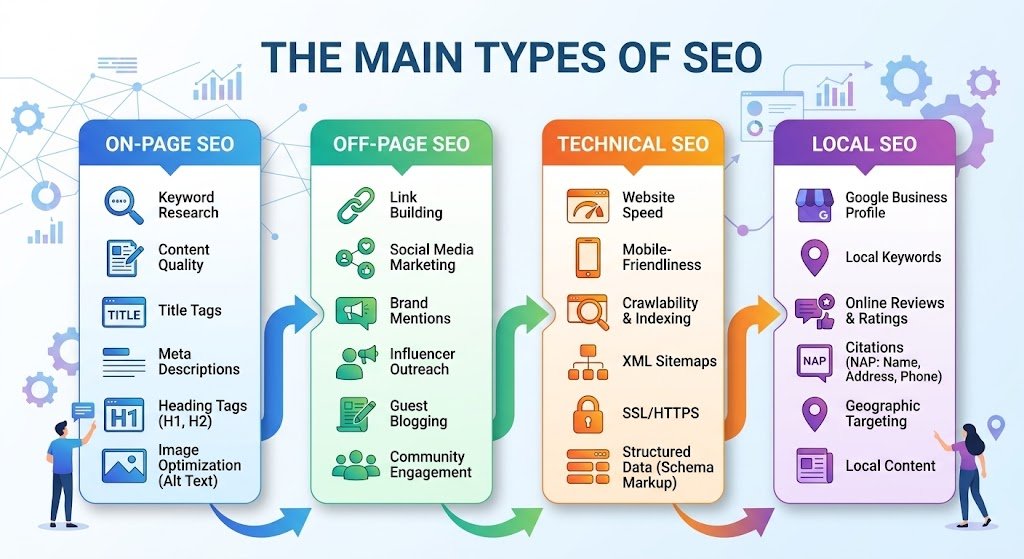
SEO is not one single activity.
A complete SEO program can contain several interconnected areas.
1. Technical SEO
Technical SEO focuses on the technical systems and architecture that affect crawling, indexing, rendering, performance, and website accessibility.
Common technical SEO areas include:
- Crawling
- Indexation
- XML sitemaps
- Robots.txt
- Canonical URLs
- Redirects
- Duplicate content
- JavaScript rendering
- Site architecture
- Structured data
- Core Web Vitals
- Mobile usability
- HTTPS
- URL structure
Technical SEO does not replace good content.
It creates the foundation that allows useful content to be discovered and processed effectively.
Explore the complete Technical SEO guide:
2. On-Page SEO
On-page SEO focuses on the content and elements of individual pages.
This can include:
- Page titles
- Headings
- Main content
- Search intent
- Internal links
- Images
- Alt text
- URLs
- Entities and related concepts
- Content structure
- Metadata
The goal is not to repeat the same keyword dozens of times.
Instead, a strong page should make its subject clear while thoroughly satisfying the user’s search intent.
Explore the On-Page SEO pillar:
3. Keyword Research
Keyword research is the process of discovering and analyzing the words and phrases people use when searching.
Modern keyword research goes beyond collecting a list of keywords.
You should understand:
- Search intent
- Topic relationships
- Search demand
- Competition
- Business relevance
- User problems
- Commercial value
- Related entities
- Content formats
For example, someone searching for “SEO” has a different need from someone searching for “SEO agency pricing.”
The first query may be educational.
The second may indicate commercial investigation.
Learn more about Keyword Research:
4. Content SEO
Content SEO focuses on creating and optimizing useful content that satisfies search intent.
SEO content can include:
- Blog posts
- Guides
- Service pages
- Product pages
- Comparison pages
- Case studies
- FAQs
- Tutorials
- Glossaries
- Industry pages
Good content should answer the user’s question rather than exist simply to target a keyword.
Content also needs a clear relationship with the rest of the website.
A pillar page can introduce a broad subject, while supporting pages can answer narrower questions.
This creates a topic cluster.
Explore the SEO Content Guide:
5. Link Building and Off-Page SEO
Off-page SEO focuses on signals and activities that happen beyond the individual page.
Link building is one part of off-page SEO.
A backlink is a link from another website to your website.
Links can help search engines discover pages and can contribute to how a site’s authority and relevance are evaluated.
But not every backlink has the same value.
Relevant, editorially earned links can be more meaningful than large quantities of unrelated links.
Off-page SEO can include:
- Digital PR
- Editorial backlinks
- Linkable assets
- Brand mentions
- Relevant outreach
- Unlinked mention reclamation
- Competitor link-gap research
- Industry relationships
Avoid building a strategy around backlink quantity alone.
Explore the Link Building guide:
6. Local SEO
Local SEO helps businesses become more visible for searches connected to a location.
It is particularly important for businesses that serve specific cities, regions, or physical areas.
Local SEO can involve:
- Google Business Profile
- Location pages
- Local content
- Reviews
- Citations
- Business information
- Local links
- NAP consistency
- Local search measurement
For example, a dentist in Lahore has different search needs from an ecommerce store selling products worldwide.
Local SEO connects a business with geographically relevant search demand.
Explore the Local SEO guide:
7. E-Commerce and Industry SEO
Different business models require different SEO structures.
An ecommerce website may need to optimize:
- Category pages
- Product pages
- Filters
- Faceted navigation
- Product descriptions
- Product schema
- Out-of-stock pages
- Internal links
A SaaS company may focus more heavily on:
- Feature pages
- Use cases
- Comparison pages
- Integration pages
- Educational content
A manufacturer may need:
- Product categories
- Technical specifications
- Industry pages
- Application pages
- Buyer guides
This is why SEO strategy should reflect the website’s business model instead of using one template for every company.
Explore Industry SEO:
8. WordPress SEO
WordPress is widely used for business websites and publishing.
WordPress SEO can involve:
- Website architecture
- Categories and tags
- Permalinks
- Plugins
- XML sitemaps
- Metadata
- Canonicals
- Schema
- Internal links
- Performance
- Indexation
Installing an SEO plugin does not automatically optimize a website.
The underlying content, architecture, technical configuration, and publishing decisions still matter.
Explore WordPress SEO:
9. AI Search, AEO and GEO
Search is expanding beyond traditional blue links.
Users may discover information through AI-powered search experiences, answer engines, and conversational systems.
This has created growing interest in:
- Answer Engine Optimization (AEO)
- Generative Engine Optimization (GEO)
- LLM SEO
- AI search visibility
The fundamental principles remain connected to traditional SEO:
- Clear information
- Strong topical coverage
- Useful answers
- Consistent entities
- Accessible content
- Supporting evidence
- Strong website architecture
However, AI visibility should not be treated as a guaranteed placement system.
Explore AI Search Optimization:
SEO vs. Paid Search
SEO and paid search are different channels.
With SEO, businesses work to earn organic visibility.
With paid search, advertisers pay for placements through advertising platforms.
They can work together.
For example, paid search data can help a business understand which search terms convert, while SEO can build organic visibility around relevant topics.
SEO and paid advertising should therefore not always be treated as competing activities.
The correct mix depends on:
- Business goals
- Budget
- Competition
- Sales cycle
- Search demand
- Conversion rate
- Time horizon
What Are SEO Rankings?
An SEO ranking refers to where a webpage appears in search results for a particular query.
For example, if a page appears among the first organic results for a relevant search, it has greater visibility than a page appearing much farther down.
However, rankings are only one SEO metric.
A business should also monitor:
- Organic clicks
- Impressions
- Click-through rate
- Qualified traffic
- Leads
- Sales
- Revenue
- Conversion rate
- Indexed pages
- Search visibility
- Brand searches
A ranking without business value is not necessarily a successful SEO outcome.
What Is Search Intent?
Search intent is the underlying reason behind a search.
A person searching for “what is SEO” is probably looking for an explanation.
Someone searching for “SEO agency Lahore” may be evaluating service providers.
Someone searching for “buy SEO software” has a more transactional need.
Common search-intent categories include:
Informational
The user wants to learn something.
Examples:
- what is SEO
- how does SEO work
- what is technical SEO
Navigational
The user wants to find a particular website, brand, or page.
Examples:
- Google Search Console
- Digital Soules SEO services
Commercial Investigation
The user is researching options before making a decision.
Examples:
- best SEO agency
- SEO services comparison
- SEO software reviews
Transactional
The user is ready to complete an action.
Examples:
- buy SEO software
- hire SEO agency
- SEO consultation
Understanding intent helps determine what type of page should target a query.
What Is a Topic Cluster?
A topic cluster is a group of related pages organized around a central subject.
The structure commonly looks like this:
Pillar Page → Cluster Pages → Supporting Content
For example:
SEO
→ Technical SEO
→ On-Page SEO
→ Keyword Research
→ Content SEO
→ Link Building
→ Local SEO
→ SEO Tools
→ AI Search SEO
The pillar page provides the broad overview.
The supporting pages answer narrower questions in greater detail.
Internal links connect these pages so users can move naturally from one topic to another.
This is the structure we are using for the Digital Soules SEO content plan.
What Is Internal Linking?
Internal linking means linking from one page on your website to another page on the same website.
Internal links help users discover related information.
They can also help search engines understand relationships between pages.
For example, this page explains SEO at a broad level.
A reader who wants to understand technical SEO can move from this pillar to the dedicated Technical SEO guide.
From that guide, they can continue to more specific technical SEO articles.
A useful internal-linking structure should be:
- Relevant
- Natural
- Helpful
- Contextual
- Easy to navigate
Do not add internal links simply to increase the number of links on a page.
The link should give the reader a useful next step.
How to Create an SEO Strategy
An SEO strategy should begin with the business rather than a random keyword list.
Step 1: Understand the business
Identify:
- Products
- Services
- Target customers
- Locations
- Revenue drivers
- Sales process
- Competitive advantages
Step 2: Analyze the website
Review:
- Existing pages
- Technical health
- Indexation
- Content quality
- Internal links
- Backlinks
- Search performance
- Conversion paths
Step 3: Research search demand
Identify the topics and questions relevant customers search for.
Separate keywords by:
- Intent
- Topic
- Funnel stage
- Business value
- Page type
Step 4: Build the page map
Assign each important search topic to the most appropriate page.
This helps prevent multiple pages from competing for the same primary intent.
Step 5: Create topic clusters
Group related content around broader pillar topics.
Step 6: Optimize existing pages
Not every opportunity requires a new article.
Some pages may need:
- Better search intent alignment
- Improved headings
- More complete information
- Better internal links
- Technical corrections
- Content consolidation
Step 7: Publish supporting content
Create focused pages for important questions that deserve their own search result.
Step 8: Build authority
Earn relevant links, mentions, references, and relationships that support the site’s authority.
Step 9: Measure results
Track both SEO metrics and business outcomes.
Step 10: Improve continuously
SEO is not a one-time project.
Search behavior, competitors, websites, products, and search systems change.
How to Learn SEO
You do not need to understand every SEO concept on your first day.
Start with the fundamentals.
A practical learning sequence is:
- Understand how search engines work.
- Learn search intent.
- Learn keyword research.
- Learn on-page SEO.
- Learn technical SEO.
- Learn content strategy.
- Learn internal linking.
- Learn off-page SEO and link building.
- Learn local SEO.
- Learn SEO measurement.
- Study real websites.
- Practice by optimizing a website.
If you are starting from zero, focus on understanding why an optimization is useful instead of memorizing hundreds of SEO rules.
You can continue with the Digital Soules learning resources:
- How to Learn SEO
- How to Learn SEO From Scratch
- What Are SEO Skills?
- Can I Learn SEO By Myself?
- How Long Does It Take to Learn SEO?
These supporting pages should provide the detailed answers while this page remains the central SEO fundamentals hub.
Common SEO Mistakes
1. Keyword stuffing
Repeating a keyword unnaturally does not make content better.
Write naturally and cover the topic comprehensively.
2. Creating pages for every tiny keyword variation
Very similar keywords do not always require separate pages.
First determine whether the searches represent different intents.
3. Ignoring technical SEO
Excellent content can still struggle if important pages cannot be properly crawled, rendered, or indexed.
4. Publishing without internal links
A new article should have a logical relationship with the rest of the website.
5. Measuring only rankings
Rankings can fluctuate and do not necessarily translate into leads or revenue.
6. Chasing backlinks without relevance
A large backlink count does not automatically mean a strong SEO strategy.
7. Writing only for search engines
The ultimate user is a person.
Content should be understandable, useful, accurate, and easy to navigate.
8. Expecting instant results
SEO often requires time for implementation, discovery, indexing, content development, authority building, and measurement.
How Long Does SEO Take?
There is no universal SEO timeline.
Some technical or indexing improvements may become visible relatively quickly.
More competitive organic growth can require substantially longer.
The timeline depends on factors such as:
- Website history
- Competition
- Existing authority
- Technical condition
- Content quality
- Search demand
- Publishing frequency
- Internal resources
- Implementation speed
- Link acquisition
- Market
Instead of promising a specific ranking within a fixed number of days, an SEO program should establish measurable milestones and track progress over time.
How Is SEO Measured?
A useful SEO measurement system connects search visibility with business outcomes.
Important measurements can include:
Visibility
- Impressions
- Search rankings
- Search visibility
- Indexed pages
Traffic
- Organic sessions
- Organic clicks
- Landing-page traffic
- New users
Engagement
- Engagement rate
- User journeys
- Returning visitors
- Page interactions
Conversions
- Leads
- Form submissions
- Calls
- Purchases
- Sign-ups
Business impact
- Qualified leads
- Revenue
- Customer acquisition
- Pipeline contribution
- Conversion value
Google Search Console can help analyze search performance, while analytics and CRM data can provide additional business context.
SEO Tools You Can Use
SEO professionals use different tools for different jobs.
Common categories include:
Search performance tools
Used to understand impressions, clicks, queries, and indexing.
Analytics tools
Used to understand traffic and conversions.
Crawlers
Used to identify technical issues and analyze website architecture.
Keyword research platforms
Used to discover search demand, related topics, competitors, and keyword opportunities.
Backlink tools
Used to analyze referring domains, backlinks, competitors, and link opportunities.
Page-speed tools
Used to evaluate performance and technical experience.
Rank trackers
Used to monitor selected search queries over time.
The tool is less important than knowing what question you are trying to answer.
Explore the SEO Tools guide:
SEO and AI: What Is Changing?
Search behavior continues to evolve.
People can now discover information through traditional search engines, AI-powered search experiences, answer engines, social platforms, videos, and other discovery systems.
This means SEO increasingly needs to consider the broader search journey.
Important areas include:
- Entity understanding
- Clear brand information
- Structured content
- First-hand expertise
- Supporting evidence
- Topical depth
- Internal linking
- Technical accessibility
- Consistent business information
AI should not be treated as a replacement for SEO fundamentals.
A technically inaccessible, poorly structured, or unhelpful website does not become strong simply because AI was used to create its content.
The Relationship Between SEO and Other Marketing Channels
SEO rarely operates in isolation.
It can work alongside:
- Paid search
- Social media
- Email marketing
- Content marketing
- Digital PR
- Conversion optimization
- Brand marketing
- Sales
- Customer retention
For example, a content asset created for SEO may also be useful for sales teams.
A successful paid-search query may reveal a valuable SEO topic.
A digital PR campaign may generate both brand visibility and relevant links.
The strongest strategy considers how these channels support the same business objectives.
A Simple SEO Checklist
Before publishing an important SEO page, ask:
Search intent
- Does this page match what the searcher wants?
- Is this the correct page type for the query?
Content
- Does the page answer the main question?
- Does it provide enough useful detail?
- Is the information accurate?
- Does it demonstrate relevant expertise?
On-page SEO
- Is the title descriptive?
- Is there a clear H1?
- Are headings logically structured?
- Are important concepts covered naturally?
- Are internal links relevant?
Technical SEO
- Can search engines crawl the page?
- Can the page be indexed?
- Is the canonical URL correct?
- Does the page load properly?
- Is the mobile experience usable?
Internal linking
- Does the page link to relevant supporting content?
- Do relevant supporting pages link back to this hub?
- Are anchor texts descriptive and natural?
Conversion
- What should the reader do next?
- Is the next step relevant to the search intent?
Frequently Asked Questions About SEO
What is SEO in simple words?
SEO is the process of improving a website so that search engines can understand it and people can discover useful pages through relevant searches.
What does SEO stand for?
SEO stands for Search Engine Optimization.
How does SEO work?
SEO combines technical accessibility, relevant content, website structure, search intent, internal linking, authority, and other factors to help search engines understand and surface useful pages for relevant searches.
Is SEO free?
Organic search traffic does not require paying a search engine for every click, but SEO itself requires resources. Businesses may invest in strategy, writers, developers, tools, outreach, content, and specialist expertise.
Is SEO still important in 2026?
SEO remains relevant because people continue to use search and other discovery systems to find information, products, and services. The search environment is evolving, particularly with AI-powered experiences, so SEO strategies also need to evolve.
How long does SEO take?
There is no fixed timeline. Results depend on competition, website condition, authority, content, search demand, implementation, and many other factors.
Can I learn SEO myself?
Yes. SEO can be learned through documentation, courses, practical projects, website analysis, and repeated experimentation.
What are the main types of SEO?
The major areas include technical SEO, on-page SEO, keyword research, content SEO, off-page SEO, link building, local SEO, ecommerce SEO, international SEO, and newer areas such as AI search optimization.
What is the difference between SEO and SEM?
SEO generally refers to organic search optimization, while SEM is commonly used to describe search-engine marketing and may include paid search depending on the context.
Does SEO guarantee first-page rankings?
No. Search results depend on many factors outside an SEO professional’s direct control. A responsible SEO strategy should focus on clear work, measurable improvements, and business outcomes rather than guaranteed positions.
Start Your SEO Journey
SEO becomes much easier to understand when you stop viewing it as a collection of tricks and start viewing it as a system.
The system connects:
Search demand → Intent → Pages → Content → Technical foundation → Internal links → Authority → Visibility → Conversions
Start with the fundamentals, then go deeper into each area.
For technical issues, study technical SEO.
For page optimization, study on-page SEO.
For search demand, study keyword research.
For content planning, study SEO content strategy.
For authority, study link building and off-page SEO.
For location-based businesses, study local SEO.
For modern search experiences, explore AI search optimization.
The goal is not simply to rank a page.
The goal is to build a website that search engines can understand and that real people find useful enough to visit, trust, and take action on.
Continue exploring Digital Soules’ SEO resources and move from the fundamentals into the specialist guides that match your website’s needs.