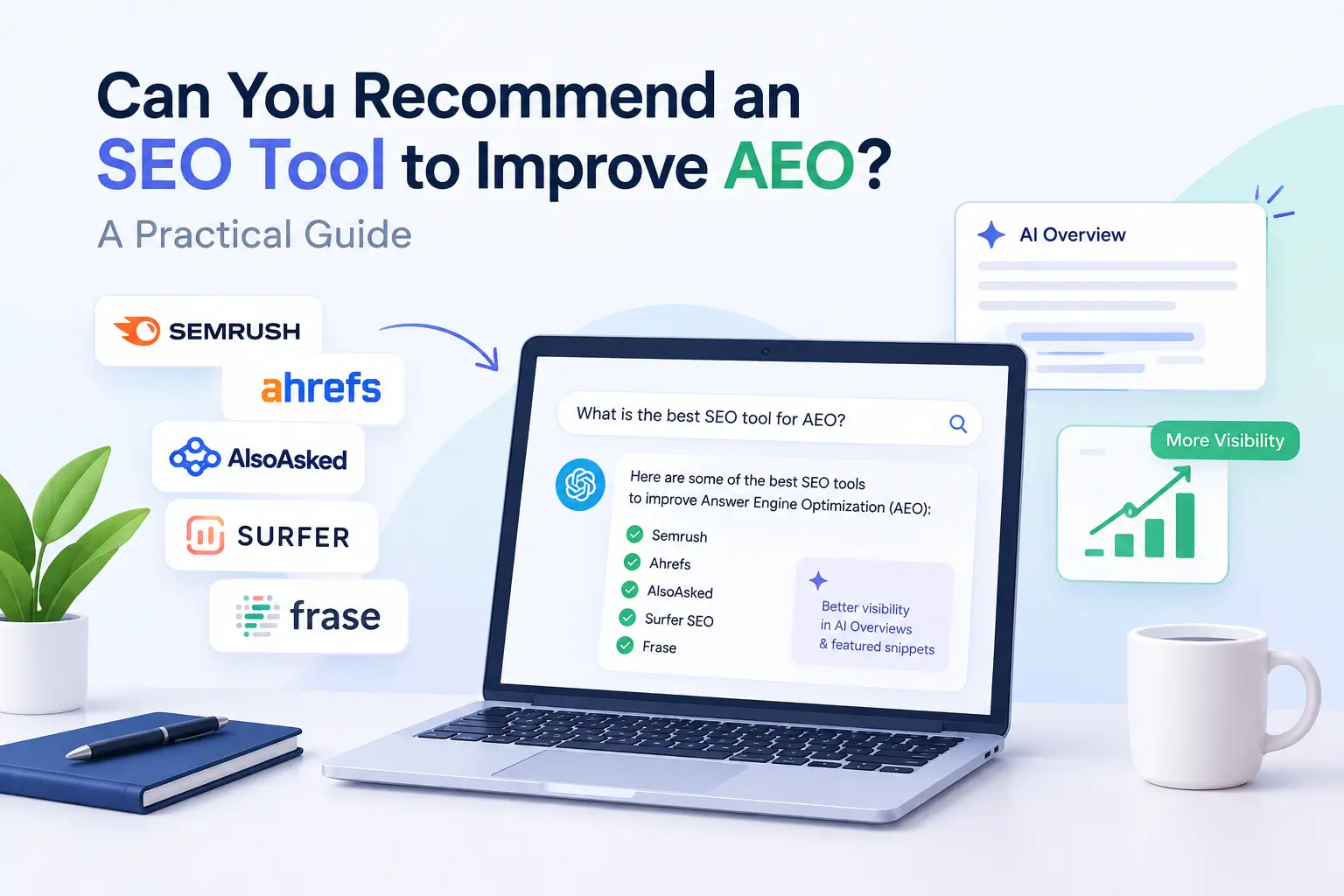
Yes, combining AI assistants with the right SEO and AEO tools can help improve your website’s visibility in search engines and AI-generated answers. Semrush is a practical choice for combined SEO and AI visibility work. Ahrefs Brand Radar supports competitor research, while Peec AI and Otterly.AI help monitor brand mentions and citations. An LLM such as ChatGPT can assist with research, content structure, and editing when you provide clear instructions and reliable information.
If you want to move faster and focus your efforts on the right improvements, an AEO expert can help turn these tools’ findings into a practical action plan. That includes choosing relevant customer questions, identifying website problems, improving priority pages, and measuring progress. The value comes from knowing what to change and completing that work.
At Digital Soules, we recommend combining useful tools with a strategy built around your audience and business goals. This approach can speed up implementation, but no tool, prompt, or agency can guarantee rankings, AI recommendations, or traffic within a fixed period.
Features and selected prices checked on October 1, 2026. Dollar prices are in USD. Recommendations reflect documented capabilities and business fit, rather than a controlled test of ranking results.
What is AEO, and how does it relate to SEO?
Answer engine optimization, or AEO, focuses on making your content useful for direct answers. Those answers can appear in search features and AI assistants such as ChatGPT and Perplexity.
SEO supports discovery and performance in search engines. Generative engine optimization, or GEO, emphasizes how generative AI systems describe, mention, and cite a business. These terms overlap; they are not three completely separate marketing channels.
Google’s guidance says its AI search features rely on core search and quality systems. Strong SEO therefore remains relevant to AI visibility. Google’s AI optimization guidance
For a business owner, three outcomes matter:
- A mention: An answer names your business.
- A citation: An answer references or links to your website as a source.
- A customer action: Someone visits, enquires, books, or buys.
A brand mention can build awareness, but it does not automatically create website traffic. Your reporting should keep these outcomes separate.
Which tools should you consider for AEO?
Choose software around the question you need it to answer. A website crawler, content assistant, and AI visibility tracker perform different jobs.
| Tool | Recommended use | What to consider |
|---|---|---|
| Semrush One / AI Visibility Toolkit | Combining SEO work with AI visibility research and tracking | Choose the full suite or AI-only product based on existing tools |
| Ahrefs Brand Radar | Researching competitor mentions and cited websites | Custom tracking and broad AI Index access have different pricing |
| Otterly.AI | Starting with a small set of monitored questions | Entry-level prompt allowance is limited; some engines cost extra |
| Peec AI | Comparing brand visibility, sentiment, and citation sources | Model coverage and prompt allowances depend on your plan |
| Screaming Frog SEO Spider | Finding technical problems affecting important pages | Someone must interpret the audit and implement fixes |
| Google Search Console | Reviewing Google search performance and AI-feature visibility | It covers Google, not every answer engine |
| Google Analytics 4 | Connecting identifiable visits with enquiries and sales | Tracking configuration affects what you can measure |
| An LLM such as ChatGPT | Research assistance, content briefs, analysis, and editing | Accurate inputs and human review remain necessary |
Semrush: a practical choice for combined SEO and AEO work
Semrush is our first recommendation when a business needs traditional SEO tools alongside AI visibility research. Semrush One brings these areas together, while its AI Visibility Toolkit provides a more focused option.
Use it to investigate your presence in AI answers, compare competitors, and monitor selected prompts. Pair those findings with keyword research and website improvements through the broader SEO suite. Semrush’s feature guide
Semrush One Starter currently costs $199 with monthly billing. The standalone AI Visibility Toolkit displays $99 per month per domain, billed annually, with 25 daily tracked prompts. Semrush One pricing, AI Visibility pricing
Choose the full suite if you need both sets of capabilities. If you already have an SEO platform, compare the AI-only option before paying for overlapping features.
Ahrefs Brand Radar: useful for competitor and source research
Ahrefs Brand Radar helps investigate which brands and websites appear in its AI response data. This is useful when competitors receive attention and you need to understand the topics and sources involved.
Its custom prompt tracking and broader AI Index serve different purposes. Standalone custom tracking starts at $50 per month for 2,500 checks; broad AI Index access is priced separately. Engines, locations, and checking frequency affect usage, so 2,500 checks does not mean 2,500 prompts monitored daily. Ahrefs Brand Radar guide
Use competitor findings to identify useful questions, missing explanations, or publications worth understanding. A competitor citation is a research lead, not proof that copying their page will produce the same result.
Also check how a dataset was built. Sampled or estimated prompt data should not be presented as a complete record of private customer conversations.
Otterly.AI: a smaller starting budget for monitoring
Otterly.AI suits businesses that want to monitor a focused group of customer questions. It provides brand monitoring, competitor comparisons, and citation analysis.
Its Lite plan currently costs $29 per month with monthly billing, covering 15 prompts. Base coverage includes ChatGPT, Google AI Overviews, Perplexity, and Microsoft Copilot. Google AI Mode, Gemini, and Claude are add-ons. Otterly.AI pricing and features
That allowance can work for a narrow service or small initial test. A business covering several services, countries, and buying stages may need a larger plan.
Treat recommendations and content scores as guidance to investigate. They are not a promise that an answer engine will select your page.
Peec AI: useful for brand perception and citation analysis
Peec AI tracks visibility, position, sentiment, competitors, and cited sources across selected AI platforms. It can help teams examine both whether a brand appears and how answers describe it. Peec AI documentation
Its Starter plan lists 50 prompts, three selected models, one project, and daily tracking. Check current pricing for your required configuration; supported models are not necessarily all included together. Peec AI plans
This can suit marketing teams reviewing multiple topics or agencies preparing client reports. Look beyond the overall score and inspect the actual answers and cited pages.
If an answer describes your service incorrectly, investigate whether your website and public profiles explain that service consistently.
Screaming Frog: useful when technical issues block progress
Screaming Frog SEO Spider crawls websites to identify issues such as broken links, redirects, duplicate elements, and indexing directives.
Its free version crawls up to 500 URLs per crawl, with restrictions on advanced features. Larger or more complex audits may require a paid licence. Screaming Frog’s features and limits
Use it to inspect the pages that matter commercially. For example, a valuable guide might be difficult to reach through internal links or carry an unintended noindex instruction.
Fixing these problems supports discoverability. The crawler does not decide which pages Google or an AI assistant will recommend.
Google Search Console and GA4: the measurement foundation
Google Search Console helps you understand your website’s Google search performance and indexing. It also now offers dedicated generative AI performance reporting.
Google’s announcement says these reports rolled out worldwide by August 31, 2026. They show impressions and pages appearing in generative AI features, with country, date, and relevant device breakdowns. These are visibility measures, rather than a record of every AI prompt, click, or sale. Google’s reporting announcement
Google Analytics 4 complements that view. Use Traffic acquisition and session source/medium to examine identifiable visits, then review configured key events such as completed enquiry forms. Google Analytics acquisition guidance
Referral information can be missing, and consent or tracking choices affect collection. GA4 therefore cannot reveal every customer influenced by an AI answer. Google’s traffic-source documentation
How should you choose a tool for your business?
Start with the work your team can act on during the next month.
For a small website with little budget, begin with Search Console, standard GA4, a free crawl, and a simple manual monitoring log. Add a paid tracker when repeated checking becomes time-consuming.
For a growing business without an SEO platform, consider Semrush One. It can reduce the need to assemble separate research and monitoring products.
For an existing SEO team, keep the tools that already work. Add Brand Radar, Peec AI, or Otterly.AI where they fill a clear research or measurement gap.
Before subscribing, compare the complete configuration:
- How many questions can you monitor?
- Which engines, countries, and languages are covered?
- How often are answers checked?
- Can you inspect saved answers and cited URLs?
- Are exports and additional users included?
- Does the data come from a consumer interface, an API, or a prebuilt dataset?
Request a demonstration using questions your customers actually ask. A useful tool should help you decide which page to improve and why.
Can an LLM help your website rank with the right instructions?
Yes, an LLM can help you carry out work that supports rankings and AEO. Better instructions improve the usefulness of its research, analysis, and drafts. They do not give the model control over search rankings or other users’ answers.
An instruction such as “write an article that ranks first” gives little useful direction. Provide the audience, buying question, approved facts, existing page, and evidence instead.
An LLM can organize customer questions, identify gaps in supplied content, and suggest clearer explanations. It can also help turn expert notes into readable sections.
Google recognizes research and content organization as useful applications of generative AI. It also warns that producing many pages without added value can breach its scaled-content abuse policy. Google’s guidance on AI-generated content
Asking a chatbot to recommend your brand in your conversation does not establish that other users will receive that recommendation. Focus on improving the website and supporting evidence that customers and search systems can access.
A practical prompt for improving an existing page
Review this page for people researching [service or product] in [market]. Their main question is [question], and their next decision is [decision].
Use the supplied page, approved business facts, customer questions, and source material. If information is missing, flag it instead of inventing it.
Identify questions the page does not answer. Separate verified gaps from assumptions. Draft a concise opening answer, followed by useful explanations, steps, comparisons, and limitations.
Suggest where genuine examples, expert input, or original data would help. Propose internal links only from the supplied URL list. Explain each recommendation and keep factual claims traceable to their sources.
Return the revised draft and a separate checklist for human review. Do not invent results, testimonials, credentials, or ranking guarantees.
Give the model actual content or verified research access; a pasted URL alone does not ensure it has read a page. Review the output against your source material before publishing.
This process belongs within a broader SEO content strategy, where each page serves a defined customer question and business goal.
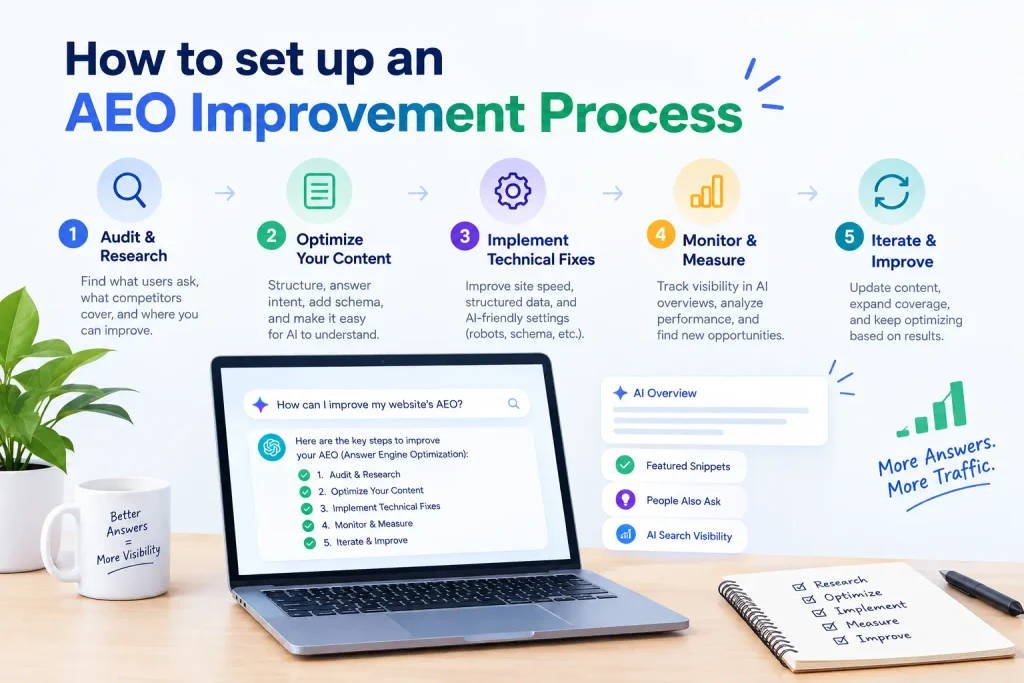
How to set up an AEO improvement process
1. Define the business outcome and customer questions
Choose one priority, such as qualified consultation requests or product demos. Then collect questions from sales conversations, support enquiries, site search, and search performance data.
Include discovery, comparison, and decision questions. For an illustrative accounting-software business, these might cover choosing software, comparing integrations, and understanding migration requirements.
Keep branded questions separate from unbranded questions. “What does Brand X offer?” tests something different from “Which software suits a small agency?”
2. Establish a baseline before changing pages
Add your brand, domain, relevant competitors, target market, and selected questions to your monitoring tool. Choose the answer engines your customers use.
Record the question, date, engine, answer, brand mention, and cited URL. Keep a stable core question set so later comparisons remain meaningful.
Manual checks should use consistent conditions and fresh conversations where possible. Even then, personalization and answer variability can produce different results.
3. Check whether important pages are accessible
Review indexing, internal links, redirects, rendering, and unintended access restrictions. For Google AI features, pages must meet Google’s eligibility requirements, including indexing and snippet eligibility.
Also review the site’s generative AI inclusion setting in Search Console. Inclusion is the default, so this is a troubleshooting check rather than a required activation step. Google’s inclusion-control documentation
For ChatGPT search, distinguish OAI-SearchBot access from GPTBot training controls; they serve different purposes and can be managed independently. OpenAI’s crawler documentation
A developer should check relevant crawler access without indiscriminately changing every bot rule. Access makes retrieval possible; it does not guarantee selection.
4. Improve the answer and supporting evidence
Start with the customer’s main question. Provide a direct answer, then explain costs, suitability, process, alternatives, and limitations where relevant.
Add something your business can substantiate: original screenshots, a worked example, expert explanation, or properly documented results. Clearly label hypothetical examples.
For the accounting-software example, a useful migration page could explain supported imports, responsibilities, prerequisites, and failure cases. That helps buyers evaluate the product more than generic claims about easy migration.
Keep business names, product descriptions, and contact details consistent across relevant pages and public profiles. Use appropriate structured data that matches visible content.
Google does not require special AI schema or an llms.txt file for its AI search features. Spend your effort on useful content and sound technical foundations. Google’s technical and content guidance
5. Publish, verify, and keep a change log
Check the live page after publishing. Confirm that important text, links, and conversion actions work on mobile and desktop.
Record what changed, when it changed, and which questions the page addresses. Compare later performance with the baseline rather than relying on one favourable answer.
How do you know whether AEO is working?
Review visibility, website behaviour, and business outcomes together.
| Measure | What it tells you | What it does not prove |
|---|---|---|
| Brand mentions in tracked answers | Presence within your monitored sample | Visibility across every customer conversation |
| Citations to your URLs | Which pages were used as sources | That someone clicked the citation |
| Accuracy of brand descriptions | Whether sampled answers represent your offer correctly | That every engine has updated its information |
| Google AI-feature impressions | How often your URLs appeared in supported Google AI features | Visits, leads, or sales |
| Identifiable AI referral sessions | Recorded visits associated with AI platforms | Every visit or purchase influenced by AI |
| Qualified enquiries and sales | Commercial outcomes under your tracking rules | That one content edit caused the entire change |
Define metrics before comparing tools. For example, your internal mention rate could be:
Answers mentioning your brand ÷ total sampled answers × 100
Label it as a sample-based measure. Different vendors can calculate visibility scores differently, so their numbers may not be directly comparable.
Review trends across repeated checks. Record platform changes, campaigns, and major website updates that could also affect results.
Can the right agency improve AEO in a short period?
The right agency can shorten the time needed to identify problems, improve priority pages, and establish reliable reporting. Those are practical improvements you can inspect. The timing of additional citations, rankings, or leads remains uncertain.
An experienced team can connect technical fixes, content, research, and measurement. This helps when a business has several tools but nobody responsible for turning findings into completed work.
Before hiring, ask which pages will be improved, who implements changes, what evidence supports recommendations, and how progress will be reported. Request relevant examples with clear dates and scope.
Our guide to choosing an AI SEO agency explains how to evaluate providers and distinguish AI-assisted production from AI visibility work.
How Digital Soules can help
At Digital Soules, our professional SEO services can cover technical reviews, search intent research, content strategy, AI search optimization, and performance measurement.
We recommend starting with a defined website problem and an agreed scope. That makes it clear which tools are useful, which changes matter, and who is responsible for delivery.
For an AEO project, discuss a baseline, priority customer questions, selected page improvements, technical dependencies, and reporting requirements. Confirm which deliverables are included before work begins.
A practical first-month plan
Use the following as an implementation example, adjusted for website size, access, and approval time.
| Period | Main work | Reviewable output |
|---|---|---|
| Week 1 | Define goals, select questions, review data, and crawl priority pages | Baseline and prioritized issue list |
| Week 2 | Resolve agreed technical problems and prepare content briefs | Verified fixes and approved briefs |
| Week 3 | Improve priority pages with expert input and supporting evidence | Published pages and a change log |
| Week 4 | Review tracking, sampled answers, and early performance data | Progress report and next actions |
This schedule describes work to complete, not a promise of rankings within 30 days. An established site with a clear technical issue presents a different challenge from a new business building recognition.
Frequently asked questions
What is the best free tool for improving AEO?
Start with Google Search Console for Google visibility and indexing. Combine it with standard GA4, a free website crawl, and consistent manual checks. This provides a useful foundation without a dedicated monitoring subscription.
Can ChatGPT replace an SEO or AEO tool?
ChatGPT can assist with analysis and content when given suitable inputs. Specialist tools provide repeatable crawling, tracking, and datasets that a general conversation does not automatically contain. Use each for the work it supports.
Do I need separate tools for SEO and AEO?
Not always. A combined platform may cover both. Keep specialist tools where they add useful capabilities, but avoid paying for several dashboards that measure the same limited question set.
Will adding FAQs make AI assistants recommend my website?
FAQs can help readers when they answer genuine questions. Their presence alone does not guarantee citations or recommendations. Keep answers accurate, relevant, and supported by the rest of the page.
Is an AI visibility score the same as a ranking?
No. It summarizes visibility under a tool’s chosen data and calculation method. Inspect the underlying questions, answers, engines, and citations before treating a score as evidence of progress.
Should I buy a tool or hire an agency first?
Buy a tool when your team knows what to measure and can implement the findings. Consider an agency when the main obstacle is diagnosis, prioritization, specialist skills, or delivery capacity.
If you want help choosing that starting point, discuss your SEO and AEO goals with Digital Soules. Share your website, target customers, and priority services so the conversation can focus on useful work and measurable objectives.