Low-competition backlink sites are websites where a SaaS company can realistically earn a listing, profile link, integration mention, or editorial backlink without competing against thousands of established brands for the same opportunity.
These websites can be especially useful for:
- New SaaS startups building their first backlinks.
- Bootstrapped founders with limited marketing budgets.
- AI tools looking for niche-specific visibility.
- B2B software companies targeting decision-makers.
- SaaS businesses trying to improve their visibility in traditional search and AI-powered search experiences.
However, low competition does not automatically mean high SEO value. A smaller directory with relevant visitors may be more useful than a high-authority website that receives little interest in your category.
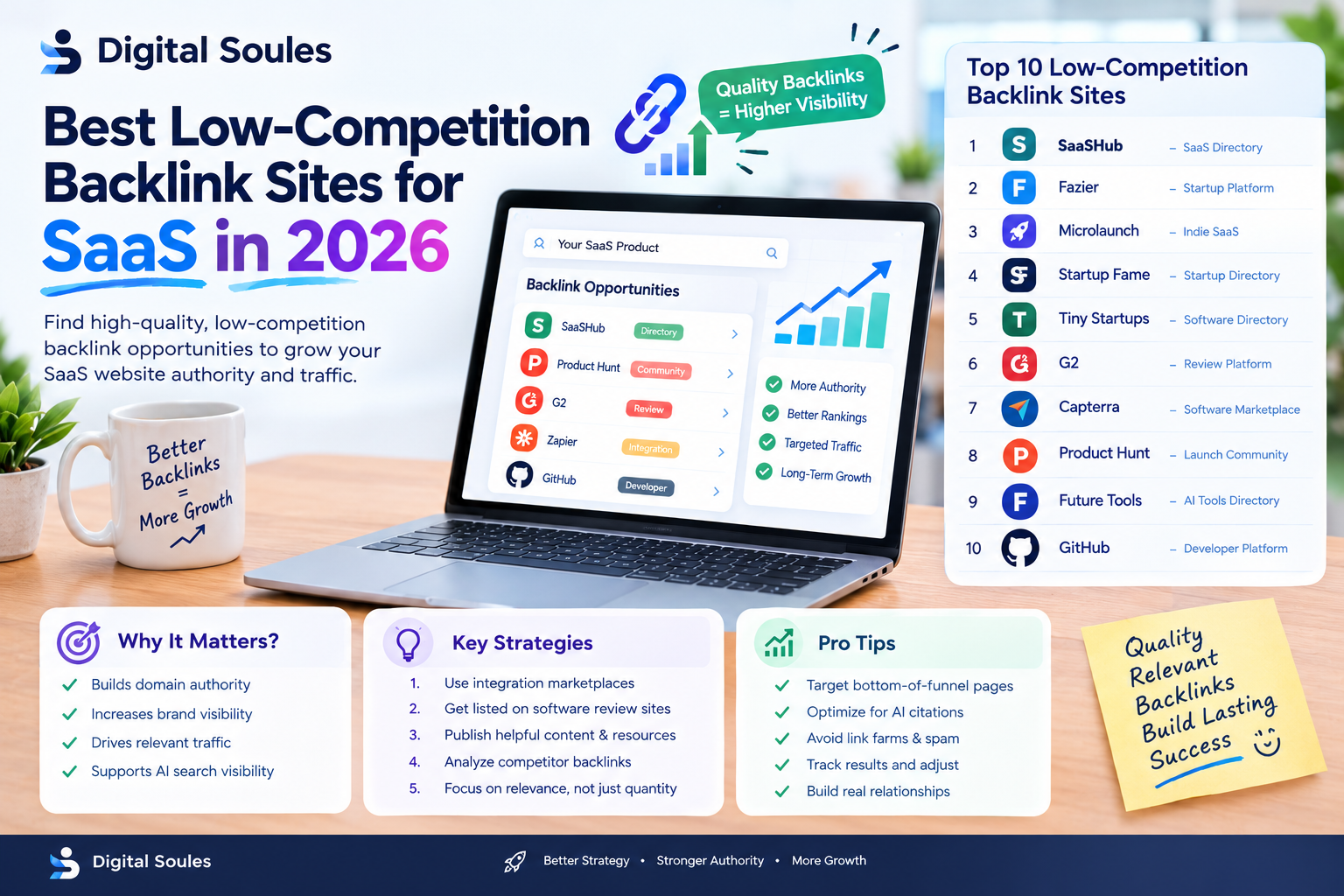
Top 10 Websites for SaaS Backlinks in 2026
The following platforms are practical starting points for SaaS link building. Free access, editorial approval, and link attributes can vary, so confirm the current requirements before submitting.
| # | Website | Best for | Cost approach | Competition |
|---|---|---|---|---|
| 1 | SaaSHub | SaaS discovery and alternatives | Check listing options | Moderate |
| 2 | Fazier | Startup and product launches | Check current plans | Low to moderate |
| 3 | Microlaunch | Indie SaaS and early-stage products | Check submission terms | Low to moderate |
| 4 | Startup Fame | Startup discovery | Check listing conditions | Low to moderate |
| 5 | Tiny Startups | Small software products | Check current terms | Low to moderate |
| 6 | G2 | B2B software discovery and reviews | Free profile options; paid services may be available | High |
| 7 | Capterra | Software buyers comparing solutions | Vendor listing options | High |
| 8 | Product Hunt | Launch visibility and early adopters | Free to use | High |
| 9 | Future Tools | AI products and tools | Check current submission terms | Moderate |
| 10 | GitHub | Developer tools, APIs, and open-source software | Free public repositories | Depends on niche |
Important: The competition labels above are qualitative estimates, not measured keyword-difficulty scores. These are potential backlink and discovery opportunities, not a guarantee of dofollow links or improved rankings. Recent directory research also shows that submission fees and link attributes change over time. Source: SaaSCity directory research.
1. SaaSHub
Website: https://www.saashub.com/
SaaSHub helps people discover software products and compare alternatives. It can be a useful starting point for SaaS businesses that want to build a public product profile.
Why consider it:
- Reach users searching for software solutions.
- Associate your product with relevant categories and alternatives.
- Create another place where prospects can discover your brand.
- Support a broader online presence beyond your own website.
How to get listed: Search for your product or its category, review the available listing process, and submit an accurate description, logo, and official website URL.
Low-competition tip: Choose a precise category instead of positioning your product as a general-purpose tool. A specialized CRM for real estate agencies, for example, has a clearer audience than a generic CRM.
2. Fazier
Website: https://fazier.com/
Fazier is a product discovery and launch platform suited to founders who want to introduce new software to an audience interested in startups and digital products.
Why it can be useful:
- Showcase a new SaaS product.
- Explain your product’s core value proposition.
- Gather feedback and early interest.
- Add a relevant third-party brand mention to your digital footprint.
How to get listed: Review its current launch or submission options and prepare a concise description, product screenshots, pricing details, and a working destination page.
Low-competition tip: Avoid launching with a generic description such as “AI-powered productivity platform.” Explain exactly who the tool serves and what it helps them accomplish.
3. Microlaunch
Website: https://microlaunch.net/
Microlaunch is geared toward smaller launches and independent products. It can be worth evaluating if your SaaS is new and you do not yet have the audience needed for a large launch campaign.
Potential benefits include product discovery, early feedback, and a public product listing.
To improve your submission:
- Use a clear product name and one-sentence value proposition.
- Include genuine screenshots or a short demonstration.
- Explain the problem your SaaS solves.
- Link to a relevant landing page.
- Respond to questions and feedback after publication.
Before investing time, check whether the current submission terms provide an external link and whether that link is marked nofollow, sponsored, or otherwise qualified.
4. Startup Fame
Website: https://startupfa.me/
Startup Fame is a startup discovery directory that can help early-stage companies establish another relevant presence online.
It may be particularly useful for:
- Recently launched SaaS products.
- Bootstrapped software businesses.
- Niche productivity tools.
- New B2B applications seeking early visibility.
How to approach it: Write a product description focused on a specific audience, submit your official website, and complete any required profile fields.
If the directory asks for a reciprocal link or badge, assess whether the arrangement provides genuine value. Do not add hundreds of reciprocal links simply to obtain backlinks.
5. Tiny Startups
Website: https://tinystartups.com/
Tiny Startups is another potential discovery platform for smaller software businesses.
It is worth considering when your product is early-stage and you want to reach people who enjoy exploring new tools.
A good listing should include:
- The primary problem your software solves.
- The intended customer.
- Your most important features.
- A direct link to the relevant product page.
- Transparent pricing or trial information.
Low-competition tip: Make your listing more useful than a short promotional pitch. Explain a specific use case, such as automating invoice reminders for small agencies or tracking SEO reports for clients.
6. G2
Website: https://www.g2.com/
G2 is a major B2B software discovery and review platform. It is generally more competitive than small startup directories, but its buyer-focused audience makes it valuable for many SaaS companies.
Best for:
- Business software.
- Marketing and sales platforms.
- Project management applications.
- Customer support and analytics tools.
Create a complete company or product profile where eligible, and encourage genuine customers to share honest reviews without offering incentives that violate platform rules.
Backlink perspective: Treat G2 primarily as a buyer-discovery and reputation channel, rather than assuming its profile link will pass ranking credit.
7. Capterra
Website: https://www.capterra.com/
Capterra helps buyers compare software products across business categories. It can be a strong fit for SaaS companies with a defined product category and a clear target customer.
To improve your profile:
- Select the most relevant software categories.
- Explain your core features accurately.
- Include screenshots and pricing information where appropriate.
- Keep product details consistent with your website.
- Build a genuine review-generation process.
Capterra is not necessarily a low-competition placement. However, a niche software category may provide a more focused opportunity than competing for broad, high-volume software terms.
8. Product Hunt
Website: https://www.producthunt.com/
Product Hunt is a product-launch community where makers introduce products and receive feedback from other users.
Its official launch guide emphasizes preparation, a clear product explanation, strong visuals, and genuine engagement. Read the Product Hunt Launch Guide.
A launch can support:
- Brand awareness.
- Referral visits.
- Early-user acquisition.
- Community feedback.
- Additional mentions from people who discover your product.
How to approach it: Prepare your product page, demo, screenshots, and launch message in advance. Participate in the community authentically and respond to comments.
Do not treat Product Hunt as a guaranteed dofollow backlink source. Its value is broader than the link itself.
9. Future Tools
Website: https://www.futuretools.io/
Future Tools focuses on discovering AI tools, making it a more relevant prospect for SaaS products that genuinely use artificial intelligence.
It may suit AI writing applications, workflow automation products, image-generation tools, research assistants, and other AI-powered software.
Before submitting, check the current listing criteria and any fees.
Low-competition tip: Explain what makes your product distinct from existing tools. A specialized AI tool for ecommerce product descriptions has a more specific positioning than another general AI assistant.
10. GitHub
Website: https://github.com/
GitHub is especially useful for developer-focused SaaS products, APIs, SDKs, plugins, and open-source components.
A legitimate GitHub presence can help users evaluate your software, inspect integrations, and understand how your product works.
Useful assets include:
- An open-source SDK.
- Example API integrations.
- A starter template.
- A developer documentation repository.
- Code samples and tutorials.
Do not create empty repositories solely to place links. Publish resources that developers can actually use, and link to your product documentation when it is relevant.
More Free Backlink Opportunities for SaaS
The first ten websites are a starting shortlist, not a complete list. These additional options can be more valuable when they match your product or audience.
| Website | Best use | Recommended approach |
|---|---|---|
| GetApp | Software comparisons | Create an accurate vendor profile |
| Software Advice | Business software discovery | Review vendor eligibility |
| GoodFirms | Software and service providers | Build a complete company profile |
| SourceForge | Software downloads and developer tools | Publish a legitimate software listing |
| Wellfound | Startup visibility | Complete your startup profile |
| Hashnode | Developer-focused publishing | Publish useful technical articles |
| DEV Community | Developer education | Share original tutorials and case studies |
| Medium | Thought leadership | Publish substantive articles with relevant attribution |
| Substack | Industry newsletters | Share useful analysis and product insights |
| Crunchbase | Company discovery | Maintain an accurate company profile |
Some of these platforms use qualified links, offer different features on free and paid plans, or have editorial requirements. Check the live profile before counting a backlink as acquired.
How to Find Low-Competition Backlink Sites for Your SaaS
A curated list is useful, but finding websites that match your exact product can be even more effective.
1. Search for Niche Directories
Search Google using queries that include your product category:
SaaS directories for [your niche]submit your [software category] tool[your niche] software directorybest [your niche] tools submitalternatives to [competitor] submit productstartup directory free submission
For example, an email marketing SaaS should search for email marketing directories, marketing automation software lists, and CRM integration marketplaces rather than submitting to every general business directory.
2. Analyze Competitor Backlinks
Use an SEO tool such as Ahrefs, Semrush, or Moz to examine the referring domains of three to five competing SaaS products.
Look for:
- Niche directories where competitors are listed.
- Software comparison articles.
- Integration partner pages.
- Podcasts and interviews.
- Technical tutorials that reference similar tools.
- Industry associations and partner ecosystems.
Prioritize websites that link to several competitors but have not yet covered your product. This can reveal an established opportunity that you can pursue with a stronger listing or a more useful contribution.
3. Look for Integration Marketplaces
If your SaaS connects with other platforms, integration directories may offer a more relevant opportunity than general directories.
Examples include:
- Zapier — for supported workflow integrations.
- Make — for supported automation integrations.
- Shopify App Store — for Shopify applications.
- Slack App Directory — for Slack integrations.
- HubSpot App Marketplace — for HubSpot integrations.
- Salesforce AppExchange — for eligible Salesforce applications.
These are not simply link-submission sites. You generally need a real integration or an eligible app. Zapier, for example, documents its process for getting applications into its directory. Zapier’s app-directory guidance.
A relevant integration can create a stronger long-term acquisition channel because users may discover your SaaS while trying to solve a specific workflow problem.
4. Check Whether a Backlink Is Actually Available
Before spending time on a submission, check:
- Is the basic listing free?
- Is your product eligible?
- Does the page link to your official website?
- Is the link clickable and publicly accessible?
- Does the link use
nofollow,sponsored, orugc? - Does the directory require a reciprocal link?
- Is the listing indexed or likely to provide genuine referral traffic?
Remember that nofollow links and brand mentions can still have discovery and referral value. Do not reject a relevant platform only because its link does not pass conventional ranking credit.
Which Backlink Is the Most Powerful?
There is no single backlink type that is always the most powerful. For SaaS, a relevant editorial link from a trusted industry publication or a respected website in your niche can be especially valuable when it is earned naturally and points to a genuinely useful resource.
Consider these categories:
1. Relevant editorial backlinks: Links earned because an article, research report, or tutorial finds your content useful.
2. Integration and partner links: Links from a genuine platform integration, technology partner, or implementation guide.
3. Software review profiles: Listings on established software discovery platforms that help buyers evaluate your product.
4. Niche directories: Listings on directories that serve your precise market and have real users.
5. Community and launch links: Links from product communities, developer resources, and launch platforms that help people discover your SaaS.
A link’s value depends on context, relevance, editorial quality, placement, and whether it brings useful visitors—not just a Domain Rating number.
Google explicitly identifies buying links for ranking purposes, excessive link exchanges, and automated link creation as link spam. Google Search spam policies.
How to Build SaaS Backlinks Without a Large Budget
Use this practical four-week plan to establish a foundation without submitting to hundreds of irrelevant websites.
Week 1: Prepare Your Assets
Create a consistent product description, logo, screenshots, feature list, pricing information, and a dedicated landing page.
Prepare useful destination pages such as:
- Product overview.
- Integration documentation.
- Feature comparison.
- Competitor alternatives.
- Original research or a detailed case study.
Week 2: Submit to Relevant Directories
Start with five to ten relevant directories and product communities. Complete each profile carefully rather than copying a low-quality description across dozens of sites.
Record submission dates, approval status, listing URLs, and link attributes in a spreadsheet.
Week 3: Create Link-Worthy Content
Publish a useful resource that another website might naturally reference, such as:
- Original survey findings.
- A free calculator or template.
- An industry benchmark report.
- A technical tutorial.
- A detailed integration guide.
- A case study with measurable results.
Useful resources create reasons for other sites to link to you beyond the fact that you asked for a backlink.
Week 4: Conduct Targeted Outreach
Find websites that already discuss your SaaS category. Contact relevant editors, creators, integration partners, or resource-page owners with a specific reason your resource could improve their content.
Keep outreach personal and helpful. Avoid bulk messages offering payment for followed links or demanding keyword-rich anchor text.
Track referral visits, qualified leads, search performance, and conversions—not just the number of backlinks acquired.
Backlink Strategies to Avoid in 2026
Avoid shortcuts that create large numbers of links without building meaningful relevance.
- Private blog networks (PBNs): Networks built primarily to manipulate rankings.
- Automated link blasts: Services that create hundreds or thousands of links through software.
- Mass reciprocal linking: Exchanging links at scale solely to manipulate rankings.
- Irrelevant directories: Websites with no meaningful relationship to your product or audience.
- Paid followed links: Advertising placements designed to pass ranking credit instead of being properly qualified.
- Fake reviews: Fabricated testimonials or incentivized reviews that violate platform rules.
- Unhelpful Web 2.0 pages: Thin, duplicated articles created only to insert links.
The goal is not to avoid every nofollow link or directory listing. The goal is to build a backlink profile that makes sense for a real software business.
Frequently Asked Questions
1. What are the best sites for free backlinks in 2026?
Start by evaluating relevant platforms such as SaaSHub, Fazier, Microlaunch, Startup Fame, Tiny Startups, GitHub, Hashnode, DEV Community, and eligible profiles on software review platforms. Whether each opportunity is free and provides a website link depends on its current policies.
2. What are the top 10 websites for getting backlinks?
For SaaS, a practical shortlist is SaaSHub, Fazier, Microlaunch, Startup Fame, Tiny Startups, G2, Capterra, Product Hunt, Future Tools, and GitHub. Choose based on your product type and audience instead of assuming that every site offers a followed link.
3. Which backlink is most powerful?
A relevant, naturally earned editorial backlink from a trusted website in your industry can be highly valuable. But no individual link type guarantees ranking improvements, and Domain Rating alone cannot determine the value of a link.
4. Are free directory backlinks good for SEO?
They can support discovery, referral traffic, and a natural brand presence. Their direct ranking impact varies, and a directory listing is not guaranteed to improve search positions. Prioritize relevance and quality over quantity.
5. How many backlinks does a new SaaS website need?
There is no fixed number. A new SaaS business should first build a credible online presence, earn relevant mentions, publish useful content, and study competing pages. The right number depends on the competition, search intent, and strength of the pages you want to rank.
6. Are dofollow backlinks better than nofollow backlinks?
A followed link can pass ranking credit, while qualified links may not pass it in the same way. However, nofollow and other qualified links can still send visitors, build awareness, and support a natural link profile. Evaluate the full opportunity, not just its link attribute.
7. Can SaaS directories help with AI search visibility?
A complete profile can make your product easier to discover and understand, but no directory guarantees citations in ChatGPT, Perplexity, or Google’s AI-powered search experiences. Strengthen your visibility with consistent product information, trustworthy third-party mentions, useful documentation, and independent reviews.
Conclusion
The best low-competition backlink strategy for SaaS in 2026 is to combine relevant directories, software review profiles, genuine integration listings, developer resources, and editorial outreach.
Start with a small shortlist that fits your product. Verify submission requirements and link attributes, then expand based on the quality of traffic and leads you receive.
The key principle is simple: build links that help people discover, understand, and trust your software. A handful of relevant placements can be more useful to your business than hundreds of links from unrelated websites.