Introduction
Choosing the best local SEO tools can make a significant difference in how effectively a business attracts customers from Google Search and Google Maps. However, not every local business needs an expensive SEO platform, and not every tool solves the same problem.
A local plumber may need help improving their Google Business Profile and generating customer reviews. A multi-location dental practice may need consistent business listings across directories. Meanwhile, an SEO agency managing 30 clients may need automated reporting, competitor tracking, and location-based ranking data.
The challenge is choosing software that solves the right problem without paying for unnecessary features.
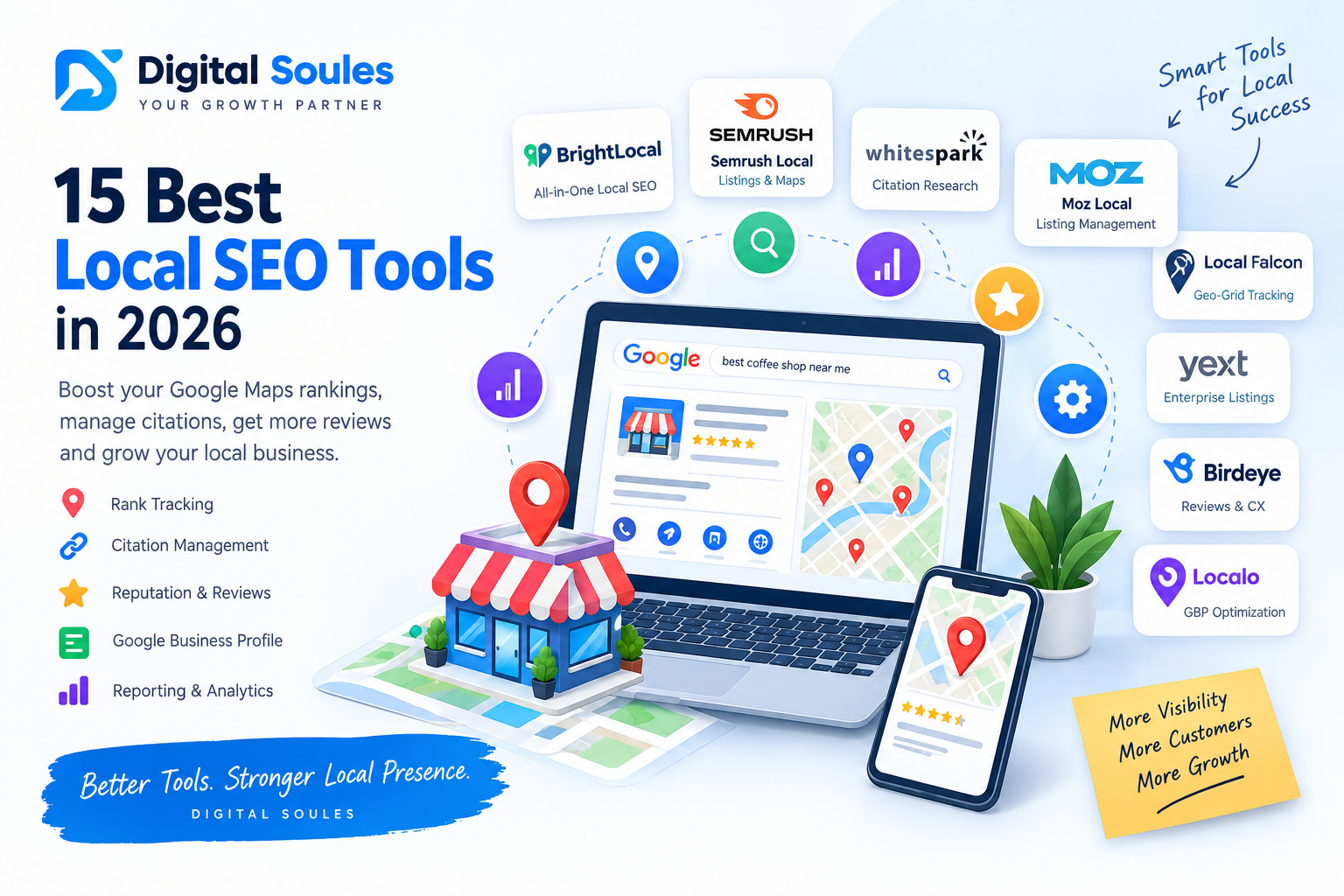
In this guide, we compare 15 of the best local SEO tools in 2026, covering their primary use cases, important features, limitations, free options, and suitability for different business sizes. We also explain how to build a practical local SEO toolkit without wasting money on overlapping subscriptions.
Quick answer: BrightLocal is a strong all-in-one choice for local SEO agencies, Semrush Local suits businesses wanting integrated listing and Google Business Profile management, Local Falcon specializes in Google Maps geo-grid tracking, and Whitespark is particularly useful for citation research. For beginners, Google Business Profile, Google Search Console, and Google Search Console’s free reporting features are sensible starting points.
What Are Local SEO Tools?
Local SEO tools are software applications that help businesses improve their visibility in location-based search results. They help monitor Google Maps rankings, optimize Google Business Profiles, manage online business listings, analyze competitors, track reviews, and identify website issues that may affect local search performance.
These tools are particularly useful for businesses that serve customers in a specific city, neighborhood, or service area.
Examples include:
- Restaurants and cafes
- Dentists and medical practices
- Plumbers, electricians, and home service companies
- Lawyers and accounting firms
- Real estate agencies
- Local retail stores
- Digital marketing and SEO agencies
The right software makes it easier to identify problems, measure progress, and prioritize improvements instead of relying entirely on manual research.
The 15 Best Local SEO Tools in 2026
Here is a quick comparison of the leading platforms and their primary strengths.
| Tool | Best For | Main Use |
|---|---|---|
| 1. GBPPromote | Google Business Profile promotion | Profile-focused optimization |
| 2. BrightLocal | Local SEO agencies | Rankings, citations, audits, reviews, reporting |
| 3. Semrush Local | Integrated local marketing | Listings, reviews, Maps tracking |
| 4. Whitespark | Citation research | Citation opportunities and local rankings |
| 5. Moz Local | Listing management | Business information distribution |
| 6. Local Falcon | Google Maps visibility | Geographic rank heatmaps |
| 7. Yext | Large organizations | Enterprise listing management |
| 8. Birdeye | Multi-location businesses | Reviews and customer experience |
| 9. Synup | Agencies and franchises | Local marketing operations |
| 10. Localo | Beginners and small businesses | Guided Google Business Profile optimization |
| 11. Uberall | Enterprise brands | Multi-location digital presence |
| 12. Podium | Customer-facing businesses | Reviews and customer communication |
| 13. ReviewTrackers | Reputation management | Review monitoring and analysis |
| 14. Localeze | Business data distribution | Business listing data ecosystem |
| 15. Local Viking | Google Business Profile management | Profile workflows and local rank tracking |
Note: This is a shortlist organized by use case, not a claim that every platform is equally suitable for every business. Feature availability, pricing, geographic coverage, and integrations can vary.
1. GBPPromote: For Google Business Profile Promotion
GBPPromote is worth evaluating if your primary objective is improving the visibility and presentation of a Google Business Profile.
Google Business Profile optimization can involve choosing accurate business categories, completing services and business information, uploading relevant photos, and maintaining a trustworthy profile.
Best for: Businesses and marketers looking for profile-focused optimization support.
What to evaluate before choosing it:
- Which profile optimization features are included?
- Does the platform provide useful ranking or competitor data?
- Does it support the locations and countries you target?
- Are reporting and ongoing monitoring included?
Potential limitation: Confirm the exact feature set and pricing directly with the provider. A profile promotion tool should not replace a proper website audit, review strategy, citation analysis, or independent ranking measurement.
2. BrightLocal: Best All-in-One Local SEO Tool for Agencies
BrightLocal is a strong option for agencies and consultants who need to manage several aspects of local SEO from one platform.
It combines local ranking reports, citation audits, Google Business Profile audits, review monitoring, and client reporting. Its reporting capabilities are especially useful when an agency must explain progress to clients who do not understand technical SEO.
Key features
- Local ranking tracking for Google and other supported search results
- Local Search Grid for geographic visibility analysis
- Citation tracking and citation-building services
- Google Business Profile audits
- Review monitoring and reputation management
- White-label reporting for agency clients
Why choose BrightLocal?
Suppose you manage SEO for five local dental clinics. One clinic ranks well in its immediate neighborhood but poorly in surrounding areas. Another has inconsistent business information, while a third needs stronger review management.
BrightLocal can help organize these different tasks and present the findings in a client-friendly report.
Pros
- Broad set of local SEO workflows
- Useful reporting for agencies
- Citation and reputation features
- Designed specifically around local search
Cons
- Paid plans may be unnecessary for a single business with simple needs.
- Some services and features may require additional costs.
- Users should compare the available reporting and listing limits against their client volume.
Best for: Local SEO agencies, consultants, and businesses that need regular local search reporting.
Official website: https://www.brightlocal.com/
3. Semrush Local: Best for Integrated Local Marketing
Semrush Local is a practical option for businesses already using Semrush or wanting a connected workflow for listings, reviews, and map rankings.
Its feature set includes listing management, Google Business Profile management, review workflows, and Map Rank Tracker. The latter helps visualize how rankings vary across different geographic points.
Key features
- Business listing management across supported directories
- Google Business Profile management
- Review monitoring and response assistance
- Google Maps rank tracking and heatmaps
- Local competitor research
- Integration with broader SEO workflows
Why choose Semrush Local?
Imagine a home services company ranks well near its office but struggles to appear in Google Maps in nearby neighborhoods.
A geographic ranking report can reveal where visibility is strong and where it weakens. The business can then investigate relevant service pages, profile categories, competition, review signals, and other local ranking factors.
Pros
- Combines several local marketing tasks
- Useful for businesses with multiple locations
- Works well alongside broader Semrush SEO workflows
Cons
- Some plans are priced per location, which can increase costs as a business expands.
- Listing distribution and other advanced features may require a higher plan.
- The full platform may be more than a small business needs.
Best for: Businesses and agencies that want local SEO management alongside broader keyword and competitor research.
Official website: https://www.semrush.com/features/local-seo/
4. Whitespark: Best for Local Citation Research
Whitespark is well known for its local citation research and citation-building services. Citations are online mentions of a business’s identifying information, such as its name, address, and phone number.
Accurate listings can help customers discover a business and support consistent business information across the web.
Key features
- Local citation research
- Citation-building services
- Local rank tracking
- Competitor citation analysis
- Tools and resources for local search marketers
Why choose Whitespark?
Suppose a law firm has an established Google Business Profile but is missing from relevant local directories and professional listings. Whitespark can help identify citation opportunities and organize the process of building relevant listings.
The goal should be quality and accuracy rather than submitting a business to hundreds of irrelevant directories.
Pros
- Specialized citation research
- Useful for competitive local SEO campaigns
- Relevant to agencies and local SEO consultants
Cons
- It may require additional tools for comprehensive review management or website auditing.
- Citation work alone will not solve every local ranking problem.
Best for: Businesses and agencies that need a focused citation strategy.
Official website: https://whitespark.ca/
5. Moz Local: Best for Straightforward Listing Management
Moz Local focuses on managing and distributing business listing information across supported platforms.
For businesses with incorrect phone numbers, inconsistent opening hours, or outdated addresses, listing management can reduce the effort involved in maintaining accurate business information.
Key features
- Listing distribution and management
- Business data consistency monitoring
- Duplicate listing support, depending on coverage
- Listing visibility and reporting
Why choose Moz Local?
A restaurant may have changed its phone number or business hours but still appear with outdated details on several third-party platforms. A listing management solution can help identify and correct these discrepancies where supported.
Pros
- Focused listing management
- Useful for businesses that want less manual maintenance
- Suitable for organizations with recurring listing updates
Cons
- Directory coverage varies by country and platform.
- It may not provide all the citation research, heatmap, or reporting functions an agency requires.
Best for: Businesses that want to maintain accurate listings without manually updating every supported directory.
Official website: https://moz.com/products/local
6. Local Falcon: Best for Google Maps Geo-Grid Tracking
Local Falcon specializes in geographic rank tracking. Rather than reporting a single ranking from one location, it shows how visibility changes across a geographic grid.
This matters because Google Maps results can vary significantly depending on the searcher’s location.
Key features
- Geographic ranking heatmaps
- Keyword-based local ranking scans
- Competitor visibility analysis
- Historical ranking comparisons
- Reporting for location-based SEO campaigns
Why choose Local Falcon?
Consider an HVAC company targeting an entire city. It may appear prominently near its office but struggle to rank in distant neighborhoods.
A geo-grid report can help identify these weak areas. The business can then investigate whether the issue relates to proximity, competition, relevance, profile quality, or local website content.
Pros
- Specialized geographic ranking visualization
- Useful for comparing competitors
- Makes local visibility patterns easier to explain
Cons
- It is not a complete citation, review, or website SEO platform.
- Scan credits and reporting limits should be considered before selecting a plan.
Best for: Local SEO specialists, agencies, and businesses that want a clearer picture of Google Maps visibility.
Official website: https://www.localfalcon.com/
7. Yext: Best for Enterprise Listing Management
Yext is designed for organizations that need to manage business information across many locations and digital platforms.
For a national retail brand or franchise, updating location information individually can become difficult. Centralized listing management can help standardize these updates.
Key features
- Centralized business information management
- Listing distribution across supported publishers
- Multi-location workflows
- Enterprise-oriented controls and integrations
Pros
- Designed for large-scale operations
- Helpful for businesses with many locations
- Centralizes important business information
Cons
- May be excessive for a single-location business.
- Pricing and contract requirements should be evaluated against the number of locations and required services.
Best for: Franchises, national brands, and large multi-location organizations.
Official website: https://www.yext.com/
8. Birdeye: Best for Reviews and Customer Experience
Birdeye combines reputation management with customer communication and other local business marketing workflows.
For service businesses, online reviews influence how prospective customers evaluate trustworthiness before contacting a provider.
Key features
- Review monitoring
- Review request workflows
- Review response management
- Customer feedback and reputation reporting
- Multi-location reputation management
Pros
- Useful for organizations receiving reviews across several platforms
- Supports centralized reputation workflows
- Can help teams respond more consistently
Cons
- A broad customer experience platform may be unnecessary if you only need basic ranking reports.
- Available features and integrations depend on the chosen plan.
Best for: Healthcare groups, service businesses, and multi-location brands that prioritize customer feedback.
Official website: https://birdeye.com/
9. Synup: Best for Local Marketing Operations
Synup offers local marketing software for managing business listings, reputation, and related workflows.
It can be useful for agencies and organizations that need to standardize recurring local marketing tasks across multiple businesses or locations.
Key features
- Listing management
- Reputation and review workflows
- Local presence monitoring
- Multi-location management capabilities
Pros
- Designed around recurring local marketing work
- Useful for managing multiple business profiles
- Can reduce manual administrative tasks
Cons
- Compare its reporting, integrations, and listing coverage with your existing tools before committing.
- Small businesses may not need its broader workflow features.
Best for: Agencies and businesses that need repeatable local marketing processes.
Official website: https://www.synup.com/
10. Localo: Best for Beginners
Localo is worth considering if you want guidance on improving a Google Business Profile without navigating a complex SEO platform.
Beginners often struggle to decide what to fix first. A tool that turns profile analysis into practical tasks can make local SEO easier to manage.
Key features
- Google Business Profile analysis
- Local ranking monitoring
- Competitor insights
- Optimization recommendations
- Local SEO task guidance
Why choose Localo?
A small plumbing business might discover that its profile information is incomplete, its services are poorly described, and competitors have stronger review profiles.
A guided workflow can help the owner prioritize these issues rather than trying to implement every possible SEO tactic at once.
Pros
- Accessible to non-technical users
- Focuses on practical profile improvements
- Useful for small businesses with limited SEO experience
Cons
- Automated recommendations still require human judgment.
- It should not replace a technical website audit when the website has deeper problems.
Best for: Small businesses, freelancers, and beginners managing their own local SEO.
Official website: https://localo.com/
11. Uberall: Best for Enterprise Local Marketing
Uberall provides tools for managing local digital presence across multiple locations and platforms.
Organizations with hundreds of branches may need centralized controls to coordinate business information, reviews, and local customer engagement.
Key strengths
- Multi-location presence management
- Listing and location data workflows
- Reputation management
- Enterprise-oriented operations
Potential limitation: The value depends on the size of the organization, its integrations, and the workflows it needs to centralize.
Best for: Large brands, franchises, and organizations managing extensive location networks.
Official website: https://uberall.com/
12. Podium: Best for Customer Communication and Reviews
Podium is a customer interaction platform with review-related capabilities. It is worth considering when a business wants to make it easier for customers to communicate with staff and provide feedback.
Key strengths
- Customer messaging workflows
- Review request and management features
- Customer interaction tools
- Business communication support
Potential limitation: Businesses looking mainly for geographic ranking reports, technical SEO audits, or citation research may need a separate tool.
Best for: Local service providers and customer-facing businesses that prioritize communication and reputation.
Official website: https://www.podium.com/
13. ReviewTrackers: Best for Review Monitoring and Analysis
ReviewTrackers focuses on collecting, monitoring, and analyzing online customer feedback.
Businesses can use review data to understand recurring customer complaints, identify service improvements, and manage their reputation across supported review platforms.
Key strengths
- Review monitoring
- Reputation reporting
- Feedback analysis
- Multi-location review management
Potential limitation: Review analytics do not replace a dedicated local rank tracker or citation research platform.
Best for: Businesses that need better visibility into customer feedback and online reputation.
Official website: https://www.reviewtrackers.com/
14. Localeze: Best for Evaluating Business Data Distribution
Localeze is associated with business listing data and local information distribution. Its relevance depends on the directories, data partners, and distribution services available to a particular business.
What to check before choosing it:
- Whether the service accepts your business type and target market
- Which publishers and directories are covered
- Whether it provides direct access or works through a partner
- How data corrections and updates are handled
Potential limitation: It is not a direct substitute for a full local SEO platform that combines rank tracking, reviews, and website audits.
Best for: Businesses and marketers researching local business data distribution options.
15. Local Viking: Best for Google Business Profile Workflows
Local Viking is a specialized platform for local SEO and Google Business Profile-related workflows.
Depending on the available plan, it may be relevant for marketers managing multiple profiles and tracking location-based search performance.
Key strengths to evaluate
- Google Business Profile management workflows
- Local rank tracking
- Multi-location support
- Reporting and operational efficiency
Potential limitation: Verify the current feature set, supported account connections, and pricing before selecting it for a production workflow.
Best for: Local SEO practitioners and agencies with recurring profile management tasks.
Official website: https://localviking.com/
How to Choose the Right Local SEO Tool
The best tool depends on the problem you are trying to solve, not the number of features listed on a sales page.
Before purchasing a subscription, identify your biggest local SEO bottleneck.
If your business does not appear in Google Maps
Start with Google Business Profile and a geographic ranking tool such as Local Falcon. Check your primary category, service relevance, profile completeness, competitors, and visibility across the locations you actually serve.
If your business information is inconsistent
Consider BrightLocal, Semrush Local, or Moz Local. Compare their directory coverage in your target country and confirm how they handle corrections and duplicate listings.
If you need more local citations
Evaluate Whitespark for citation research and building services. Focus on relevant directories, legitimate local organizations, and industry-specific listings rather than mass submissions to low-quality websites.
If your business has too few customer reviews
Consider BrightLocal, Birdeye, Podium, or ReviewTrackers, depending on whether you need review requests, monitoring, response workflows, or broader customer communication.
Always request honest reviews from real customers and follow the relevant platform’s policies.
If you manage multiple SEO clients
BrightLocal is a strong starting point for reporting and local SEO workflows. Semrush Local may be attractive if your agency already uses Semrush, while specialized tools can fill gaps in citation research or geo-grid reporting.
If you have hundreds of business locations
Evaluate enterprise platforms such as Yext or Uberall. Prioritize location governance, integrations, user permissions, publisher coverage, and total cost across all locations.
A Practical Local SEO Toolkit on a Budget
You do not need 15 subscriptions to get started.
A lean toolkit can cover the most important tasks using free Google tools and one paid platform when a clear need arises.
| Task | Recommended Starting Tool | Cost Approach |
|---|---|---|
| Manage your Google business listing | Google Business Profile | Free |
| Monitor website search performance | Google Search Console | Free |
| Measure website traffic and conversions | Google Analytics | Free |
| Check website performance | PageSpeed Insights | Free |
| Research local competitors | Google Search and Maps | Free |
| Track geographic Maps visibility | Local Falcon or Semrush Local | Paid |
| Audit citations and local rankings | BrightLocal or Whitespark | Paid or service-based |
| Manage reviews at scale | BrightLocal or a reputation platform | Paid |
A sensible starting sequence
- Claim and verify your Google Business Profile if eligible.
- Correct your business name, address or service area, phone number, hours, and categories.
- Connect Google Search Console and Google Analytics to your website where appropriate.
- Review your local competitors and the search results for your most important services.
- Fix inaccurate business listings and improve relevant local landing pages.
- Ask genuine customers for honest reviews.
- Add paid rank tracking when you need reliable geographic comparisons or client reporting.
This approach helps you invest in software only after you understand what needs improvement.
Common Local SEO Problems and the Tools That Help
Problem 1: Your Google Maps ranking changes from one neighborhood to another
A single ranking check cannot show your entire local visibility.
Potential solution: Use Local Falcon or a map rank tracking feature in Semrush Local to compare performance across multiple geographic points. Investigate proximity, competitor strength, relevance, and your overall local presence before deciding what to change.
Problem 2: Customers find an old phone number or incorrect opening hours
Inconsistent business information can frustrate customers and undermine confidence.
Potential solution: Audit your business listings using BrightLocal, Semrush Local, or Moz Local. Correct inaccurate records on the platforms that matter to your market.
Problem 3: Competitors have more reviews
A competitor with a stronger review profile may look more trustworthy to prospective customers.
Potential solution: Establish a consistent, policy-compliant process for requesting honest feedback. Use a review management tool if manual monitoring becomes difficult. Do not buy fake reviews or offer prohibited incentives.
Problem 4: Your agency spends too much time creating reports
Manual screenshots and spreadsheets become difficult to maintain when client numbers grow.
Potential solution: Evaluate BrightLocal’s reporting features or the reporting capabilities of your existing SEO platform. Check whether automated schedules, branding, and location-level comparisons are included in your plan.
Problem 5: You are paying for too many SEO subscriptions
Several platforms may overlap in rank tracking, review monitoring, and listing management.
Potential solution: Map each subscription to a specific business need. Keep the tools that provide unique value, and cancel redundant features after confirming that your workflow will still function.
Final Verdict: Which Local SEO Tool Should You Choose?
There is no universal winner for every local business. The most practical choice depends on your budget, location count, and the problem you need to solve.
- Best all-around agency starting point: BrightLocal
- Best for integrated local marketing: Semrush Local
- Best for Google Maps geo-grid tracking: Local Falcon
- Best for citation research: Whitespark
- Best for straightforward listing management: Moz Local
- Best for enterprise listing operations: Yext or Uberall
- Best for beginners: Start with Google Business Profile and free Google tools, then evaluate Localo if you need guided optimization.
For a small business, begin with free tools and a clear optimization checklist. For an agency, choose a platform that saves measurable time across reporting and client management. For a multi-location company, prioritize accurate business data, location-level reporting, and scalable workflows.
Remember that software does not guarantee higher rankings. Local SEO results depend on relevance, distance, prominence, the quality of your website and business information, competition, and the customer experience you provide. Use tools to identify problems and measure progress not as a replacement for sound local SEO strategy. Explore more SEO guides, digital marketing insights, and AI tools on Digital Soules to grow your online visibility and business.