
AI tools are becoming increasingly popular, but building a great product is only half the battle. To attract users, improve search visibility, and establish credibility, businesses also need a strong online presence. One practical way to achieve these goals is by submitting AI products to relevant directories.
The best AI tool directories for backlinks help SaaS companies, AI startups, developers, and digital businesses showcase their products to targeted audiences. Depending on the platform, a listing can generate referral traffic, improve brand awareness, attract early adopters, and provide a backlink that supports an overall SEO strategy.
However, not every directory offers the same benefits. Some focus exclusively on AI tools, while others cover SaaS products, startups, software reviews, and newly launched businesses. Choosing the right platforms is essential for getting meaningful results rather than collecting links that provide little value.
In this guide, Digital Soules explores the best AI tool directories for backlinks, their benefits, submission considerations, and practical ways to use directory listings as part of a sustainable link-building strategy.
What Are AI Tool Directories?
AI tool directories are online platforms that organize and categorize artificial intelligence products. They help users discover tools for writing, image generation, video editing, automation, coding, marketing, productivity, research, and other tasks.
For example, someone searching for an AI video editor might browse a dedicated AI directory to compare available products, explore features, and visit the websites of relevant providers.
Businesses can submit their AI products to these platforms, usually by providing information such as:
- Product name and website URL
- Product description and key features
- Relevant categories and use cases
- Pricing model and available plans
- Screenshots, logos, or product demonstrations
- Social profiles and contact information
Many directories also include a website link in the product listing. Depending on the platform’s linking policy, this may be a followable backlink, a nofollow link, or a link with another qualifying attribute.
The primary objective should be to earn relevant exposure and genuine visitors, with backlinks serving as one part of the broader SEO benefit.
Why Are AI Tool Directory Backlinks Important?
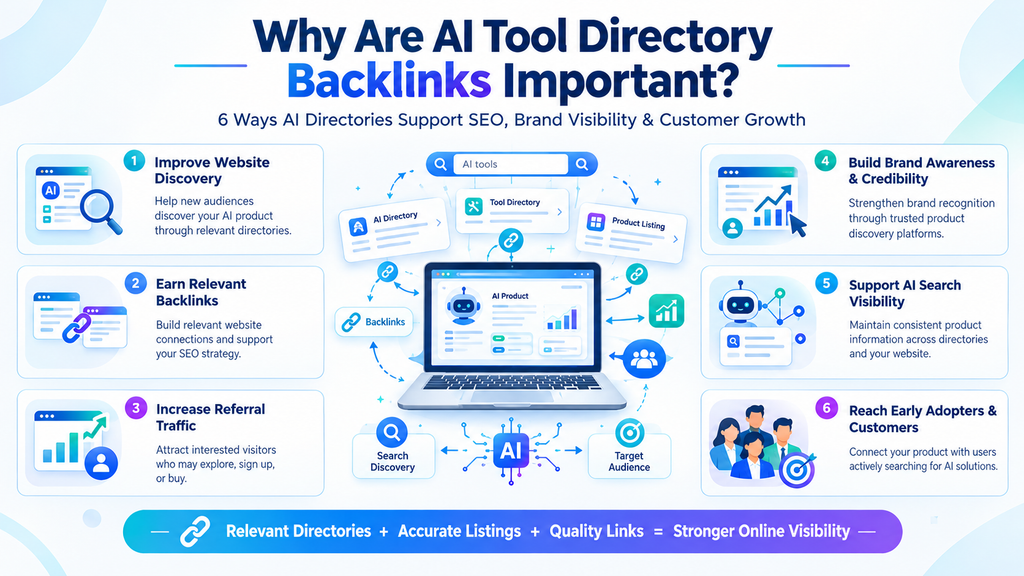
Directory submissions can support an SEO strategy when they connect your business with relevant websites, potential customers, and communities interested in your product.
1. Improve Website Discovery
An established AI directory can introduce your product to people who are actively searching for software solutions. This creates an additional discovery channel beyond search engines, social media, and paid advertising.
A listing can be especially valuable for new AI startups that have limited brand recognition and are still building their organic search presence.
2. Earn Relevant Backlinks
A backlink is a link from another website to your website. Search engines may use links as one of several signals when discovering pages and evaluating their importance.
A listing on an AI directory can provide a contextually relevant link when the platform references your product and its official website. However, the SEO value depends on the directory’s quality, the linking page, and the link attributes.
A followable link may pass ranking signals, while nofollow or other qualified links can still provide referral traffic and brand exposure.
3. Increase Referral Traffic
Directory visitors often have a specific interest in discovering products. If your listing communicates your product’s value clearly, some visitors may click through to explore your website, sign up for a free trial, or purchase a subscription.
The quality of this traffic matters more than the number of directory submissions.
4. Build Brand Awareness and Credibility
Being featured on recognized product discovery platforms can make your business easier to find and compare. Product Hunt, for example, gives startups an opportunity to introduce products to a community interested in discovering new technology.
Listings should complement other trust-building activities, including customer reviews, useful content, transparent pricing, and an informative website.
5. Support AI Search Visibility
Search experiences increasingly include AI-generated summaries and recommendations. Maintaining consistent product information across reputable directories, review platforms, and your own website can help reinforce your brand’s online presence.
This does not guarantee that an AI assistant will recommend your product or cite your website. Instead, directory listings are one component of a broader visibility strategy that includes useful content, accurate information, and credible third-party mentions.
6. Reach Early Adopters and Potential Customers
Some platforms specialize in new product launches, while others attract people comparing established software solutions. Choosing directories that match your product’s maturity and target audience can help you reach relevant users.
For example, a newly launched AI writing assistant may benefit from a startup discovery platform, while an established enterprise AI product may gain more value from software comparison and review websites.
15+ Best AI Tool Directories for Backlinks
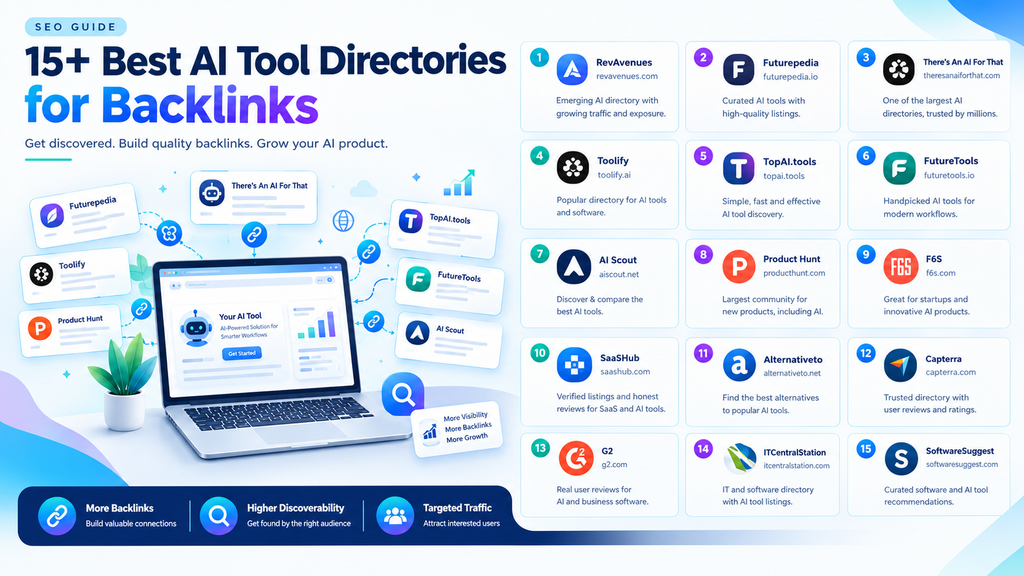
The following platforms are worth evaluating for AI product discovery, startup exposure, software visibility, and potential backlinks. Submission costs, approval requirements, listing features, and link attributes can change, so verify the current policies before submitting.
1. RevAvenues An Emerging AI Directory
RevAvenues is a platform to investigate when looking for additional exposure for AI products. Emerging directories can provide opportunities to reach specialized audiences and establish a presence before a category becomes crowded.
Why consider it?
- Potential exposure to users exploring AI products.
- An additional channel for brand discovery.
- An opportunity to build a consistent product profile.
Best for: AI startups and businesses exploring additional niche listing opportunities.
SEO tip: Review the directory’s existing listings, indexation, editorial standards, and backlink attributes before paying for placement.
2. Futurepedia
Futurepedia is an AI discovery platform that organizes artificial intelligence tools across different categories and use cases.
It can be relevant for businesses offering AI-powered writing assistants, productivity tools, image generators, research solutions, and other consumer or professional applications.
Why consider it?
- AI-focused product discovery.
- Category-based exposure to potential users.
- An opportunity to communicate product features and use cases.
Best for: AI products targeting users who actively explore artificial intelligence applications.
SEO tip: Write a distinctive product description that explains the problem your tool solves rather than repeating generic marketing claims.
3. There’s An AI For That (TAAFT)
There’s An AI For That, commonly abbreviated as TAAFT, is an AI tool discovery platform built around finding tools for particular tasks.
Its task-oriented approach can make it relevant for products that solve clearly defined problems, such as generating marketing content, summarizing documents, creating images, or automating repetitive workflows.
Why consider it?
- Exposure to users searching for tools by task.
- Opportunities to position products around specific use cases.
- Potential referral traffic from relevant product searches.
Best for: AI tools with a clearly defined function and target audience.
SEO tip: Explain the exact tasks your product performs, who benefits from it, and how it differs from alternatives. Check current submission and pricing requirements before applying.
4. Toolify
Toolify is an AI directory that helps users explore tools across a range of categories.
Its broad AI focus makes it worth considering for startups looking to expand product discovery beyond their own website and social channels.
Why consider it?
- AI-specific categorization.
- Product discovery opportunities.
- A potential source of referral traffic and brand mentions.
Best for: AI software companies targeting a broad audience.
SEO tip: Select the most accurate category and keep your product name, website URL, pricing, and feature information consistent across listings.
5. TopAI.tools
TopAI.tools is another platform to consider when building a presence across AI-focused directories.
Businesses can investigate whether their products fit its categories and whether its listing format provides enough room to explain important features.
Why consider it?
- An AI-focused discovery channel.
- Potential visibility for specialized software.
- Another opportunity to create a consistent online product profile.
Best for: AI startups, niche software providers, and independent developers.
SEO tip: Prioritize accurate categorization and a clear value proposition. Confirm the current listing conditions and link attributes instead of assuming every listing provides a followable backlink.
6. FutureTools
FutureTools is associated with discovering and exploring AI tools. It is worth evaluating as part of a broader submission campaign, particularly when your product fits its editorial focus.
Why consider it?
- Exposure to AI enthusiasts and technology adopters.
- An additional channel for product discovery.
- Potential referral traffic from users researching AI applications.
Best for: AI products targeting technology enthusiasts, creators, and professionals.
SEO tip: Check whether the platform is accepting submissions and whether your tool fits its current content and listing criteria.
7. AI Scout
AI Scout is another name to investigate when researching AI-specific product discovery opportunities.
Before prioritizing it, evaluate the quality and relevance of its existing listings, its audience, and how easily users can navigate from category pages to individual products.
Why consider it?
- Potential niche exposure.
- An opportunity to diversify relevant product listings.
- A supplementary channel for AI software discovery.
Best for: AI businesses looking to evaluate additional specialized directories.
SEO tip: Assess real audience relevance and listing quality rather than choosing a directory solely because it advertises a backlink.
8. Product Hunt
Product Hunt is a well-known platform for launching and discovering technology products, including AI applications, SaaS platforms, and developer tools.
Unlike a conventional directory submission, launching on Product Hunt can involve preparing a product page, coordinating a launch, responding to community feedback, and introducing the product to potential users.
Why consider it?
- Product launch exposure.
- Opportunities to collect feedback from early adopters.
- Potential referral traffic and brand mentions.
- A dedicated page for presenting product features and positioning.
Best for: New AI tools, SaaS startups, and products ready for public discovery.
SEO tip: Prepare a strong product description, clear screenshots, a useful demo, and a compelling launch message. Do not assume that a Product Hunt link is guaranteed to pass PageRank; check the current link attributes.
Website: https://www.producthunt.com/
9. BetaList
BetaList helps people discover startups and new products, making it worth investigating for businesses that are preparing to launch or are still building their initial audience.
Why consider it?
- Exposure to startup-focused audiences.
- Potential early user acquisition.
- An opportunity to introduce products before broader market adoption.
Best for: Early-stage AI startups, beta products, and new SaaS businesses.
SEO tip: Explain what makes the product useful, identify the intended audience, and provide a clear landing page. Check eligibility, publication timelines, and current submission terms.
Website: https://betalist.com/
10. SaaSHub
SaaSHub focuses on discovering software and comparing products, including alternatives to existing applications.
This makes it particularly relevant for AI tools that compete in established software categories, such as project management, writing, design, customer support, and marketing automation.
Why consider it?
- Software discovery and comparison opportunities.
- Potential visibility among users evaluating alternatives.
- Relevant product positioning for competitive categories.
Best for: AI-powered SaaS products and software alternatives.
SEO tip: Describe the features that distinguish your product from competitors. Ensure that comparisons are accurate and that your listing targets the right software category.
11. There’s the SaaS Directory The SaaS Directory
The SaaS Directory is another platform to evaluate when looking for SaaS-specific listing opportunities.
A general SaaS directory may be useful even when your product uses AI as a core feature, provided it fits the site’s submission guidelines.
Why consider it?
- Exposure within the SaaS ecosystem.
- Potential discovery by business software buyers.
- An additional place to establish your product’s online presence.
Best for: B2B AI software, subscription-based products, and business productivity tools.
SEO tip: Focus on business outcomes, integrations, pricing, and the specific problems your product solves.
Website: https://thesaasdirectory.com/
12. Fazier
Fazier is a product discovery and launch platform worth considering for startups introducing new software and digital products.
For AI companies, a launch-focused listing may help communicate product benefits to people interested in finding new tools.
Why consider it?
- Product launch and discovery opportunities.
- Potential exposure to startup audiences.
- An additional channel for presenting new features.
Best for: New AI applications, independent software products, and early-stage startups.
SEO tip: Make your product page useful to potential customers by explaining the intended use cases, pricing, and key differentiators.
Website: https://fazier.com/
13. Awesome Indie
Awesome Indie is worth evaluating for independent makers and smaller software businesses looking for product discovery opportunities.
Its suitability depends on the platform’s current editorial focus and the types of products it accepts.
Why consider it?
- Potential exposure for independent projects.
- An opportunity to introduce products outside major launch platforms.
- Additional brand visibility for smaller software companies.
Best for: Indie developers, bootstrapped startups, and small AI software teams.
SEO tip: Review existing featured products before submitting, and make sure your product meets the platform’s current requirements.
Website: https://awesomeindie.com/
14. F6S
F6S is a startup-focused platform used by founders and businesses to discover startup programs, opportunities, and resources.
It is not exclusively an AI directory, but it may be relevant to AI startups that want to establish a company profile and explore the startup ecosystem.
Why consider it?
- A startup-oriented company presence.
- Potential exposure to founders and startup programs.
- Opportunities to discover relevant business resources.
Best for: AI startups, technology companies, and early-stage businesses.
SEO tip: Keep your company profile accurate and complete. Evaluate the available company-page fields and their actual link attributes.
Website: https://www.f6s.com/company/
15. Startup Stash
Startup Stash is a startup resource directory that organizes tools and resources for entrepreneurs.
Depending on its current categories and submission rules, it may be useful for products that serve founders, marketers, developers, and small businesses.
Why consider it?
- Exposure to startup-oriented audiences.
- Potential discovery among entrepreneurs researching software.
- An additional channel for relevant product mentions.
Best for: AI business tools, startup software, and productivity applications.
SEO tip: Select a category that accurately reflects your product and explain why startup teams would benefit from it.
Website: https://startupstash.com/
16. G2
G2 is a software discovery and review platform that helps buyers evaluate products using categories, product information, and user reviews.
For established AI companies, a software profile can contribute to brand visibility and help potential customers research products before making purchasing decisions.
Why consider it?
- Software discovery and comparison.
- Opportunities to build a customer review presence.
- Potential exposure to business software buyers.
Best for: B2B AI platforms, enterprise software, and established SaaS products.
SEO tip: Focus on a complete product profile and genuine customer feedback. Review the platform’s policies and available listing options before investing in a paid plan.
Website: https://www.g2.com/
17. Capterra
Capterra helps businesses research and compare software across a variety of categories.
It may be especially useful for AI products serving professional teams, including marketing automation, customer relationship management, analytics, and business productivity.
Why consider it?
- Product discovery among software buyers.
- Opportunities to communicate features and pricing.
- Potential support for buyer research and evaluation.
Best for: B2B AI software and products with clear business use cases.
SEO tip: Keep product information current and encourage honest customer reviews in accordance with platform policies. Do not treat a listing as a guaranteed followable backlink.
Website: https://www.capterra.com/
18. AppSumo
AppSumo is known for software deals and product offers, making it a different type of opportunity from a traditional AI directory.
It can be relevant for eligible AI tools that have a suitable offer and want to reach customers interested in discovering software products.
Why consider it?
- Potential exposure to software buyers.
- An opportunity to promote an eligible product offer.
- Potential customer acquisition beyond organic search.
Best for: AI SaaS products with an appropriate commercial offer.
SEO tip: Evaluate the commercial terms, audience fit, support requirements, and economics before committing to a promotion.
Website: https://appsumo.com/
19. Crunchbase
Crunchbase is a company and startup information platform used for researching businesses, funding, and company profiles.
It is not an AI tool directory in the narrow sense, but an accurate company profile can contribute to your wider digital footprint.
Why consider it?
- Company discovery and research.
- A place to maintain business information.
- Potential brand recognition among startup and investment audiences.
Best for: AI startups, technology companies, and businesses seeking a broader company profile.
SEO tip: Keep company information consistent with your official website. Review current profile options and link attributes instead of assuming that a listing provides a dofollow link.
Website: https://www.crunchbase.com/
20. GitHub and SourceForge
GitHub and SourceForge can be valuable discovery channels for AI products with open-source components, developer-focused functionality, or downloadable software.
They are not interchangeable with curated commercial AI directories, but they may be relevant when your product genuinely serves technical users.
Why consider them?
- Developer-focused product discovery.
- Opportunities to document projects and releases.
- Community participation and technical credibility.
Best for: Open-source AI tools, developer utilities, libraries, and technical applications.
SEO tip: Publish useful documentation, maintain a clear README, and provide meaningful updates. Do not create empty repositories solely to obtain backlinks.
Websites:
- GitHub: https://github.com/
- SourceForge: https://sourceforge.net/
How to Choose the Best AI Tool Directories
Submitting your product to every available website is rarely the most efficient approach. A better strategy is to evaluate each directory according to its audience, quality, cost, and relevance.
Use the following criteria before investing time in a submission.
| Evaluation factor | What to check |
|---|---|
| Topical relevance | Does the directory cover AI, SaaS, or your product category? |
| Audience quality | Are visitors likely to need your product? |
| Organic visibility | Are relevant directory pages indexed and discoverable in search? |
| Backlink attributes | Is the link followable, nofollow, sponsored, or otherwise qualified? |
| Listing requirements | Does the platform accept your product and business model? |
| Cost | Is the submission free, paid, or subject to a launch fee? |
| Referral potential | Could the listing realistically attract qualified visitors? |
| Maintenance | Can you update your product details when features or pricing change? |
Remember that domain-level authority metrics published by SEO tools are third-party estimates. They are not direct Google ranking scores, and a high domain rating alone does not guarantee that a listing will improve your rankings.
How to Submit Your AI Tool to Directories
A structured submission process helps you maintain consistency and avoid wasting time on low-value listings.
Step 1: Prepare Your Product Information
Before submitting your product, create a reusable information sheet containing:
- Official product name and URL.
- A concise description of the main benefit.
- A detailed description of key features.
- Relevant product categories.
- Pricing and free-trial information.
- Product logo, screenshots, and demo links.
- Company contact information and social profiles.
Use consistent business details across platforms, but adapt descriptions to the audience and requirements of each directory.
Step 2: Identify the Most Relevant Directories
Start with platforms that match your product’s category and target audience.
For example, a new AI video editor might prioritize AI discovery directories and product launch platforms. An AI analytics tool designed for enterprise teams may also benefit from business software comparison and review sites.
Build a shortlist instead of submitting indiscriminately to hundreds of websites.
Step 3: Review Submission Guidelines
Check whether the platform accepts new products, whether it charges a fee, and whether your product meets its requirements.
Some directories may require a working product, a public website, a demo, or specific company information. Others may have editorial reviews or paid promotion options.
Never assume that paying for a listing guarantees publication, a particular backlink attribute, or improved search rankings.
Step 4: Create a High-Quality Listing
Write a description that communicates what your product does and why users should care.
Avoid keyword stuffing and repetitive promotional language. A helpful listing should answer three questions:
- What problem does the product solve?
- Who should use it?
- What makes it different from alternative solutions?
Where supported, add screenshots, a demonstration video, and accurate pricing information.
Step 5: Track Your Backlinks and Referral Traffic
Maintain a spreadsheet containing the directory name, submission URL, date submitted, approval status, listing URL, cost, and observed link attributes.
After publication, use tools such as Google Search Console and your website analytics platform to monitor search visibility, referral sessions, and conversions.
Remember that a backlink tool may not immediately discover every link, and search engines may take time to crawl and process new listings.
Step 6: Update Listings Regularly
If your product changes its name, features, pricing, or website URL, update the relevant directory profiles.
Accurate listings improve the experience for potential customers and help keep your brand information consistent across the web.
Common Mistakes to Avoid When Building Directory Backlinks
Directory submissions can become a waste of resources when the focus shifts from useful exposure to link volume.
Submitting to Irrelevant Directories
A directory that has no connection to your product or target market may offer little business value. Prioritize relevant platforms where potential customers are likely to discover your solution.
Assuming Every Backlink Is Dofollow
Some platforms use nofollow or other qualifying attributes. Check the actual destination link and its HTML attributes rather than relying on outdated SEO lists.
Paying for Guaranteed Rankings
No directory can legitimately guarantee a specific Google ranking simply because you purchase a listing. Evaluate paid submissions based on their audience, exposure, features, and realistic business value.
Using Duplicate Descriptions Everywhere
Copying identical descriptions across every platform can make your listings less useful. Adapt each submission to the directory’s format and audience while keeping essential product information consistent.
Ignoring Referral Traffic
A listing should not be evaluated solely by its backlink metrics. A directory that generates relevant visitors and qualified leads may be valuable even if its links do not pass ranking signals.
Creating Listings for Products That Do Not Fit
Do not misrepresent your product to qualify for a directory. Follow submission guidelines and select categories that accurately describe your offering.
AI Directory Backlinks and Generative Engine Optimization (GEO)
Generative Engine Optimization, or GEO, refers to efforts to improve a brand’s visibility in AI-powered search and answer experiences.
AI directories can contribute to this effort by making product information available across relevant third-party websites. However, their presence alone does not guarantee inclusion in AI-generated answers.
A stronger approach combines several activities:
- Publish accurate product information on your official website.
- Maintain consistent brand details across relevant directories.
- Create useful pages that explain features, use cases, and limitations.
- Earn legitimate mentions from relevant publications and communities.
- Collect authentic customer reviews where appropriate.
- Keep technical SEO, indexing, and structured data in good condition.
For example, if an AI marketing tool is listed across relevant software platforms, has a detailed official website, and receives credible independent coverage, potential customers have more opportunities to discover and evaluate the brand.
The objective is to build a reliable online presence rather than trying to manipulate AI systems through mass directory submissions.
How Digital Soules Can Help With a Stronger SEO Strategy
Directory submissions are only one component of a successful SEO campaign. To turn visibility into sustainable organic growth, businesses also need relevant content, technical optimization, a clear website structure, and a thoughtful approach to link building.
Digital Soules helps businesses explore digital marketing and SEO strategies designed to improve their online presence. Combining directory research with useful content, relevant backlinks, and a well-optimized website can create a more balanced foundation for long-term growth.
Explore Digital Soules to learn more about digital marketing and SEO-related services and resources.
Whether you are launching a new AI product or expanding an established SaaS business, focus on the platforms that match your audience, present your product accurately, and measure the results of each submission.
Frequently Asked Questions
What are the best AI tool directories for backlinks?
Futurepedia, There’s An AI For That, Toolify, TopAI.tools, and FutureTools are relevant starting points for AI-specific discovery. Product Hunt, BetaList, SaaSHub, G2, and Capterra can also be worth evaluating, depending on your product and business goals.
The best choice depends on your target audience, submission eligibility, listing quality, and the platform’s current linking policies.
Are AI directory backlinks good for SEO?
They can support SEO when listings are relevant, legitimate, and useful to potential visitors. Their value varies by platform and link attributes, and directory submissions alone are unlikely to produce substantial ranking improvements.
Are all AI directory backlinks dofollow?
No. Some directories provide followable links, while others use nofollow, sponsored, or other qualifying attributes. Always check the published listing and the platform’s current policies.
Can I submit my AI tool to multiple directories?
Yes. Submitting to multiple relevant directories is a reasonable way to expand product visibility. Prioritize quality and audience relevance rather than maximizing the number of submissions.
Are free AI directories worth using?
Free directories can be worthwhile when they attract relevant users, provide a useful product page, or help establish your brand’s online presence. Evaluate the quality of the platform instead of assuming paid listings are better.
How many directory backlinks do I need?
There is no universal number. A small set of relevant, high-quality listings may be more useful than hundreds of low-quality submissions. Focus on referral traffic, qualified leads, brand visibility, and your wider SEO performance.
Do AI directories help with GEO?
They may contribute to broader brand discoverability by making consistent product information available on third-party websites. However, no directory guarantees that an AI search system will mention or recommend your product.
Final Thoughts
The best AI tool directories for backlinks offer more than a place to submit a URL. They provide opportunities to introduce your product to relevant audiences, earn legitimate website mentions, and strengthen your overall digital presence.
Start with AI-focused platforms such as Futurepedia, There’s An AI For That, Toolify, and TopAI.tools. Then consider complementary options such as Product Hunt, BetaList, SaaSHub, G2, and Capterra according to your product’s stage and target market.
Before submitting, verify the platform’s current requirements, costs, audience relevance, and backlink attributes. Track the results and invest more time in directories that generate meaningful visibility or business outcomes.
The most effective directory strategy is not about collecting the largest number of backlinks. It is about building a relevant, credible, and discoverable online presence that supports long-term SEO growth.