Introduction
Keywords have been an important part of search engine optimization for many years. They help website owners understand what people search for and create content that matches their needs.
However, SEO has changed significantly. Search engines have become better at understanding context, user intent, related topics, and the overall meaning of content. Because of this, many website owners ask an important question: Do keywords still matter in SEO?
The short answer is yes. Keywords still matter, but the way you use them has changed.
Simply repeating a keyword throughout an article is not enough to achieve better rankings. Modern SEO requires relevant content, a clear understanding of search intent, useful information, and a well-organized website.
In this guide, we will explain why keywords still matter in SEO, how search engines use them, where to place them, and how to use them without keyword stuffing.
Do Keywords Matter in SEO?
Yes, keywords still matter in SEO because they help search engines understand the subject and relevance of a webpage.
When someone searches for information on Google, the search engine tries to identify pages that best match the query and satisfy the user’s needs.
Keywords provide useful signals about the content of a page. For example, if a webpage discusses “local SEO services,” relevant mentions of local search optimization, Google Business Profile, local rankings, and location-based searches help establish its subject.
However, keywords are only one part of SEO. Google considers many other signals and systems when determining which pages appear in search results.
A page does not automatically rank because it contains a particular keyword. It needs to provide relevant, useful, and accessible information that meets the searcher’s expectations.
If you are new to the subject, start with our guide on what SEO is and how it works.
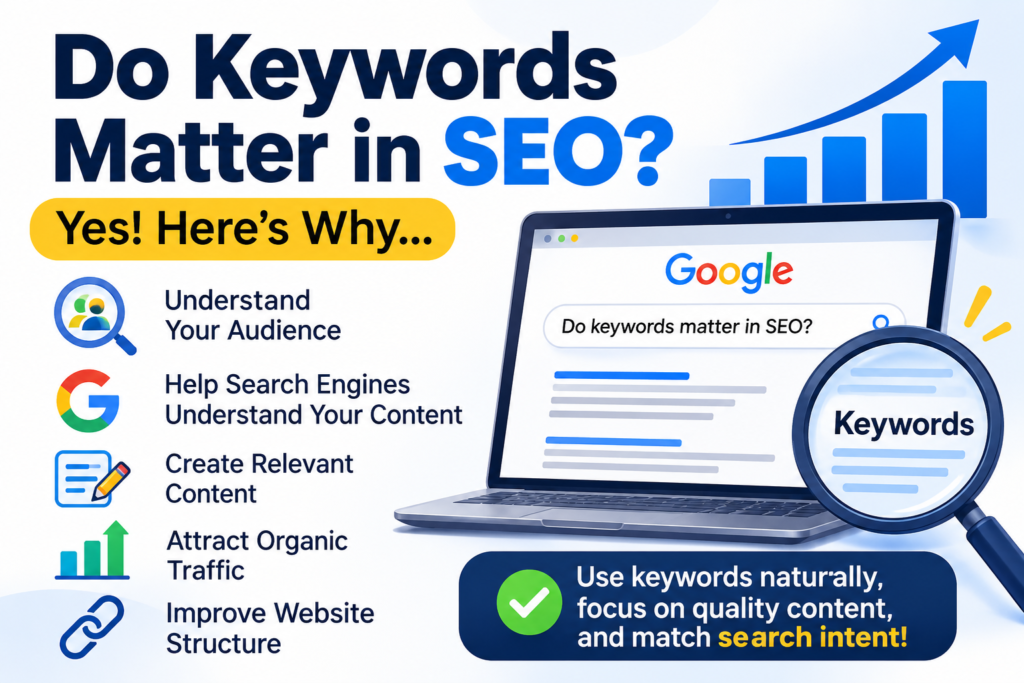
Why Are Keywords Important for SEO?
Keywords play several important roles in an effective SEO strategy.
1. They Help You Understand Your Audience
Keyword research reveals what people are searching for and the language they use when looking for information, products, or services.
For example, someone searching for “how to improve website speed” probably wants practical advice, while someone searching for “website speed optimization services” may be looking for professional help.
Understanding these differences helps businesses create content that matches their audience’s needs.
2. They Help Search Engines Understand Your Content
Relevant keywords help communicate the subject of a webpage.
For example, an article about keyword research may naturally include terms such as:
- Search volume
- Keyword difficulty
- Search intent
- Long-tail keywords
- Organic search
- Keyword analysis
These terms provide context and help explain the topic.
However, you should include them because they are relevant to the subject, not simply to increase keyword frequency.
3. They Help You Create Relevant Content
Keyword research can reveal questions and topics that your audience wants to understand.
For example, if you manage a digital marketing website, keyword research may reveal interest in:
- What is technical SEO?
- How does local SEO work?
- What is keyword difficulty?
- How do backlinks help SEO?
- How can I improve organic traffic?
These searches can become useful blog topics, tutorials, or supporting sections within existing articles.
4. They Help Attract Relevant Organic Traffic
Ranking for relevant search queries can bring visitors who are interested in your products, services, or information.
For example, a website offering SEO consulting services should target searches related to SEO consulting rather than unrelated high-volume keywords.
Relevant visitors are generally more valuable than traffic that has no connection to your business.
5. They Support Website Structure and Internal Linking
Keywords help organize content around related subjects.
For example, a website may have a main SEO guide supported by articles about SERPs, SEO titles, keyword difficulty, and SEO reporting.
These articles can be connected through relevant internal links, helping users explore related information.
How Does Google Use Keywords?
Google uses automated systems to understand webpage content and determine which results may be relevant to a search.
Keywords can help Google understand the topic of a page, but the search engine does not rely on exact keyword matching alone.
Here are some important ways keywords contribute to search relevance.
1. Understanding Search Queries
When someone searches for a phrase, Google tries to understand what the person wants to find.
For example, these searches have closely related meanings:
- How to make a website faster
- Improve website loading speed
- Website speed optimization tips
A useful page may be relevant to several variations without repeating every phrase exactly.
2. Understanding Content Context
Search engines use language understanding systems to interpret the meaning and context of webpage content.
For example, an article about “Apple” may discuss the technology company or the fruit.
The surrounding information helps clarify which subject the page covers.
3. Matching Search Intent
Search intent refers to the reason behind a search query.
The main types include:
- Informational: Users want to learn something.
- Navigational: Users want to find a particular website or page.
- Commercial investigation: Users are comparing products or services.
- Transactional: Users are ready to take an action, such as purchasing something.
Your content should match the purpose behind the keyword.
4. Understanding Related Terms and Concepts
A webpage can cover a topic without using the exact same keyword in every paragraph.
For example, a guide about SEO reporting may naturally discuss organic clicks, impressions, keyword rankings, conversions, and website performance.
These related concepts help explain the subject more completely.
Where Should You Use Keywords in SEO?
Although there is no need to repeat keywords excessively, some webpage elements deserve attention during optimization.
1. SEO Title
Include your primary keyword naturally in the SEO title when appropriate.
Example:
Target Keyword: Do keywords matter in SEO?
SEO Title: Do Keywords Matter in SEO? Importance and Best Practices
A descriptive title helps users understand what the page covers.
2. H1 Heading
The H1 heading introduces the main topic of your webpage.
For example:
Do Keywords Matter in SEO? A Complete Beginner’s Guide
Your H1 should clearly describe the content.
3. Introduction
Mention the main topic naturally near the beginning of the article.
This helps readers understand what they are going to learn.
4. Subheadings
Use relevant keyword variations in H2 and H3 headings when they make the content easier to navigate.
For example:
- Why Are Keywords Important for SEO?
- How Does Google Use Keywords?
- Where Should You Use Keywords in SEO?
Avoid adding keywords to headings when they do not fit naturally.
5. Main Content
Use relevant keywords throughout your content wherever they make sense.
Your priority should be explaining the subject clearly and answering the questions your audience has.
6. URL Slug
Create a short, descriptive URL that represents the page topic.
For example:
example.com/do-keywords-matter-in-seo/
You can learn more about URL structure in our guide on what an SEO slug is.
7. Image Alt Text
Write descriptive alt text for images that communicate useful information.
If an image illustrates keyword research, describe what it actually shows. Do not insert unrelated keywords just to optimize the image.
8. Internal Link Anchor Text
Use relevant and descriptive anchor text when linking to other pages.
For example, if you mention the number of keywords to target on a webpage, link to our guide on how many keywords you should use for SEO.
This helps visitors discover related information and provides context about the linked page.
Do Keywords Directly Affect Google Rankings?
Keywords help search engines understand what a page is about, but there is no single keyword placement or repetition formula that guarantees higher rankings.
Google considers many factors and systems when presenting search results.
These include relevance, content quality, usability, page accessibility, and other signals.
For example, consider two articles targeting the same keyword.
Article A:
- Repeats the target keyword frequently.
- Provides limited information.
- Does not answer important user questions.
Article B:
- Uses the target keyword naturally.
- Explains the topic in detail.
- Answers relevant questions.
- Provides accurate and helpful information.
- Has a clear structure.
Article B offers a more useful experience, even if it uses the exact keyword fewer times.
The lesson is simple: keyword optimization should support content quality, not replace it.
What Happens If You Do Not Use Keywords in SEO?
You do not need to force exact-match keywords into every page. However, publishing content without understanding the topic’s search language can create problems.
1. Search Engines May Have Less Context
If your page uses vague language and does not clearly explain its subject, it may be harder for search engines and visitors to understand what the content offers.
2. You May Miss Relevant Search Opportunities
Keyword research can reveal questions and variations that your original content plan overlooked.
Without research, you may miss useful topics your audience is actively searching for.
3. Your Content May Not Match Search Intent
If you do not understand the search query, you may create content that does not satisfy the user’s expectations.
For example, someone searching for “best SEO tools” expects a comparison or recommendations, not just a definition of SEO software.
4. You May Target the Wrong Audience
Without relevant keyword targeting, a business may attract visitors who are not interested in its products or services.
Keyword research helps connect your content with the right audience.
How to Use Keywords Without Keyword Stuffing
Keyword stuffing means repeating keywords excessively or adding them unnaturally to manipulate search rankings.
It can make content difficult to read and may violate Google’s spam policies when used to manipulate search results.
Follow these practices instead.
1. Focus on One Main Topic
Give every important page a clear purpose.
Choose a primary keyword or topic and organize the content around it.
2. Use Related Keywords Naturally
Include relevant variations when they fit the context.
For example, an article about keyword research can naturally discuss keyword selection, search volume, competition, and search intent.
3. Write for People First
Make sure every section provides useful information.
If a sentence sounds unnatural because of keyword repetition, rewrite it.
4. Answer Related Questions
Use questions from keyword research and search results to identify useful information your audience expects.
Do not add unnecessary sections just to include more keywords.
5. Review Your Content Before Publishing
Read your article carefully and check whether:
- The topic is clear.
- The title accurately describes the page.
- Keywords are used naturally.
- Headings are descriptive.
- The content answers the searcher’s questions.
- Repeated phrases do not make the writing awkward.
Best Tools to Find and Analyze SEO Keywords
Keyword research tools can help you discover search queries, evaluate competition, and organize your content strategy.
Here are some useful options.
1. Google Keyword Planner
Google Keyword Planner helps users discover keyword ideas and review estimated search volumes and competition information. It is primarily designed for Google Ads, but it can also support organic keyword research.
2. Google Search Console
Google Search Console shows the queries for which your website receives impressions and clicks.
It is especially useful for identifying existing keyword opportunities and finding pages that may need improvement.
3. Ahrefs
Ahrefs provides keyword research features, keyword difficulty estimates, competitor analysis, and organic search data.
It can help you discover related search terms and evaluate potential keyword opportunities.
4. Semrush
Semrush offers keyword research, competitor analysis, position tracking, and content optimization features.
It can help businesses organize their SEO campaigns and monitor keyword performance.
5. Ubersuggest
Ubersuggest provides keyword ideas, estimated search volume, SEO difficulty information, and competitor research features.
It can be useful for beginners who want to explore keyword opportunities.
Remember that third-party keyword metrics are estimates. They should support your decisions rather than be treated as guaranteed search performance data.
Common Keyword Mistakes That Can Hurt Your SEO Strategy
Even when businesses understand the importance of keywords, they sometimes use them incorrectly.
Avoid these common mistakes:
1. Targeting Only High-Volume Keywords
High search volume does not automatically mean a keyword is valuable.
Consider relevance, competition, search intent, and business goals.
2. Ignoring Long-Tail Keywords
Long-tail keywords are more specific search phrases that can reveal clear user needs.
For example:
- Broad keyword: SEO services
- Long-tail keyword: Affordable local SEO services for small businesses
Long-tail searches may have lower search volume, but they can attract highly relevant visitors.
3. Using the Same Keyword on Every Page
Assign each important page a distinct topic and purpose.
Avoid creating multiple pages that target the same search intent without a clear reason.
4. Focusing Only on Keyword Density
There is no official ideal keyword density percentage.
Do not increase keyword repetition just to satisfy an SEO plugin or reach an arbitrary number.
5. Ignoring Search Intent
A keyword should match the type of information your page provides.
Always review what users expect before deciding which content format to create.
Frequently Asked Questions About Keywords in SEO
1. Do keywords still matter in SEO in 2026?
Yes. Keywords remain useful for understanding search queries, identifying audience needs, and organizing website content. However, modern SEO requires more than exact keyword matching. Content relevance, search intent, usefulness, and other ranking signals also matter.
2. Can a website rank without using exact keywords?
Yes. A page can be relevant to a search query without repeating its exact wording. Search engines can understand related terms, context, and the meaning of content. However, clearly communicating the page’s topic remains important.
3. How many keywords should I use per page?
There is no fixed number. A practical approach is to focus on one primary keyword and a relevant group of secondary keywords and related terms. The number depends on the page’s purpose and subject.
4. Is keyword density still important?
There is no ideal keyword density percentage that Google requires. Focus on natural writing, useful information, and relevant topic coverage rather than keyword frequency.
5. Are keywords more important than backlinks?
Keywords and backlinks serve different purposes. Keywords help communicate a page’s subject and relevance, while backlinks can help search engines discover pages and understand their authority and relevance. Neither should be considered a replacement for useful content and a strong SEO strategy.
6. Should I use keywords in every heading?
No. Use keywords in headings when they accurately describe the section. Headings should improve content organization and make the article easier to understand.
7. Can using too many keywords hurt SEO?
Excessive and unnatural keyword repetition can result in keyword stuffing. It can make content less useful and may violate Google’s spam policies when done to manipulate rankings.
Final Thoughts
Keywords still matter in SEO, but successful optimization is no longer about repeating the same phrase as many times as possible. They help you understand your audience, identify relevant search opportunities, organize website content, and communicate the subject of your pages.
The best approach is to select relevant keywords, understand search intent, and use them naturally throughout your content. Combine keyword research with useful information, proper internal linking, technical optimization, and a clear website structure.
If you want to improve your understanding of keyword research and search engine optimization, explore more practical guides and digital marketing resources at Digital Soules.