In today’s competitive digital marketplace, having a website is no longer enough to attract customers. Your business also needs to be visible when potential customers search for the products, services, and solutions you offer. This is where search engine optimization (SEO) becomes an essential part of a sustainable digital marketing strategy.
Whether you operate a local business, a growing SaaS company, an e-commerce store, or a B2B organization, SEO can help you reach relevant audiences, build brand credibility, and generate qualified leads through organic search.
But is SEO still worth the investment in 2026, especially with the growth of artificial intelligence, changing search experiences, and increasing competition for online visibility?
The answer is yes. However, successful SEO requires more than inserting keywords into website content. It involves understanding search intent, improving website performance, creating useful content, building authority, and continuously measuring results.
In this guide, we explore seven reasons why your business should invest in SEO, how organic search can contribute to long-term growth, and what businesses should prioritize when developing an effective SEO strategy.
What Is SEO and Why Does It Matter for Businesses?
Search engine optimization is the process of improving a website’s visibility in unpaid search results by making its content, technical structure, and overall experience more useful to search engines and people.
When someone searches for a service, product, or answer related to your business, SEO helps search engines understand your website and determine whether its pages are relevant to that query.
A comprehensive SEO strategy typically includes:
- Keyword research: Identifying the search terms your potential customers use.
- On-page SEO: Optimizing titles, headings, content, internal links, and other page elements.
- Technical SEO: Improving crawlability, indexability, website speed, and mobile usability.
- Content marketing: Publishing helpful, original content that addresses customer questions.
- Off-page SEO: Earning relevant backlinks, brand mentions, and industry recognition.
- Local SEO: Improving visibility for location-based searches and relevant local customers.
These activities work together to help your business attract the right audience rather than simply increasing website traffic.
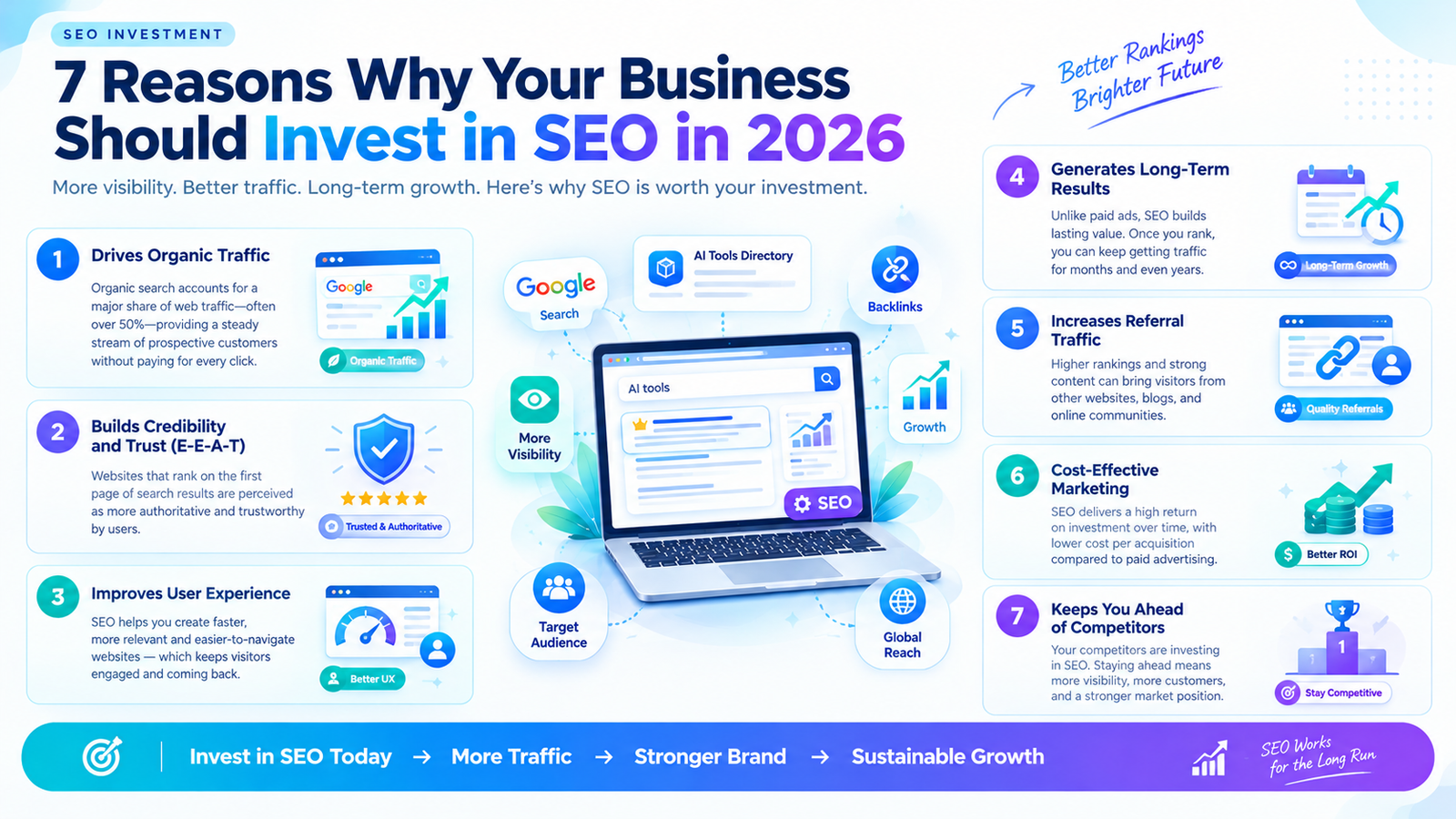
7 Reasons Why Your Business Should Invest in SEO
1. SEO Drives Consistent Organic Traffic
One of the biggest reasons to invest in SEO is its ability to attract people who are already searching for information, products, or services related to your business.
Unlike outbound marketing, where businesses often interrupt people with promotional messages, SEO helps your website appear when potential customers actively look for solutions.
For example, someone searching for “best SEO agency for small businesses” may be comparing service providers and preparing to make a purchasing decision. A relevant, informative service page can help your business reach that person at the right moment.
Organic search can attract visitors through several types of queries:
- Informational searches: “How does SEO work?”
- Commercial searches: “Best SEO services for small businesses.”
- Transactional searches: “Hire an SEO agency.”
- Local searches: “SEO company near me.”
Targeting these different search intents allows you to reach prospects at different stages of the buying journey.
Google’s search documentation recommends using the language your audience uses and creating useful content that helps people accomplish their goals. This makes keyword research and search intent important foundations of an effective SEO strategy.
For better results, identify the questions your audience asks, develop dedicated pages for relevant topics, and connect related content through internal links.
Business benefit: A well-planned SEO strategy can create a sustainable source of relevant website visitors and help reduce dependence on paid advertising alone.
2. SEO Builds Brand Credibility and Customer Trust
Customers are more likely to investigate businesses that provide useful information, demonstrate expertise, and maintain a professional online presence.
SEO supports this process by helping your brand become discoverable when people research industry topics, compare solutions, or evaluate potential providers.
Imagine a business owner researching digital marketing services. They discover your company through a helpful blog post, explore your service pages, read customer testimonials, and find clear information about your expertise. Each interaction gives them another opportunity to evaluate your business.
Trust is strengthened through several elements:
- Accurate, original, and regularly maintained content.
- Clear information about your business, team, and services.
- Genuine customer reviews and testimonials.
- Relevant case studies and examples of previous work.
- Secure browsing and transparent contact information.
- Authoritative backlinks and meaningful industry references.
Google’s guidance on helpful content emphasizes reliability, originality, relevant experience, and people-first information. These principles can help businesses create content that serves customers instead of merely targeting rankings.
It is important to remember that appearing on Google’s first page does not automatically guarantee that a business is trustworthy. Search visibility and customer confidence must be supported by genuine expertise and a positive experience.
Business benefit: SEO can help establish brand familiarity, demonstrate expertise, and make potential customers more comfortable considering your products or services.
3. SEO Can Deliver Long-Term Marketing Value
Paid advertising can generate traffic quickly, but that traffic generally depends on maintaining an advertising budget. SEO works differently because the content, technical improvements, and authority you build can continue contributing to visibility after the initial work is completed.
Consider publishing a detailed guide that answers a question your ideal customers frequently search for. If the page becomes relevant and maintains its usefulness, it may continue attracting visitors for months or years.
That does not mean SEO produces permanent rankings or free traffic without maintenance. Competitors can publish better resources, search algorithms can change, and customer behavior can evolve. Successful pages require monitoring and occasional improvements.
Nevertheless, SEO can create valuable digital assets, including:
- Evergreen blog articles that answer recurring questions.
- Service pages targeting high-intent search queries.
- Industry guides that attract relevant backlinks.
- Product pages that help customers compare solutions.
- Local landing pages that connect businesses with nearby audiences.
Over time, these assets can support multiple stages of the customer journey and strengthen your website’s overall visibility.
To evaluate long-term value, track organic leads, assisted conversions, customer acquisition costs, and revenue generated through organic search rather than focusing exclusively on rankings.
Business benefit: SEO can build a compounding marketing asset that continues creating opportunities beyond the initial investment, although results are never guaranteed.
4. SEO Can Improve Marketing Efficiency and Return on Investment
Every business has limited marketing resources. Investing in channels that attract relevant prospects and support measurable business outcomes is therefore essential.
SEO can improve marketing efficiency by connecting your website with people who already demonstrate interest in your industry or services.
For instance, a B2B company could create content addressing specific customer problems, such as choosing industrial software, improving supply chain efficiency, or selecting a reliable service provider. These resources can attract qualified visitors who are more relevant than a broad, untargeted audience.
SEO also provides insights that can improve other marketing activities. Search query data can reveal customer questions, emerging needs, product comparisons, and service opportunities.
You can use these insights to improve:
- Landing page messaging and conversion rates.
- Paid search keyword selection.
- Email marketing content.
- Product descriptions and service positioning.
- Sales materials and frequently asked questions.
However, SEO is not automatically cheaper than paid advertising. It requires investment in strategy, content creation, technical expertise, and ongoing optimization. Results may also take time to develop.
To assess performance, measure the cost of generating qualified organic leads and compare it with the revenue and customer lifetime value those leads produce.
Business benefit: SEO can strengthen your overall marketing strategy and improve the efficiency of customer acquisition when it is measured against meaningful business goals.
5. SEO Improves Website Experience and Conversion Opportunities
A website should do more than attract visitors. It should help them find information, understand your offer, and take the next step without unnecessary friction.
This is why technical SEO and user experience are closely connected.
A slow, confusing, or difficult-to-use website can discourage potential customers even when its pages receive search traffic. By addressing usability and technical issues, businesses can make their websites more accessible and easier to navigate.
Important improvements include:
- Mobile usability: Make pages easy to read and navigate on smartphones.
- Page performance: Reduce unnecessary scripts, oversized images, and other sources of delay.
- Clear navigation: Help visitors find important pages and information quickly.
- Content readability: Use descriptive headings, concise paragraphs, and meaningful examples.
- Accessible design: Ensure that important content and controls are usable by a wider range of people.
- Clear calls to action: Make it easy to request a quote, book a consultation, or contact your team.
Google’s page experience guidance encourages website owners to consider the overall experience rather than focusing on a single performance metric. Technical improvements should therefore support real user needs, not just satisfy a checklist.
For example, a service business can combine a clear explanation of its offering with customer testimonials, transparent pricing information where appropriate, and a prominent inquiry form.
These improvements may help turn relevant visitors into leads, although conversion performance also depends on your offer, audience, pricing, and sales process.
Business benefit: SEO can contribute to a more useful website that supports both search visibility and customer conversion.
6. SEO Helps Your Business Adapt to AI-Powered Search
Search is evolving. Alongside traditional search results, people increasingly encounter AI-generated summaries and conversational search experiences that help them explore complex questions.
For businesses, this creates another reason to invest in strong SEO fundamentals rather than abandoning them.
Google’s guidance for AI Overviews and AI Mode explains that established SEO practices remain relevant. Pages need to meet the technical requirements for Google Search, and businesses should continue focusing on helpful, reliable, people-first content. There is no separate set of mandatory AI-specific optimizations that guarantees inclusion.
To strengthen your website for evolving search experiences, focus on:
- Providing original insights rather than repeating information available everywhere.
- Answering customer questions clearly and accurately.
- Demonstrating real expertise through examples, research, and practical advice.
- Organizing content with descriptive headings and logical page structures.
- Using relevant internal links to connect related information.
- Keeping important business and product information accurate.
- Adding useful images, videos, and structured data when appropriate.
Businesses should also avoid relying on claims that a particular AI file, schema markup, or content formatting trick guarantees visibility in AI-generated answers.
Instead, publish genuinely useful material that search systems and customers can understand and evaluate.
It is also worth monitoring how search visibility changes over time. Traditional organic clicks, qualified leads, branded searches, referral traffic, and any available AI-related referral data can help you assess how customers discover your business.
Business benefit: Strong SEO foundations can help your business adapt as search behavior changes and create more opportunities to be discovered through relevant search experiences.
7. SEO Strengthens Local Visibility and Helps You Compete
For businesses serving a specific city, region, or service area, local SEO can be particularly valuable.
Potential customers often search for nearby services when they need immediate assistance or want to compare providers in their area. Searches such as “digital marketing agency in Lahore,” “plumber near me,” or “best dental clinic in my city” demonstrate how location can influence purchasing decisions.
Local SEO helps businesses improve their visibility for relevant geographic searches.
Key activities include:
- Creating and maintaining an accurate Google Business Profile when eligible.
- Keeping business name, address, phone number, and opening hours consistent.
- Choosing relevant business categories and describing services accurately.
- Encouraging genuine customer reviews and responding professionally.
- Creating useful location-specific pages where they serve a real audience.
- Earning links and mentions from relevant local organizations and publications.
- Ensuring that contact information and directions are easy to find.
Local SEO is not limited to businesses with physical storefronts. Eligible service-area businesses can also benefit from a properly configured local presence.
Competition is another important consideration. If other businesses are investing in useful content, technical improvements, customer reviews, and relevant backlinks, ignoring SEO may leave your website less visible for valuable searches.
However, competitors’ SEO activity should not be your only reason to invest. Your strategy should focus on search opportunities that align with your services, audience, and business objectives.
Business benefit: Local SEO can help nearby customers discover your business, compare your services, and contact you when they need a solution.
How to Start Investing in SEO: A Practical Business Plan
Understanding the benefits of SEO is only the first step. The next challenge is deciding where to invest your resources.
A practical SEO strategy should begin with your business goals and prioritize activities that address the biggest opportunities.
Step 1: Audit Your Existing Website
Review your website for indexing problems, broken links, duplicate pages, slow-loading resources, weak internal linking, and missing or poorly written page titles.
Google Search Console can help you understand how your website performs in Google Search and identify technical or indexing issues.
Step 2: Research Keywords and Search Intent
Identify the terms your target customers use when searching for your products and services. Consider informational, commercial, transactional, and local queries.
Prioritize keywords based on relevance, competition, business value, and the intent behind each search rather than selecting terms solely because they have high search volume.
Step 3: Improve Important Landing Pages
Start with your highest-value service, product, and category pages. Make their purpose clear, explain the benefits of your offer, answer common objections, and provide a straightforward next step.
Step 4: Publish Helpful, Original Content
Create articles, guides, comparisons, and case studies that solve genuine customer problems. Build related content around important topics, and update existing pages when new information materially improves their usefulness.
Step 5: Build Relevant Website Authority
Earn backlinks through original research, useful resources, industry partnerships, digital PR, and legitimate business listings. Prioritize relevance and editorial value instead of buying large volumes of low-quality links.
Step 6: Measure and Refine Performance
Monitor organic clicks, impressions, relevant keyword visibility, engagement, qualified leads, and conversions. Review performance regularly and adjust your priorities according to business results.
SEO is an ongoing process. Consistent measurement helps you identify what is working and where further investment is justified.
Is SEO Still Worth Investing in During 2026?
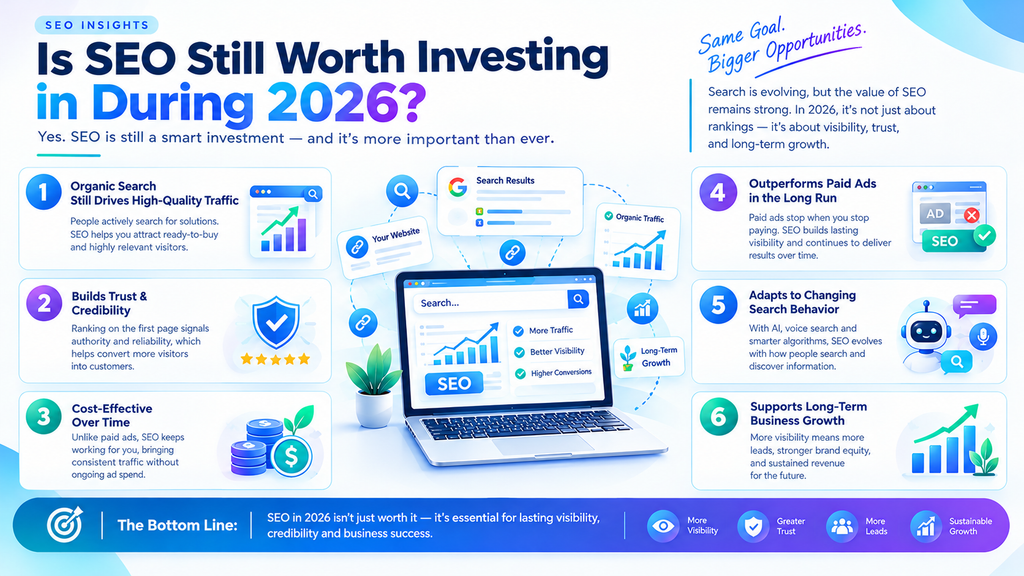
Yes. SEO remains a valuable marketing channel for businesses that want to build discoverability, reach relevant audiences, and develop a stronger online presence.
AI-powered search has changed how people discover information, but it has not eliminated the importance of useful content, technical accessibility, website authority, and clear information.
Google continues to recommend foundational SEO practices for its AI search features. Research published by BrightEdge in September 2025 also reported that AI search referrals were growing rapidly while accounting for less than 1% of referral traffic in its measured dataset. That finding illustrates why businesses should evaluate emerging channels without overlooking established organic search opportunities.
The exact results will vary by industry, competition, website quality, budget, and execution. SEO should therefore be treated as a long-term investment with measurable objectives rather than a guaranteed source of rankings or leads.
For most businesses, the practical approach is to combine SEO with other appropriate marketing channels, monitor performance, and invest consistently in the activities that deliver qualified opportunities.
Frequently Asked Questions About Investing in SEO
1. Why should a business invest in SEO?
Businesses should invest in SEO to improve organic visibility, attract relevant visitors, build credibility, support lead generation, and create long-term digital marketing assets. The value depends on whether the strategy targets the right audience and contributes to measurable business goals.
2. How long does SEO take to produce results?
SEO timelines vary according to competition, website history, technical issues, content quality, and the resources invested. Google advises that some changes may take days to be reflected, while meaningful evaluation of SEO improvements can take several months. There is no guaranteed timeline for achieving specific rankings.
3. Is SEO better than paid advertising?
Neither channel is universally better. Paid advertising can generate visibility quickly while a campaign is active, whereas SEO can build organic visibility over time. Many businesses benefit from using both, depending on their goals, budget, and customer acquisition strategy.
4. Is SEO still important with AI-powered search?
Yes. Google’s published guidance confirms that foundational SEO practices remain relevant to AI Overviews and AI Mode. Businesses should focus on technically accessible websites and original, helpful, reliable content rather than chasing unverified AI optimization shortcuts.
5. How can small businesses benefit from SEO?
Small businesses can target specific customer needs, local searches, niche topics, and relevant service keywords. A focused strategy can help them compete for suitable opportunities without trying to rank for every broad industry term.
6. How can you measure the ROI of SEO?
Measure SEO ROI by comparing the revenue attributable to organic search with the costs of SEO, including strategy, content, tools, technical work, and outreach. Track qualified leads and conversions in addition to traffic and rankings.
Final Thoughts
Investing in SEO is about building a website that customers can discover, trust, and use to make informed decisions. From organic traffic and brand credibility to local visibility and AI-powered search, a well-executed strategy can support several important business objectives.
The strongest results come from understanding your audience, creating genuinely useful content, maintaining a technically sound website, earning relevant authority, and measuring performance consistently.
If your business wants to improve its online presence, SEO is worth considering as part of a broader digital marketing strategy. Start with the opportunities most closely connected to your business goals, track the results, and continue improving as customer needs and search behavior evolve.
For more insights into search optimization and digital growth, explore Digital Soules and its digital marketing resources.