
EDU websites have long attracted attention from SEO professionals because educational institutions often publish trusted, useful, and authoritative content. However, getting a link from a .edu domain does not automatically make a backlink powerful. The value of a link depends on the quality and relevance of the linking page, the context of the link, and whether the website is genuinely useful and active.
Older EDU blog-commenting lists often contain expired pages, closed comment sections, or websites that no longer accept public comments. Some historical lists explicitly noted that many educational blogs had disabled comments because of spam.
Therefore, the best approach in 2026 is to use EDU comment opportunities as part of a broader content marketing and link-building strategy, rather than relying on mass comment submissions.
What Are EDU Comment Sites?
EDU comment sites are educational websites, university blogs, academic publications, student blogs, research websites, and other education-related platforms where visitors may be able to participate in discussions.
When an active blog allows comments, users may be able to enter:
- Name
- Email address
- Website
- Comment
- Social profile
Some websites allow a website field while others remove external links completely.
The important point is that you should only leave a comment when you have something genuinely useful to contribute.
A relevant comment can generate referral traffic, exposure, networking opportunities, and occasionally a backlink. However, the link may be nofollow, ugc, or otherwise not pass traditional ranking signals.
Are EDU Backlinks Still Valuable for SEO?
The .edu extension itself is not a magic SEO ranking factor.
A backlink from an educational website can be useful when the linking page is:
- Relevant to your industry
- Trusted by its audience
- Publicly accessible
- Editorially maintained
- Contextually related to your content
- Capable of generating referral traffic
Search engines have become much better at identifying manipulative link-building patterns. Modern SEO should therefore focus on earning links because your content is genuinely useful, rather than trying to obtain links simply because a domain ends in .edu.
Historical EDU backlink research also shows that many educational blogs use nofollow links and that some previously available commenting opportunities have disappeared.
Top 25 EDU Comment and Educational Link Opportunities
The following resources are best treated as research starting points, not as a guarantee that every page currently accepts comments. Always verify the specific page before attempting a submission.
1. Boston University Blogs
Boston University’s blog ecosystem contains educational and university-related content. Look for active posts and discussion areas where your contribution is genuinely relevant.
2. Oregon State University Blogs
Oregon State University has a broad collection of educational and research-oriented content. Relevant discussions can provide opportunities for meaningful participation.
3. Carthage College Blogs
Carthage-related educational content can be useful for discovering discussions around education, student life, technology, and academic topics.
4. University of Wisconsin Writing Resources
This is particularly relevant for websites operating in writing, content marketing, communication, education, and related fields.
5. University of Southern Maine
Explore relevant academic resources and public-facing content rather than submitting generic promotional comments.
6. Pennsylvania State University
Penn State hosts a large ecosystem of university-related websites and blogs. Search for active pages relevant to your topic.
7. University of Washington
University of Washington provides extensive educational resources and academic content. Look for relevant publications and public discussion opportunities.
8. University of Texas
The University of Texas publishes content across many academic disciplines. Relevant resources can be useful for research and outreach.
9. MIT
MIT is a major educational and research institution. Rather than searching for generic comment links, look for appropriate resources, research pages, publications, and academic discussions.
10. University of California
The University of California system publishes educational and research content across numerous disciplines.
11. University of Michigan
University of Michigan offers extensive academic and research resources. Businesses can investigate relevant resource pages and publications.
12. Harvard University
Harvard publishes a large amount of educational and research material. Relevant businesses should focus on genuine resource value rather than attempting unrelated blog comments.
13. Yale University
Yale’s website provides academic, research, and educational resources across many subjects.
14. Purdue University
Purdue is particularly relevant for technology, engineering, science, education, and research-related topics.
15. Dartmouth College
Dartmouth publishes academic and community resources that can be useful when your content has genuine educational relevance.
16. University of California, Berkeley
UC Berkeley provides extensive research and educational material. Look for resource pages and publications relevant to your niche.
17. University of Pennsylvania
The University of Pennsylvania offers academic resources across business, medicine, technology, humanities, and other disciplines.
18. Columbia University
Columbia University provides research and educational content that may be relevant to specialized industries.
19. University of Chicago
The university’s academic ecosystem covers a wide range of subjects and can be useful for researching relevant educational resources.
20. Cornell University
Cornell provides extensive academic and research content. Relevant businesses can explore appropriate educational resources and publications.
21. University of Florida
The University of Florida publishes educational content covering numerous fields, including science, agriculture, business, health, and technology.
22. University of Illinois
University of Illinois offers research and educational resources that can be useful for topic-specific research and outreach.
23. University of Maryland
University of Maryland provides academic resources across technology, science, business, education, and other areas.
24. University of Minnesota
University of Minnesota has a broad academic and research ecosystem. Look for relevant publications and public resources.
25. University of Virginia
The University of Virginia provides educational and research material across numerous disciplines and can be researched for relevant content opportunities.
How to Find EDU Comment Sites
Instead of relying entirely on old lists, you can find new opportunities yourself.
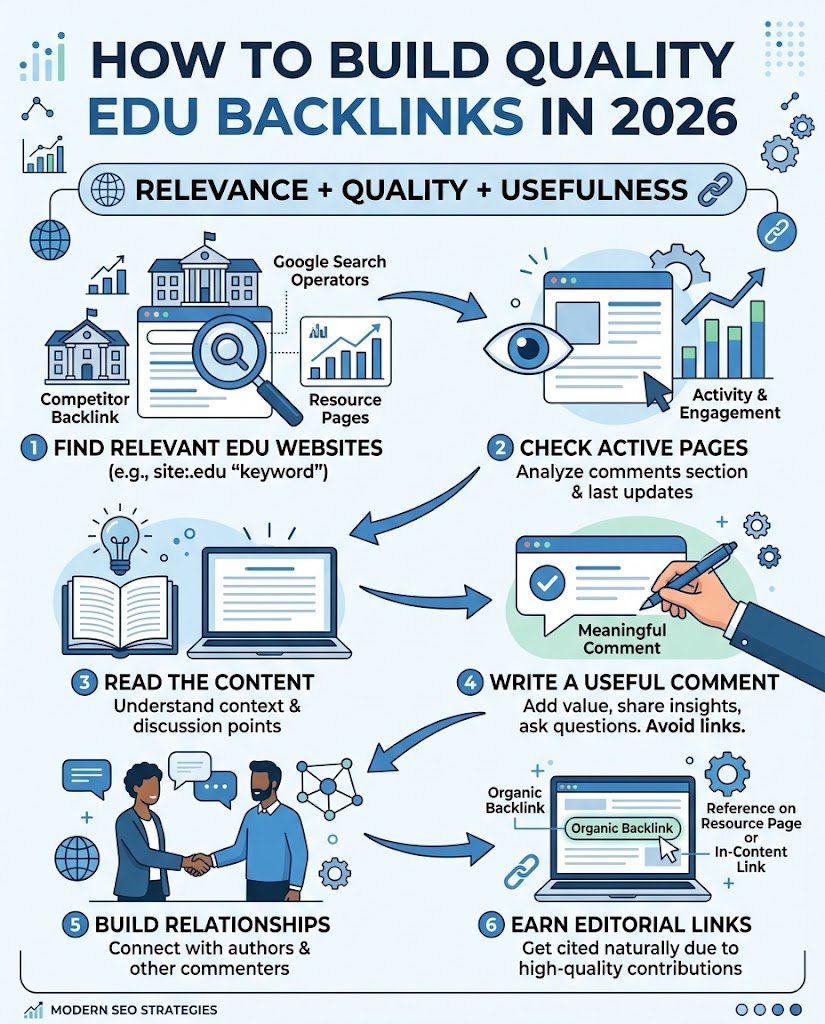
Use Google Search Operators
Google search operators can help identify educational pages that discuss your topic.
Try searches such as:
site:.edu “leave a comment”
site:.edu “post a comment”
site:.edu “add comment”
site:.edu “leave a reply”
site:.edu “reply”
You can combine these with your niche keyword.
For example:
site:.edu “SEO” “leave a comment”
site:.edu “digital marketing” “reply”
site:.edu “business” “leave a reply”
site:.edu “technology” “comment”
These searches help identify pages where discussions may exist.
Search for Your Niche
Don’t search only for .edu websites. Search for educational websites that discuss your exact subject.
For example:
site:.edu marketing blog
site:.edu entrepreneurship blog
site:.edu technology blog
site:.edu business blog
site:.edu SEO research
The more relevant the topic, the more natural your participation will be.
Analyze Competitor Backlinks
Competitor backlink analysis is another useful way to discover educational opportunities.
Find websites ranking for your target keyword and investigate their referring domains using tools such as:
- Ahrefs
- Semrush
- Moz
- Majestic
Look specifically for educational domains that link to competing resources.
The goal should not be copying every backlink. Instead, identify opportunities where your own content can provide equal or greater value.
Search University Resource Pages
University websites frequently contain resource pages, career resources, research collections, student resources, libraries, and departmental publications.
Search:
site:.edu “resources” “your topic”
site:.edu “useful links” “your topic”
site:.edu “recommended resources” “your topic”
site:.edu “research resources” “your topic”
These opportunities can sometimes be more valuable than ordinary blog comments because they may involve editorially selected resources.
How to Write a Good EDU Blog Comment
If you find an active educational blog that accepts comments, don’t immediately drop your URL.
First, read the article.
Then write a comment that contributes something useful.
A good comment can:
- Add another perspective
- Answer a question
- Provide a useful example
- Correct a misunderstanding politely
- Share relevant experience
- Ask a thoughtful question
- Expand on an idea from the article
For example, instead of writing:
“Great post. Visit my website for more information.”
write something like:
“The point about measuring search intent before creating content is especially important. Many businesses focus on keyword volume but overlook whether the searcher is looking for information, a product, or a local service.”
The second example contributes to the discussion instead of looking like advertising.
Should You Add Your Website URL to Every Comment?
No.
Adding your URL to every comment can make your activity look promotional and spammy.
If the comment form provides a website field, use your legitimate website information. But don’t force a backlink into the body of the comment unless it is genuinely relevant and allowed by the site’s policies.
Educational websites have historically suffered from comment spam, which is one reason many university blogs have disabled public commenting or introduced moderation.
Nofollow and UGC Links
Not every comment link will pass traditional ranking signals.
Many modern comment systems use attributes such as:
- nofollow
- ugc
- sponsored
A nofollow or UGC link can still have value through referral traffic, brand visibility, discovery, and a natural backlink profile.
Therefore, don’t judge an opportunity solely by whether it provides a dofollow link.
EDU Comment Sites vs EDU Resource Links
There is an important difference between a blog comment and an editorial resource link.
A blog comment is created as part of a discussion.
An editorial resource link is placed by an author or institution because the linked resource is considered useful.
For long-term SEO, earning a genuine editorial mention can be considerably more meaningful than leaving hundreds of generic comments.
Educational link-building strategies increasingly emphasize relevance, genuine value, and institutional relationships rather than mass comment spam.
Better Ways to Earn EDU Backlinks
If your website genuinely has something valuable for an academic audience, consider:
Create Educational Resources
Develop original:
- Research guides
- Statistics pages
- Industry reports
- Free tools
- Educational tutorials
- Data studies
- Scholarships
- Case studies
- Original research
Build Relationships With Universities
You can contact relevant departments, professors, student organizations, libraries, and academic communities when you have a resource that genuinely benefits their audience.
Offer Useful Student Resources
Businesses can create career guides, educational templates, tutorials, datasets, calculators, or other resources that students and educators can actually use.
Conduct Original Research
Original research can attract citations from educational websites because researchers and students need reliable sources.
Common EDU Backlink Mistakes
Mass Comment Spam
Posting the same comment on hundreds of websites is unlikely to create meaningful SEO value and can damage your reputation.
Irrelevant Comments
A marketing company commenting on an unrelated university article simply to obtain a backlink is easy to identify as promotional.
Using Keyword-Rich Names
Avoid using anchor-text keywords as your personal or business name in comment forms.
Use your actual name or legitimate brand identity.
Buying Fake EDU Links
A .edu domain does not automatically make a purchased backlink valuable. Focus on legitimate relationships and useful content.
Ignoring Website Quality
Some old EDU lists contain pages that are archived, deleted, inaccessible, or no longer accept comments. Historical lists demonstrate how quickly these opportunities can disappear.
Recommended EDU Link-Building Strategy for 2026
A balanced strategy should look like this:
1. Create useful content
Build something genuinely worth referencing.
2. Identify relevant educational websites
Focus on universities, departments, research organizations, and academic publications related to your topic.
3. Find active discussions
Look for current content where your expertise is relevant.
4. Participate naturally
Leave useful comments without forcing promotional links.
5. Research resource pages
Look for legitimate educational resource opportunities.
6. Build relationships
Contact relevant academic communities when you have something genuinely useful.
7. Track results
Monitor referral traffic, mentions, backlinks, and overall organic visibility.
EDU Backlink Checklist
Before using an educational website for SEO, check:
- Is the website active?
- Is the page publicly accessible?
- Is the content relevant to your niche?
- Does the page have real engagement?
- Is commenting currently enabled?
- Are comments moderated?
- Does the site allow external links?
- Is your contribution genuinely useful?
- Are you using your real name or legitimate brand?
- Are you avoiding keyword stuffing?
- Are you avoiding automated comments?
- Is the link placement natural?
Final Thoughts
EDU websites can be useful sources of visibility and backlinks, but the .edu extension should not be treated as an automatic ranking advantage.
The strongest approach in 2026 is to focus on relevance, quality, usefulness, and genuine participation.
Instead of posting hundreds of generic comments, identify educational websites that are relevant to your industry, read their content, participate in meaningful discussions, and create resources that universities, students, researchers, and educators would genuinely want to reference.
Use Google search operators, competitor backlink research, university resource pages, niche searches, and academic communities to discover new opportunities.
Most importantly, remember that one relevant editorial mention can be more valuable than dozens of irrelevant comments.
Build links because your content deserves to be referenced not simply because a website uses a .edu domain.